 Add to Chrome
 Add to Firefox
 Add to Edge
Vision Transformers for Preoperative CT-Based Prediction of Histopathologic Chemotherapy Response Score in High-Grade Serous Ovarian Carcinoma
Apr 10, 2026
Purpose. High-grade serous ovarian carcinoma (HGSOC) is characterized by pronounced biological and spatial heterogeneity and is frequently diagnosed at an advanced stage. Neoadjuvant chemotherapy (NACT) followed by delayed primary surgery is commonly employed in patients unsuitable for primary cytoreduction. The Chemotherapy Response Score (CRS) is a validated histopathological biomarker of response to NACT, but it is only available postoperatively. In this study, we investigate whether pre-treatment computed tomography (CT) imaging and clinical data can be used to predict CRS as an investigational decision-support adjunct to inform multidisciplinary team (MDT) discussions regarding expected treatment response. Methods. We proposed a 2.5D multimodal deep learning framework that processes lesion-dense omental slices using a pre-trained Vision Transformer encoder and integrates the resulting visual representations with clinical variables through an intermediate fusion module to predict CRS. Results. Our multimodal model, integrating imaging and clinical data, achieved a ROC-AUC of 0.95 alongside 95% accuracy and 80% precision on the internal test cohort (IEO, n=41 patients). On the external test set (OV04, n=70 patients), it achieved a ROC-AUC of 0.68, alongside 67% accuracy and 75% precision. Conclusion. These preliminary results demonstrate the feasibility of transformer-based deep learning for preoperative prediction of CRS in HGSOC using routine clinical data and CT imaging. As an investigational, pre-treatment decision-support tool, this approach may assist MDT discussions by providing early, non-invasive estimates of treatment response.

A Self-Supervised Image Registration Approach for Measuring Local Response Patterns in Metastatic Ovarian Cancer
Jul 24, 2024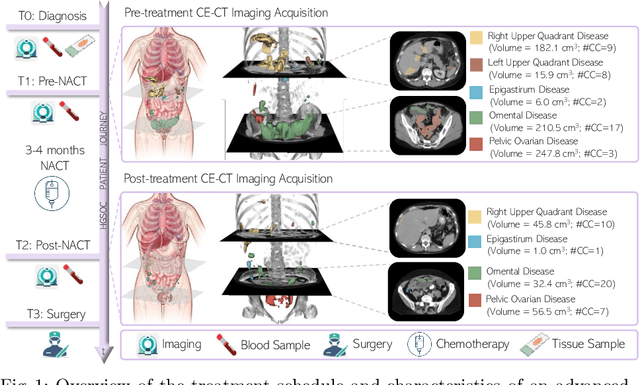
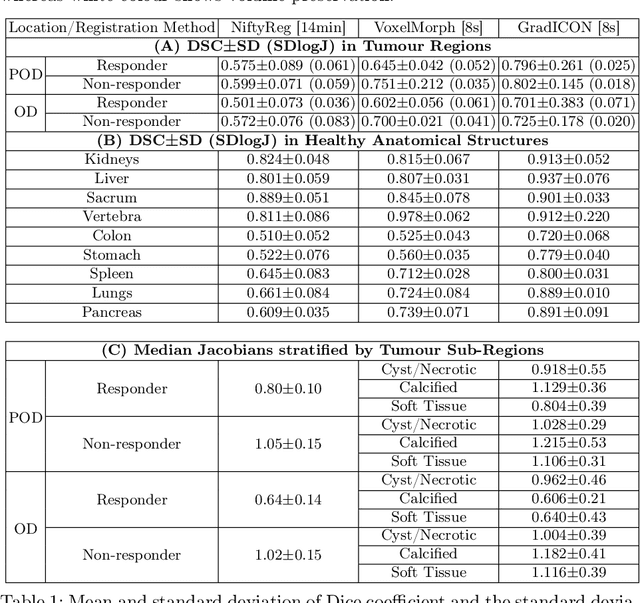
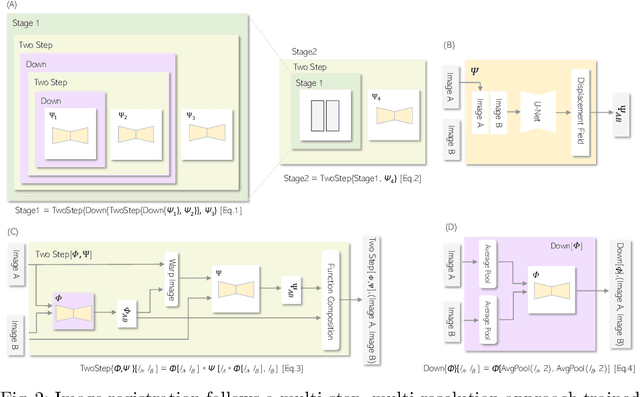
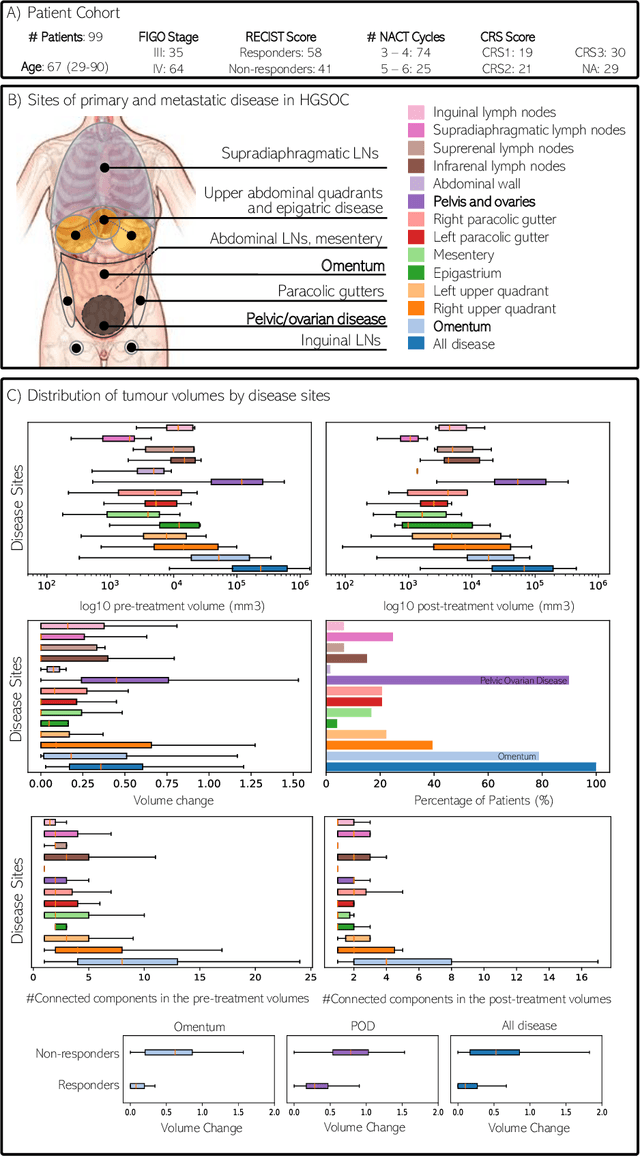
High-grade serous ovarian carcinoma (HGSOC) is characterised by significant spatial and temporal heterogeneity, typically manifesting at an advanced metastatic stage. A major challenge in treating advanced HGSOC is effectively monitoring localised change in tumour burden across multiple sites during neoadjuvant chemotherapy (NACT) and predicting long-term pathological response and overall patient survival. In this work, we propose a self-supervised deformable image registration algorithm that utilises a general-purpose image encoder for image feature extraction to co-register contrast-enhanced computerised tomography scan images acquired before and after neoadjuvant chemotherapy. This approach addresses challenges posed by highly complex tumour deformations and longitudinal lesion matching during treatment. Localised tumour changes are calculated using the Jacobian determinant maps of the registration deformation at multiple disease sites and their macroscopic areas, including hypo-dense (i.e., cystic/necrotic), hyper-dense (i.e., calcified), and intermediate density (i.e., soft tissue) portions. A series of experiments is conducted to understand the role of a general-purpose image encoder and its application in quantifying change in tumour burden during neoadjuvant chemotherapy in HGSOC. This work is the first to demonstrate the feasibility of a self-supervised image registration approach in quantifying NACT-induced localised tumour changes across the whole disease burden of patients with complex multi-site HGSOC, which could be used as a potential marker for ovarian cancer patient's long-term pathological response and survival.