 Add to Chrome
 Add to Firefox
 Add to Edge
Spectrally Safe Neural Operator Warm-Starts for Large-Scale Newton Solvers
Jun 20, 2026
Neural operators are increasingly used to warm-start Newton solvers for nonlinear PDEs, on the premise that a low test error places the initial guess inside the basin of attraction. We show that this premise is unreliable. An operator trained to the relative \(L^2\) error \(O(10^{-3})\) can still produce an initial state in which the discrete Jacobian is indefinite, because the mean-squared training controls error on average while leaving localized pointwise violations of the underlying physics. For a nearly incompressible hyperelasticity problem, we trace this to the predicted volume change: the operator disperses \(\mathrm{det} F\) well away from one, and the resulting Jacobian acquires negative eigenvalues even when the predicted field is visually indistinguishable from the reference. At a small scale, this is a nuisance; at a multi-million degree-of-freedom scale, it is disqualifying, since the conjugate gradient and other Krylov solvers needed for memory-feasible Newton steps assume a definite spectrum. We then show that a short, label-free fine-tuning phase -- penalizing the operator against the discrete energy, with no additional solution data -- shifts the Jacobian spectrum back to positive definite. Combined with an inexact outer loop, this gives a warm-started Newton method that converges across the full loading range where the unregularized operator fails, reaching up to 5.4\(\times\) wall-clock speedup over incremental continuation on a 3D problem with 6.4 million degrees of freedom.

Perron--Frobenius Operator Matching for Generative Modeling
Jun 16, 2026We introduce Perron--Frobenius Operator Matching (PFOM), a generative framework that matches density evolution via the integral PF operator, subsuming flow, diffusion, and jump models. We prove that among Bregman divergences, only Kullback--Leibler divergence preserves equality between density-level and sample-conditioned objectives, yielding a practical loss equivalent to Koopman path matching. We further develop Nesterov-accelerated training and sampling that stabilize discretization and accelerate convergence. %On Gaussian mixtures and two-moons, PFOM achieves faster KL/$W_2$/MMD decrease and improved wall-clock efficiency with empirical validation. PFOM unifies operator-theoretic identification with modern generative modeling and opens paths to adaptive dictionaries and high-dimensional applications.
Structured State-Space Regularization for Compact and Generation-Friendly Image Tokenization
Apr 13, 2026Image tokenizers are central to modern vision models as they often operate in latent spaces. An ideal latent space must be simultaneously compact and generation-friendly: it should capture image's essential content compactly while remaining easy to model with generative approaches. In this work, we introduce a novel regularizer to align latent spaces with these two objectives. The key idea is to guide tokenizers to mimic the hidden state dynamics of state-space models (SSMs), thereby transferring their critical property, frequency awareness, to latent features. Grounded in a theoretical analysis of SSMs, our regularizer enforces encoding of fine spatial structures and frequency-domain cues into compact latent features; leading to more effective use of representation capacity and improved generative modelability. Experiments demonstrate that our method improves generation quality in diffusion models while incurring only minimal loss in reconstruction fidelity.
PIG: Physics-Informed Gaussians as Adaptive Parametric Mesh Representations
Dec 08, 2024The approximation of Partial Differential Equations (PDEs) using neural networks has seen significant advancements through Physics-Informed Neural Networks (PINNs). Despite their straightforward optimization framework and flexibility in implementing various PDEs, PINNs often suffer from limited accuracy due to the spectral bias of Multi-Layer Perceptrons (MLPs), which struggle to effectively learn high-frequency and non-linear components. Recently, parametric mesh representations in combination with neural networks have been investigated as a promising approach to eliminate the inductive biases of neural networks. However, they usually require very high-resolution grids and a large number of collocation points to achieve high accuracy while avoiding overfitting issues. In addition, the fixed positions of the mesh parameters restrict their flexibility, making it challenging to accurately approximate complex PDEs. To overcome these limitations, we propose Physics-Informed Gaussians (PIGs), which combine feature embeddings using Gaussian functions with a lightweight neural network. Our approach uses trainable parameters for the mean and variance of each Gaussian, allowing for dynamic adjustment of their positions and shapes during training. This adaptability enables our model to optimally approximate PDE solutions, unlike models with fixed parameter positions. Furthermore, the proposed approach maintains the same optimization framework used in PINNs, allowing us to benefit from their excellent properties. Experimental results show the competitive performance of our model across various PDEs, demonstrating its potential as a robust tool for solving complex PDEs. Our project page is available at https://namgyukang.github.io/Physics-Informed-Gaussians/
Separable Physics-informed Neural Networks for Solving the BGK Model of the Boltzmann Equation
Mar 10, 2024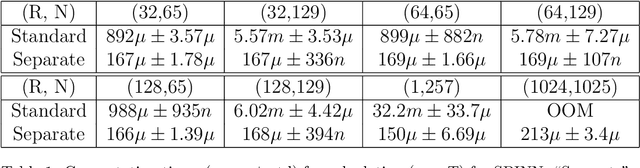
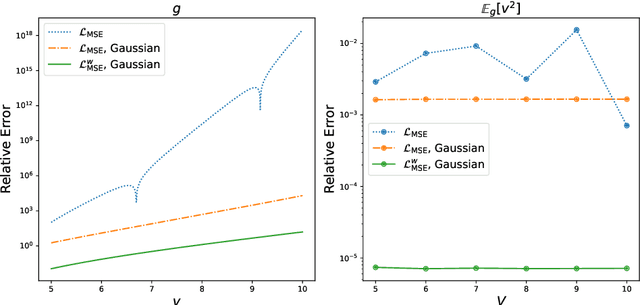
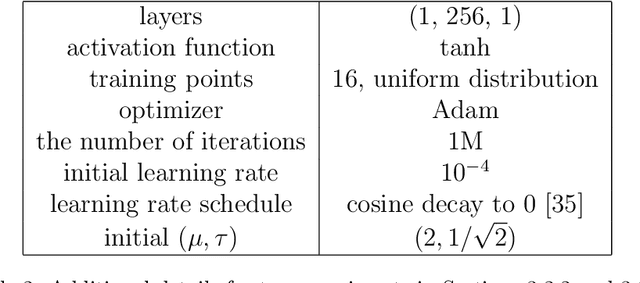
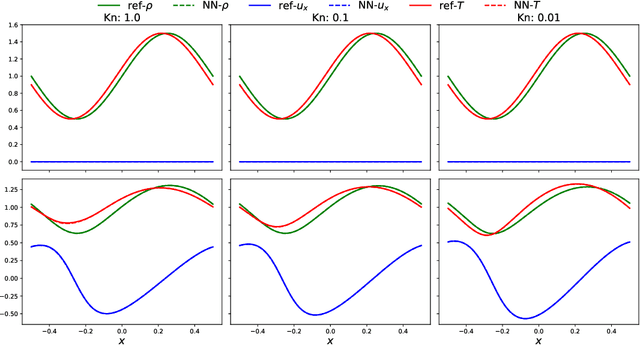
In this study, we introduce a method based on Separable Physics-Informed Neural Networks (SPINNs) for effectively solving the BGK model of the Boltzmann equation. While the mesh-free nature of PINNs offers significant advantages in handling high-dimensional partial differential equations (PDEs), challenges arise when applying quadrature rules for accurate integral evaluation in the BGK operator, which can compromise the mesh-free benefit and increase computational costs. To address this, we leverage the canonical polyadic decomposition structure of SPINNs and the linear nature of moment calculation, achieving a substantial reduction in computational expense for quadrature rule application. The multi-scale nature of the particle density function poses difficulties in precisely approximating macroscopic moments using neural networks. To improve SPINN training, we introduce the integration of Gaussian functions into SPINNs, coupled with a relative loss approach. This modification enables SPINNs to decay as rapidly as Maxwellian distributions, thereby enhancing the accuracy of macroscopic moment approximations. The relative loss design further ensures that both large and small-scale features are effectively captured by the SPINNs. The efficacy of our approach is demonstrated through a series of five numerical experiments, including the solution to a challenging 3D Riemann problem. These results highlight the potential of our novel method in efficiently and accurately addressing complex challenges in computational physics.