 Add to Chrome
 Add to Firefox
 Add to Edge
Deformba: Vision State Space Model with Adaptive State Fusion
May 20, 2026
State Space Models (SSMs) have emerged as a powerful and efficient alternative to Transformers, demonstrating linear-time complexity and exceptional sequence modeling capabilities. However, their application to vision tasks remains challenging. First, existing vision SSMs largely depend on manually designed fixed scanning methods to flatten image patches into sequences, which imposes predefined geometric structures and increases the complexity. Second, the broader adoption of vision SSMs is hindered in domains that require query-based interactions between distinct information streams. This is a result of the inherently causal and self-referential nature of SSMs designed for 1D sequence modeling tasks. This fusion mechanism is indispensable for critical perception tasks such as multi-view 3D fusion. To address these limitations, we propose Deformba, a context adaptive method that dynamically augments the spatial structural information while maintaining the linear complexity of SSMs. Deformba also allows multi-modal fusion like cross attention. To demonstrate the effectiveness and general applicability of Deformba, we test its performance on general 2D vision tasks such as image classification, object detection, and segmentation, as well as 3D vision tasks like BEV perception. Extensive experiments show that Deformba achieves strong performance across various visual perception benchmarks.

Can a Unimodal Language Agent Provide Preferences to Tune a Multimodal Vision-Language Model?
Jan 10, 2026To explore a more scalable path for adding multimodal capabilities to existing LLMs, this paper addresses a fundamental question: Can a unimodal LLM, relying solely on text, reason about its own informational needs and provide effective feedback to optimize a multimodal model? To answer this, we propose a method that enables a language agent to give feedback to a vision-language model (VLM) to adapt text generation to the agent's preferences. Our results from different experiments affirm this hypothesis, showing that LLM preference feedback significantly enhances VLM descriptions. Using our proposed method, we find that the VLM can generate multimodal scene descriptions to help the LLM better understand multimodal context, leading to improvements of maximum 13% in absolute accuracy compared to the baseline multimodal approach. Furthermore, a human study validated our AI-driven feedback, showing a 64.6% preference alignment rate between the LLM's choices and human judgments. Extensive experiments provide insights on how and why the method works and its limitations.
MamBEV: Enabling State Space Models to Learn Birds-Eye-View Representations
Mar 18, 2025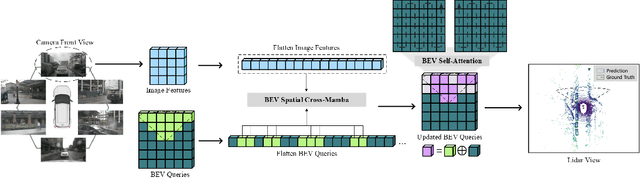
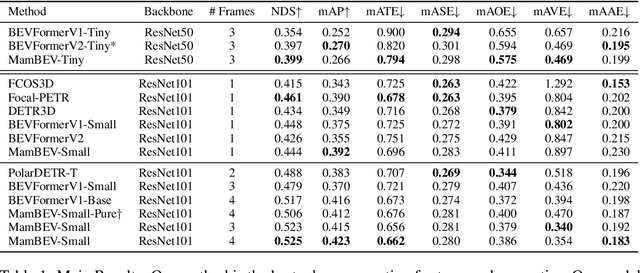
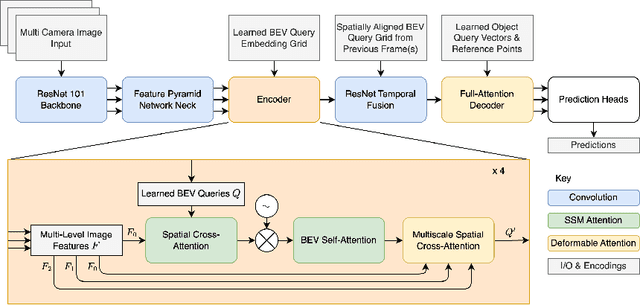
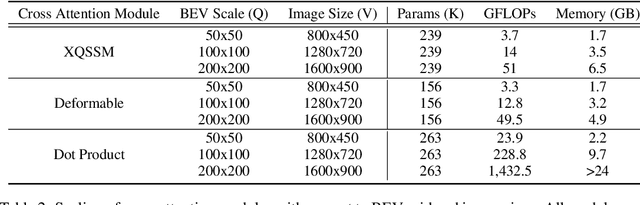
3D visual perception tasks, such as 3D detection from multi-camera images, are essential components of autonomous driving and assistance systems. However, designing computationally efficient methods remains a significant challenge. In this paper, we propose a Mamba-based framework called MamBEV, which learns unified Bird's Eye View (BEV) representations using linear spatio-temporal SSM-based attention. This approach supports multiple 3D perception tasks with significantly improved computational and memory efficiency. Furthermore, we introduce SSM based cross-attention, analogous to standard cross attention, where BEV query representations can interact with relevant image features. Extensive experiments demonstrate MamBEV's promising performance across diverse visual perception metrics, highlighting its advantages in input scaling efficiency compared to existing benchmark models.