 Add to Chrome
 Add to Firefox
 Add to Edge
Deformba: Vision State Space Model with Adaptive State Fusion
May 20, 2026
State Space Models (SSMs) have emerged as a powerful and efficient alternative to Transformers, demonstrating linear-time complexity and exceptional sequence modeling capabilities. However, their application to vision tasks remains challenging. First, existing vision SSMs largely depend on manually designed fixed scanning methods to flatten image patches into sequences, which imposes predefined geometric structures and increases the complexity. Second, the broader adoption of vision SSMs is hindered in domains that require query-based interactions between distinct information streams. This is a result of the inherently causal and self-referential nature of SSMs designed for 1D sequence modeling tasks. This fusion mechanism is indispensable for critical perception tasks such as multi-view 3D fusion. To address these limitations, we propose Deformba, a context adaptive method that dynamically augments the spatial structural information while maintaining the linear complexity of SSMs. Deformba also allows multi-modal fusion like cross attention. To demonstrate the effectiveness and general applicability of Deformba, we test its performance on general 2D vision tasks such as image classification, object detection, and segmentation, as well as 3D vision tasks like BEV perception. Extensive experiments show that Deformba achieves strong performance across various visual perception benchmarks.

MamBEV: Enabling State Space Models to Learn Birds-Eye-View Representations
Mar 18, 2025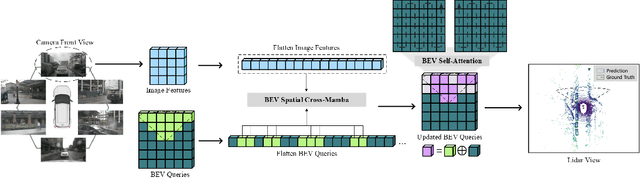
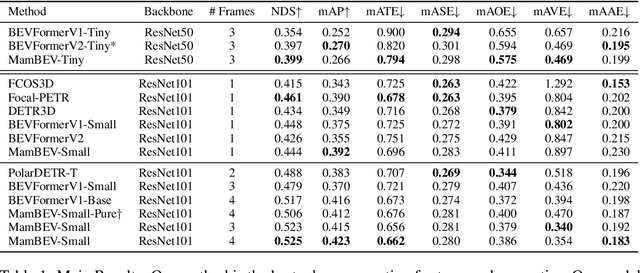
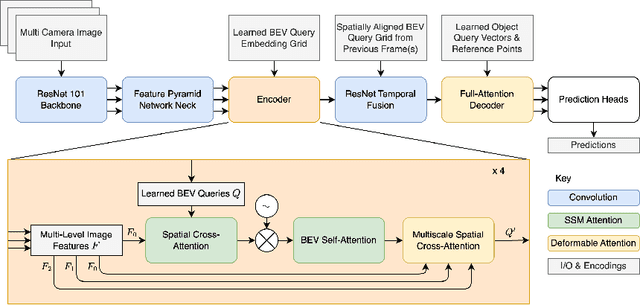
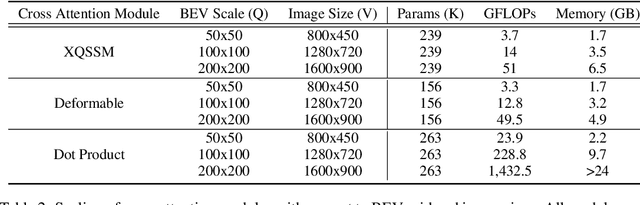
3D visual perception tasks, such as 3D detection from multi-camera images, are essential components of autonomous driving and assistance systems. However, designing computationally efficient methods remains a significant challenge. In this paper, we propose a Mamba-based framework called MamBEV, which learns unified Bird's Eye View (BEV) representations using linear spatio-temporal SSM-based attention. This approach supports multiple 3D perception tasks with significantly improved computational and memory efficiency. Furthermore, we introduce SSM based cross-attention, analogous to standard cross attention, where BEV query representations can interact with relevant image features. Extensive experiments demonstrate MamBEV's promising performance across diverse visual perception metrics, highlighting its advantages in input scaling efficiency compared to existing benchmark models.
Poster: Real-Time Object Substitution for Mobile Diminished Reality with Edge Computing
Oct 23, 2023Diminished Reality (DR) is considered as the conceptual counterpart to Augmented Reality (AR), and has recently gained increasing attention from both industry and academia. Unlike AR which adds virtual objects to the real world, DR allows users to remove physical content from the real world. When combined with object replacement technology, it presents an further exciting avenue for exploration within the metaverse. Although a few researches have been conducted on the intersection of object substitution and DR, there is no real-time object substitution for mobile diminished reality architecture with high quality. In this paper, we propose an end-to-end architecture to facilitate immersive and real-time scene construction for mobile devices with edge computing.
Metamobility: Connecting Future Mobility with Metaverse
Jan 17, 2023A Metaverse is a perpetual, immersive, and shared digital universe that is linked to but beyond the physical reality, and this emerging technology is attracting enormous attention from different industries. In this article, we define the first holistic realization of the metaverse in the mobility domain, coined as ``metamobility". We present our vision of what metamobility will be and describe its basic architecture. We also propose two use cases, tactile live maps and meta-empowered advanced driver-assistance systems (ADAS), to demonstrate how the metamobility will benefit and reshape future mobility systems. Each use case is discussed from the perspective of the technology evolution, future vision, and critical research challenges, respectively. Finally, we identify multiple concrete open research issues for the development and deployment of the metamobility.