 Add to Chrome
 Add to Firefox
 Add to Edge
LazyHMC: Hamiltonian Monte Carlo Simulation for Lazy, Infinite Dimensional Probabilistic Programs
Aug 09, 2026
Hamiltonian Monte Carlo (HMC) is a successful generic inference method in probabilistic programming, but in its ordinary formulation it needs gradients and finite-dimensional parameter spaces. In Haskell, lazy evaluation lets probabilistic programs express stochastic processes and other non-parametric Bayesian models over implicit infinite-dimensional spaces. This paper develops new formulations of gradient-based HMC for this infinite-dimensional setting, via lazy evaluation. For automatic differentiation, we provide an analysis based on a new notion of "piecewise analytic under cylindrical analytic partition" (PACAP), to show that even if a program is infinite-dimensional and defined lazily, the gradient of the likelihood function is finitely supported. For the Monte Carlo method itself, we develop several HMC variants and a No-U-Turn Sampler that operate over the infinite-dimensional parameter space but are still productive because of lazy evaluation. Experiments cover Gaussian mixture clustering, random walks, and piecewise-constant regression with Poisson-process changepoints.
* 41 pages

Likelihood hacking in probabilistic program synthesis
Mar 25, 2026When language models are trained by reinforcement learning (RL) to write probabilistic programs, they can artificially inflate their marginal-likelihood reward by producing programs whose data distribution fails to normalise instead of fitting the data better. We call this failure likelihood hacking (LH). We formalise LH in a core probabilistic programming language (PPL) and give sufficient syntactic conditions for its prevention, proving that a safe language fragment $\mathcal{L}_{\text{safe}}$ satisfying these conditions cannot produce likelihood-hacking programs. Empirically, we show that GRPO-trained models generating PyMC code discover LH exploits within the first few training steps, driving violation rates well above the untrained-model baseline. We implement $\mathcal{L}_{\text{safe}}$'s conditions as $\texttt{SafeStan}$, a LH-resistant modification of Stan, and show empirically that it prevents LH under optimisation pressure. These results show that language-level safety constraints are both theoretically grounded and effective in practice for automated Bayesian model discovery.
$ω$PAP Spaces: Reasoning Denotationally About Higher-Order, Recursive Probabilistic and Differentiable Programs
Feb 21, 2023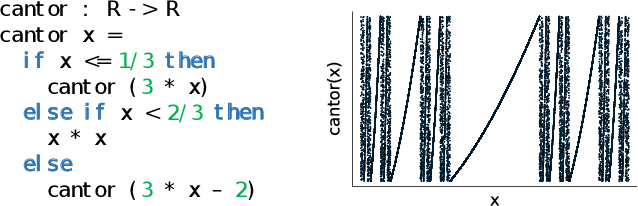
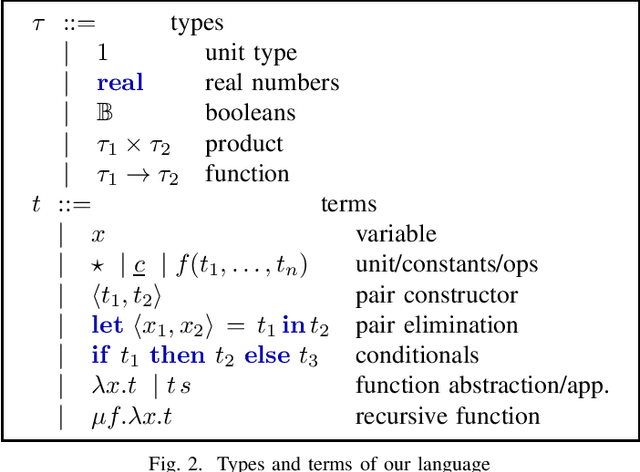
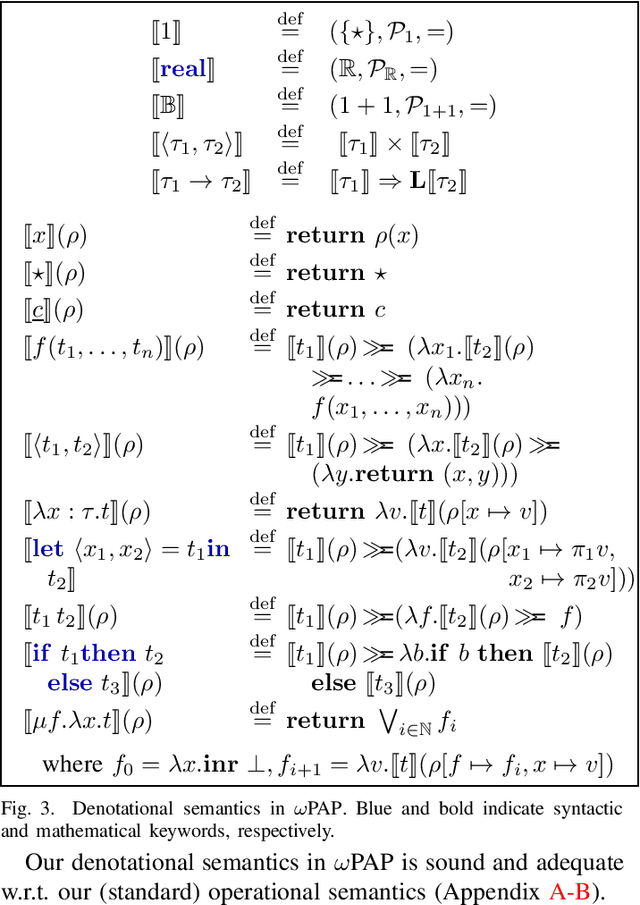
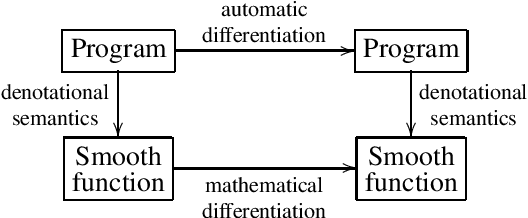
We introduce a new setting, the category of $\omega$PAP spaces, for reasoning denotationally about expressive differentiable and probabilistic programming languages. Our semantics is general enough to assign meanings to most practical probabilistic and differentiable programs, including those that use general recursion, higher-order functions, discontinuous primitives, and both discrete and continuous sampling. But crucially, it is also specific enough to exclude many pathological denotations, enabling us to establish new results about both deterministic differentiable programs and probabilistic programs. In the deterministic setting, we prove very general correctness theorems for automatic differentiation and its use within gradient descent. In the probabilistic setting, we establish the almost-everywhere differentiability of probabilistic programs' trace density functions, and the existence of convenient base measures for density computation in Monte Carlo inference. In some cases these results were previously known, but required detailed proofs with an operational flavor; by contrast, all our proofs work directly with programs' denotations.
Compositional Semantics for Probabilistic Programs with Exact Conditioning
Jan 27, 2021
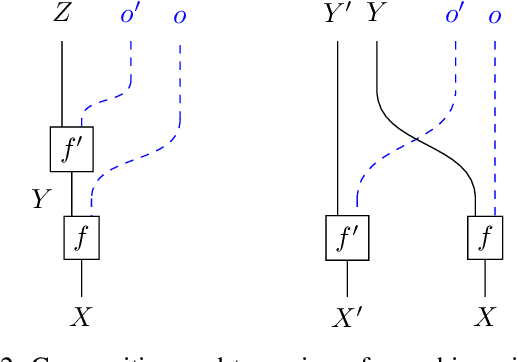
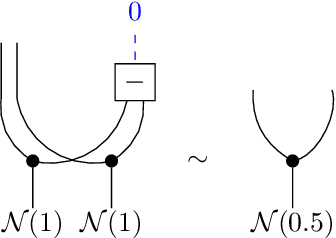
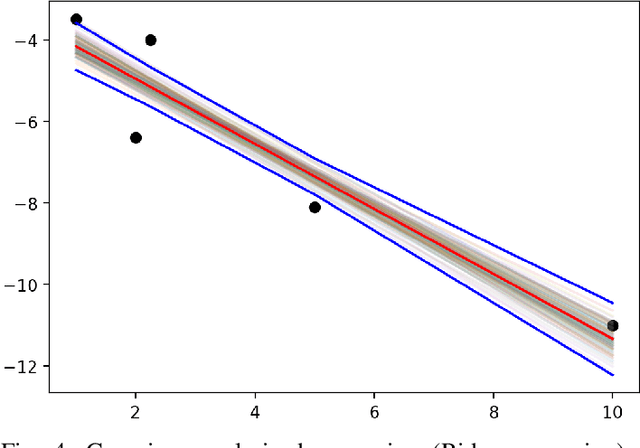
We define a probabilistic programming language for Gaussian random variables with a first-class exact conditioning construct. We give operational, denotational and equational semantics for this language, establishing convenient properties like exchangeability of conditions. Conditioning on equality of continuous random variables is nontrivial, as the exact observation may have probability zero; this is Borel's paradox. Using categorical formulations of conditional probability, we show that the good properties of our language are not particular to Gaussians, but can be derived from universal properties, thus generalizing to wider settings. We define the Cond construction, which internalizes conditioning as a morphism, providing general compositional semantics for probabilistic programming with exact conditioning.
A Convenient Category for Higher-Order Probability Theory
Apr 18, 2017
Higher-order probabilistic programming languages allow programmers to write sophisticated models in machine learning and statistics in a succinct and structured way, but step outside the standard measure-theoretic formalization of probability theory. Programs may use both higher-order functions and continuous distributions, or even define a probability distribution on functions. But standard probability theory does not handle higher-order functions well: the category of measurable spaces is not cartesian closed. Here we introduce quasi-Borel spaces. We show that these spaces: form a new formalization of probability theory replacing measurable spaces; form a cartesian closed category and so support higher-order functions; form a well-pointed category and so support good proof principles for equational reasoning; and support continuous probability distributions. We demonstrate the use of quasi-Borel spaces for higher-order functions and probability by: showing that a well-known construction of probability theory involving random functions gains a cleaner expression; and generalizing de Finetti's theorem, that is a crucial theorem in probability theory, to quasi-Borel spaces.
Semantics for probabilistic programming: higher-order functions, continuous distributions, and soft constraints
May 04, 2016We study the semantic foundation of expressive probabilistic programming languages, that support higher-order functions, continuous distributions, and soft constraints (such as Anglican, Church, and Venture). We define a metalanguage (an idealised version of Anglican) for probabilistic computation with the above features, develop both operational and denotational semantics, and prove soundness, adequacy, and termination. They involve measure theory, stochastic labelled transition systems, and functor categories, but admit intuitive computational readings, one of which views sampled random variables as dynamically allocated read-only variables. We apply our semantics to validate nontrivial equations underlying the correctness of certain compiler optimisations and inference algorithms such as sequential Monte Carlo simulation. The language enables defining probability distributions on higher-order functions, and we study their properties.