 Add to Chrome
 Add to Firefox
 Add to Edge
TimpaTeks: Automatic In-place Text Sequence Modification via Diffusion Language Model Steering
Jun 07, 2026
We extend activation steering to diffusion language models (DLMs) and study a novel problem that arose due to the inference mechanism of DLMs: Modifying a text in-place to manifest a different concept. We propose TimpaTeks, an automatic in-place text modification mechanism using DLMs. Experiments on IMDB movie reviews (sentiment) and a synthetic Cats and Dogs Dataset (arbitrary, more unconventional concept steering) show that TimpaTeks provides a feasible novel mechanism to steer diffusion language model outputs in-place. TimpaTeks enables in-place modification while simultaneously lowers sentence perplexity and retaining the original sentence structre without the need of instruction tuned models. TimpaTeks is also computationally cheaper than prompt-based DLM steering, as it performs denoising in-place rather than constructing an additional prompt-conditioned output sequence.

Sci-Rho: A Multilingual Visually-Grounded Symbolic Benchmark for STEM Problems
Jun 06, 2026Symbolic benchmarks have emerged as a key approach to assess model robustness under minor modifications to STEM-related questions. However, existing symbolic benchmarks mostly remain limited to mathematical reasoning, lack visual grounding, and are predominantly in English. In this work, we introduce Sci-Rho (Science Rhobustness), a dynamic benchmark for visually-grounded STEM problems spanning five subjects and seven languages, comprising 4,242 problem templates (606 per language) crafted by domain experts, including Olympiad medalists. Each template is implemented as executable Python code that generates diverse but equivalent problem instances by varying numerical values, visual patterns, geometric shapes, color schemes, and function types, resulting in 42,420 instances in total, each paired with reasoning steps and ground-truth solutions. We evaluated 17 state-of-the-art VLMs and discovered a noticeable gap between worst-case accuracy (defined as the proportion of problem templates that a model answers correctly across every generated variation) and average accuracy. We also discovered that smaller models show noticeable performance degradation across languages, whereas proprietary and larger models remain robust. Step-level evaluation reflects this same trend, revealing a significant gap between average F1 and worst-case F1 scores. Finally, our inspection of attention heads of a VLM reveals substantial cross-lingual variation in the relative attention allocated to image tokens compared to text tokens. Our work highlights the importance of evaluation beyond static benchmarks as a metric to measure the quality of VLMs.
Low-Resource Safety Failures Are Action Failures, Not Representation Failures
May 31, 2026Safety alignment learned in high-resource languages transfers poorly to low-resource languages. Models refuse harmful prompts in English but fail to refuse when the same prompts are translated into Swahili or Burmese. Adaptive steering methods like AdaSteer and CAST inherit this failure cross-lingually. We diagnose where transfer breaks down. Across Qwen2.5-7B, Gemma-2-9B, and Llama-3.1-8B on 23 languages, the harmfulness direction extracted from high-resource activations linearly separates harmful from harmless low-resource prompts nearly as well as high-resource ones. The relevant representation is present. Yet harmful refusal drops from 87.9% to 43.9%. The model fails to convert the representation into refusal. What fails to transfer is calibration of the safety decision, not the underlying representation. We exploit this by recalibrating, rather than retraining, a high-resource gate: a low-rank logistic readout with its decision threshold reset using as few as 1 to 4 target-language examples per class. The gate routes between refusal steering and harmfulness-direction ablation, substantially raising mean refusal selectivity ($Δ$ = harmful $-$ harmless refusal) from 33.6 for the strongest adapted baseline to 54.5 while preserving MMLU utility. These results suggest that some low-resource safety failures can be repaired by recalibrating existing representations rather than learning new ones. Our code is released: https://github.com/rashadaziz/low-resource-safety.
IndoBias: A Dual Track Culturally Grounded Benchmark for LLMs Bias Evaluation in Indonesian Languages
May 31, 2026Despite being home to more than 1300 ethnic groups and 700 indigenous languages, bias in Large Language Models has not been fully studied in Indonesia, thus leaving a critical gap in evaluating representational fairness and localized stereotypes within its uniquely vast, multilingual, and diverse sociocultural landscape. To address this, we introduce IndoBias as a culturally-grounded bias benchmark to assess LLMs bias in Indonesian and three local languages: Javanese, Sundanese, and Makasar. IndoBias features dual perspective evaluation tracks: depth-oriented (with contrastive-pairs) and breadth-oriented (with generation-based), where the latter is grounded in social science frameworks (SPI, O*NET, and WGI). Our results show that existing LLMs -- particularly decoder models -- exhibit strong bias towards prototypical sentences in Indonesian, while local languages suffer higher bias under Ideology and Religion category. We also find that LLMs responses exhibit a non-uniform Stereotype Polarity when prompted with various local entities. Finally, we discover that, in Indonesian, Common Crawl texts introduce more bias during pretraining, compared to human-reviewed article texts (e.g., Wikipedia, News), whereas introducing local languages to pretraining generally increases bias. This work highlights the importance of studying bias in culture-specific context. Warning: This paper contains example data that may be offensive, harmful, or biased.
CommonLID: Re-evaluating State-of-the-Art Language Identification Performance on Web Data
Jan 25, 2026Language identification (LID) is a fundamental step in curating multilingual corpora. However, LID models still perform poorly for many languages, especially on the noisy and heterogeneous web data often used to train multilingual language models. In this paper, we introduce CommonLID, a community-driven, human-annotated LID benchmark for the web domain, covering 109 languages. Many of the included languages have been previously under-served, making CommonLID a key resource for developing more representative high-quality text corpora. We show CommonLID's value by using it, alongside five other common evaluation sets, to test eight popular LID models. We analyse our results to situate our contribution and to provide an overview of the state of the art. In particular, we highlight that existing evaluations overestimate LID accuracy for many languages in the web domain. We make CommonLID and the code used to create it available under an open, permissive license.
University of Indonesia at SemEval-2025 Task 11: Evaluating State-of-the-Art Encoders for Multi-Label Emotion Detection
May 22, 2025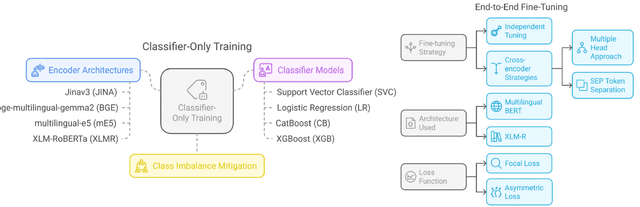
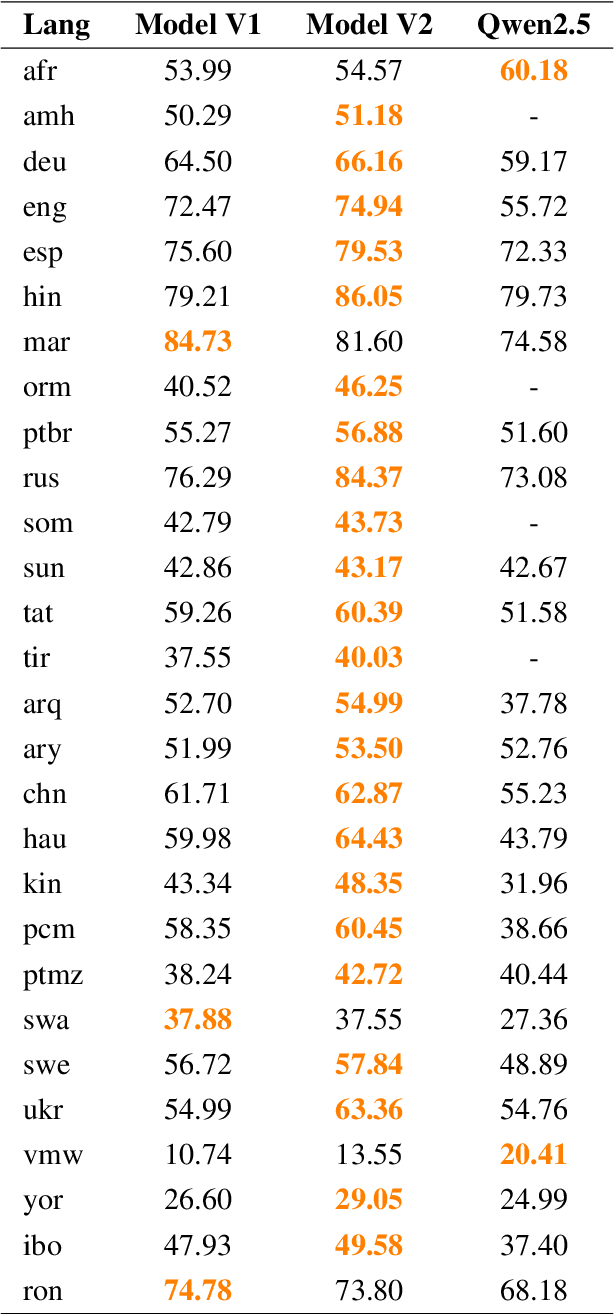
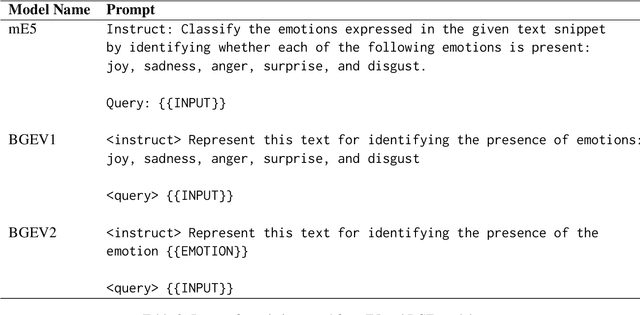
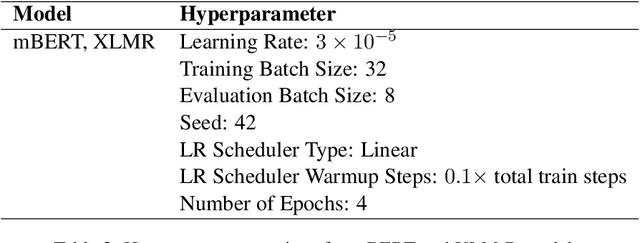
This paper presents our approach for SemEval 2025 Task 11 Track A, focusing on multilabel emotion classification across 28 languages. We explore two main strategies: fully fine-tuning transformer models and classifier-only training, evaluating different settings such as fine-tuning strategies, model architectures, loss functions, encoders, and classifiers. Our findings suggest that training a classifier on top of prompt-based encoders such as mE5 and BGE yields significantly better results than fully fine-tuning XLMR and mBERT. Our best-performing model on the final leaderboard is an ensemble combining multiple BGE models, where CatBoost serves as the classifier, with different configurations. This ensemble achieves an average F1-macro score of 56.58 across all languages.
Crowdsource, Crawl, or Generate? Creating SEA-VL, a Multicultural Vision-Language Dataset for Southeast Asia
Mar 10, 2025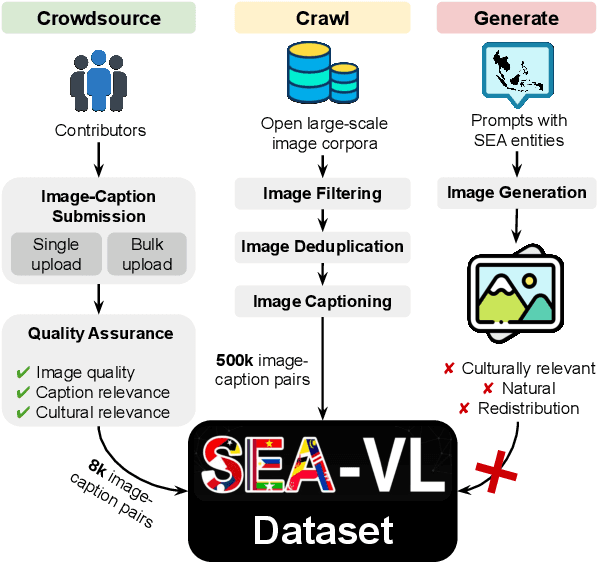
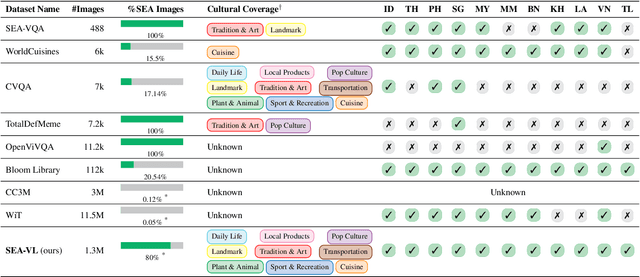
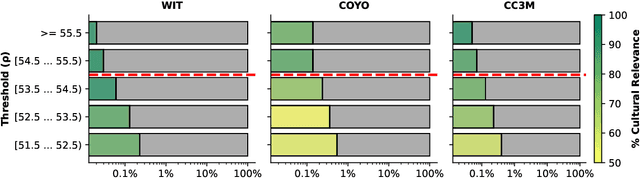
Southeast Asia (SEA) is a region of extraordinary linguistic and cultural diversity, yet it remains significantly underrepresented in vision-language (VL) research. This often results in artificial intelligence (AI) models that fail to capture SEA cultural nuances. To fill this gap, we present SEA-VL, an open-source initiative dedicated to developing high-quality, culturally relevant data for SEA languages. By involving contributors from SEA countries, SEA-VL aims to ensure better cultural relevance and diversity, fostering greater inclusivity of underrepresented languages in VL research. Beyond crowdsourcing, our initiative goes one step further in the exploration of the automatic collection of culturally relevant images through crawling and image generation. First, we find that image crawling achieves approximately ~85% cultural relevance while being more cost- and time-efficient than crowdsourcing. Second, despite the substantial progress in generative vision models, synthetic images remain unreliable in accurately reflecting SEA cultures. The generated images often fail to reflect the nuanced traditions and cultural contexts of the region. Collectively, we gather 1.28M SEA culturally-relevant images, more than 50 times larger than other existing datasets. Through SEA-VL, we aim to bridge the representation gap in SEA, fostering the development of more inclusive AI systems that authentically represent diverse cultures across SEA.