 Add to Chrome
 Add to Firefox
 Add to Edge
IndoBias: A Dual Track Culturally Grounded Benchmark for LLMs Bias Evaluation in Indonesian Languages
May 31, 2026
Despite being home to more than 1300 ethnic groups and 700 indigenous languages, bias in Large Language Models has not been fully studied in Indonesia, thus leaving a critical gap in evaluating representational fairness and localized stereotypes within its uniquely vast, multilingual, and diverse sociocultural landscape. To address this, we introduce IndoBias as a culturally-grounded bias benchmark to assess LLMs bias in Indonesian and three local languages: Javanese, Sundanese, and Makasar. IndoBias features dual perspective evaluation tracks: depth-oriented (with contrastive-pairs) and breadth-oriented (with generation-based), where the latter is grounded in social science frameworks (SPI, O*NET, and WGI). Our results show that existing LLMs -- particularly decoder models -- exhibit strong bias towards prototypical sentences in Indonesian, while local languages suffer higher bias under Ideology and Religion category. We also find that LLMs responses exhibit a non-uniform Stereotype Polarity when prompted with various local entities. Finally, we discover that, in Indonesian, Common Crawl texts introduce more bias during pretraining, compared to human-reviewed article texts (e.g., Wikipedia, News), whereas introducing local languages to pretraining generally increases bias. This work highlights the importance of studying bias in culture-specific context. Warning: This paper contains example data that may be offensive, harmful, or biased.

University of Indonesia at SemEval-2025 Task 11: Evaluating State-of-the-Art Encoders for Multi-Label Emotion Detection
May 22, 2025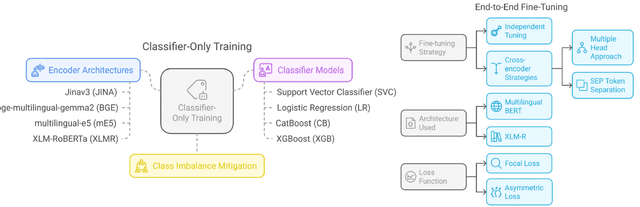
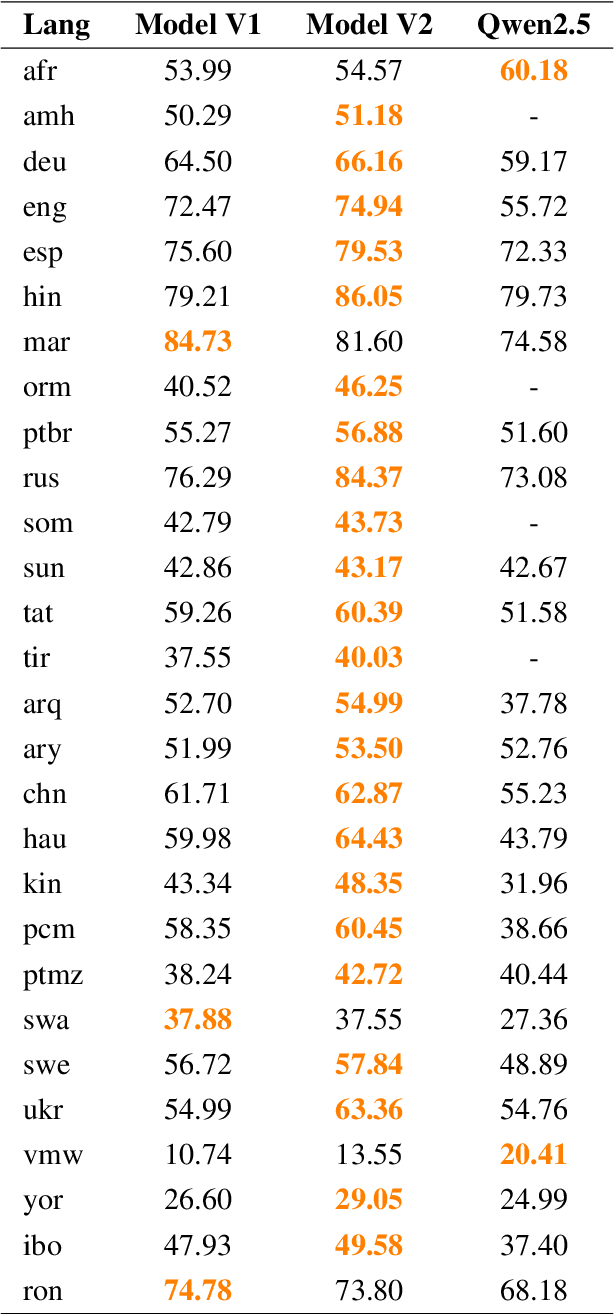
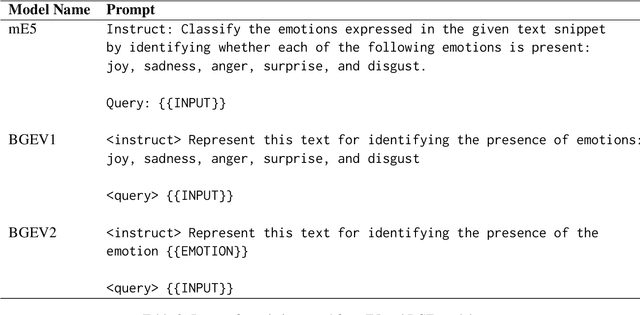
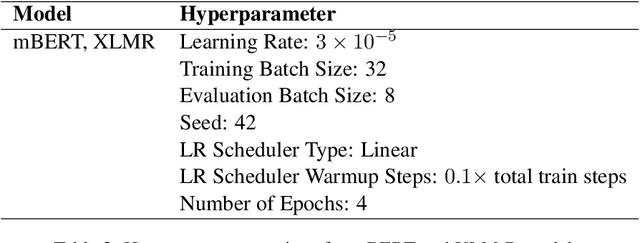
This paper presents our approach for SemEval 2025 Task 11 Track A, focusing on multilabel emotion classification across 28 languages. We explore two main strategies: fully fine-tuning transformer models and classifier-only training, evaluating different settings such as fine-tuning strategies, model architectures, loss functions, encoders, and classifiers. Our findings suggest that training a classifier on top of prompt-based encoders such as mE5 and BGE yields significantly better results than fully fine-tuning XLMR and mBERT. Our best-performing model on the final leaderboard is an ensemble combining multiple BGE models, where CatBoost serves as the classifier, with different configurations. This ensemble achieves an average F1-macro score of 56.58 across all languages.
Crowdsource, Crawl, or Generate? Creating SEA-VL, a Multicultural Vision-Language Dataset for Southeast Asia
Mar 10, 2025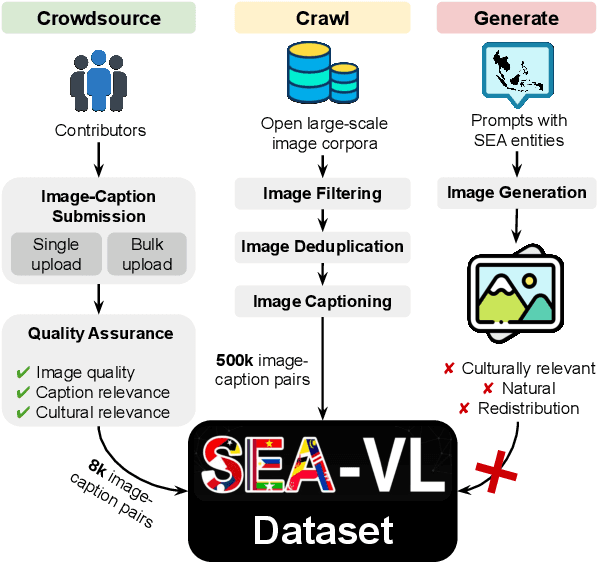
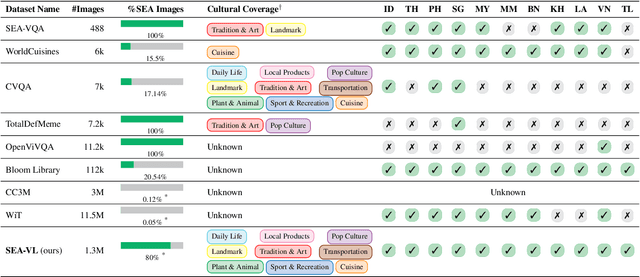
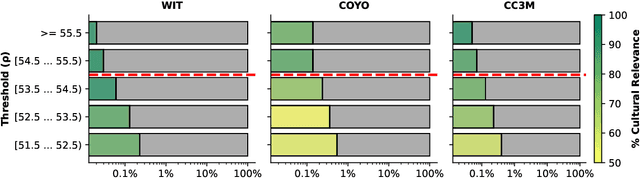
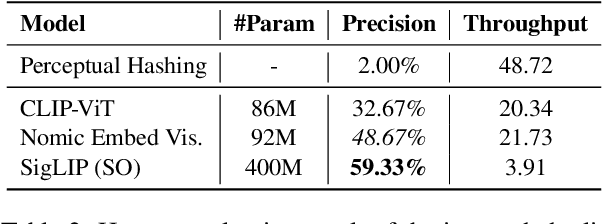
Southeast Asia (SEA) is a region of extraordinary linguistic and cultural diversity, yet it remains significantly underrepresented in vision-language (VL) research. This often results in artificial intelligence (AI) models that fail to capture SEA cultural nuances. To fill this gap, we present SEA-VL, an open-source initiative dedicated to developing high-quality, culturally relevant data for SEA languages. By involving contributors from SEA countries, SEA-VL aims to ensure better cultural relevance and diversity, fostering greater inclusivity of underrepresented languages in VL research. Beyond crowdsourcing, our initiative goes one step further in the exploration of the automatic collection of culturally relevant images through crawling and image generation. First, we find that image crawling achieves approximately ~85% cultural relevance while being more cost- and time-efficient than crowdsourcing. Second, despite the substantial progress in generative vision models, synthetic images remain unreliable in accurately reflecting SEA cultures. The generated images often fail to reflect the nuanced traditions and cultural contexts of the region. Collectively, we gather 1.28M SEA culturally-relevant images, more than 50 times larger than other existing datasets. Through SEA-VL, we aim to bridge the representation gap in SEA, fostering the development of more inclusive AI systems that authentically represent diverse cultures across SEA.