 Add to Chrome
 Add to Firefox
 Add to Edge
Generalized Linear Bandits with Memory
Aug 16, 2026
We study generalized linear bandits with memory, an endogenous non-stationary setting in which rewards depend on past actions through a finite memory matrix. Building on prior work for linear models (Clerici et al., 2024), we show that the previously known $\tilde{O}(T^{3/4})$ regret bound stems from a loose analysis, and we provide a sharpened analysis that recovers a $\tilde{O}(\sqrt{T})$ regret rate in the linear case. We then extend this improvement to generalized linear models and propose a block-wise algorithm based on shrunken confidence bounds. Our algorithm achieves a regret bound of $\tilde{O}\left(\sqrt{mT} + d\sqrt{T} + \sqrtκ\, d^{2} m^{1/4} T^{1/4} + κd^{2} \right)$, where $d$ denotes the feature dimension, $m$ the memory length, and $κ$ a curvature parameter of the link function. This attains a $\sqrt{T}$-type rate despite nonlinear rewards and memory effects. To the best of our knowledge, this analysis provides a unified treatment of memory-induced non-stationarity and nonlinear link functions, while ensuring that the leading regret term is independent of the curvature of the link function. We conduct numerical experiments that are consistent with our theoretical findings.

Concept Removal Guidance: Evidence-Calibrated Negative Guidance for Safe Diffusion Sampling
Jun 29, 2026Text-to-image diffusion models remain vulnerable to adversarial prompts that elicit disallowed content, motivating reliable inference-time controls. A popular approach is negative guidance, which subtracts a negative prompt direction with a fixed weight. However, it often forces a safety-fidelity trade-off, causing artifacts or prompt drift when over-applied and failing under attacks when under-applied. Dynamic variants reweight guidance using posterior-odds signals, which can be brittle for open-vocabulary compositional prompts, while lightweight similarity-based methods ignore the evolving image evidence along the denoising trajectory. We introduce Concept Removal Guidance (CRG), a training-free method that estimates unwanted-concept presence at each diffusion step from the model's noise predictions, and adaptively calibrates negative guidance via a closed-form constrained update enforcing a target presence threshold while minimally perturbing the conditional trajectory. Across red-teaming benchmarks, CRG reduces attack success rates while preserving benign fidelity, and extends to additional suppression targets such as artist style and violence without fine-tuning or external classifiers.
UFO: Unidentified Foreground Object Detection in 3D Point Cloud
Jan 08, 2024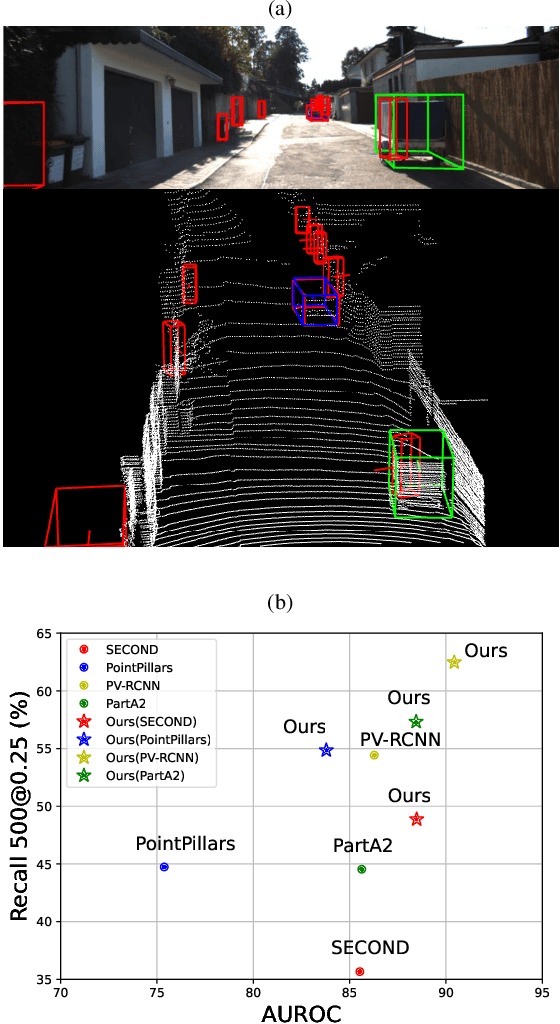
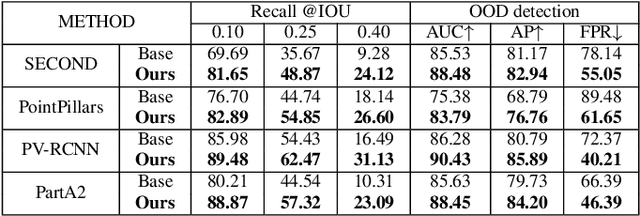
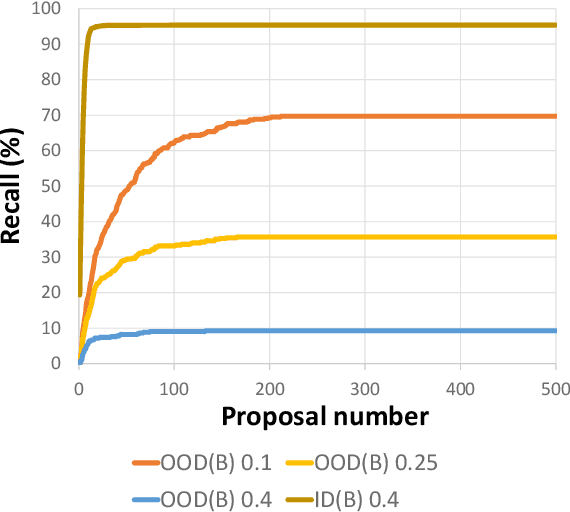
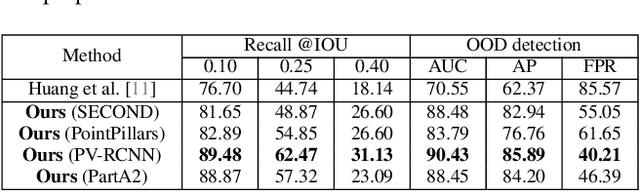
In this paper, we raise a new issue on Unidentified Foreground Object (UFO) detection in 3D point clouds, which is a crucial technology in autonomous driving in the wild. UFO detection is challenging in that existing 3D object detectors encounter extremely hard challenges in both 3D localization and Out-of-Distribution (OOD) detection. To tackle these challenges, we suggest a new UFO detection framework including three tasks: evaluation protocol, methodology, and benchmark. The evaluation includes a new approach to measure the performance on our goal, i.e. both localization and OOD detection of UFOs. The methodology includes practical techniques to enhance the performance of our goal. The benchmark is composed of the KITTI Misc benchmark and our additional synthetic benchmark for modeling a more diverse range of UFOs. The proposed framework consistently enhances performance by a large margin across all four baseline detectors: SECOND, PointPillars, PV-RCNN, and PartA2, giving insight for future work on UFO detection in the wild.
Three Factors to Improve Out-of-Distribution Detection
Aug 02, 2023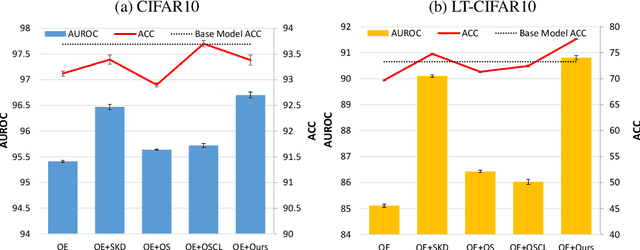
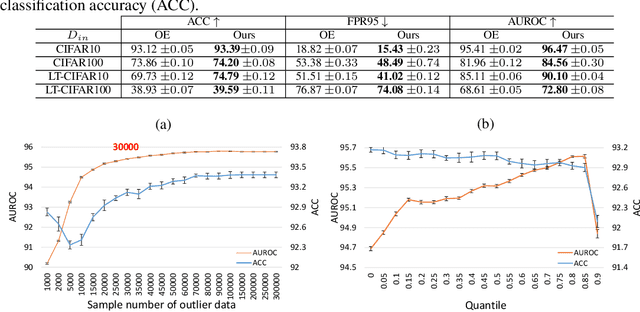
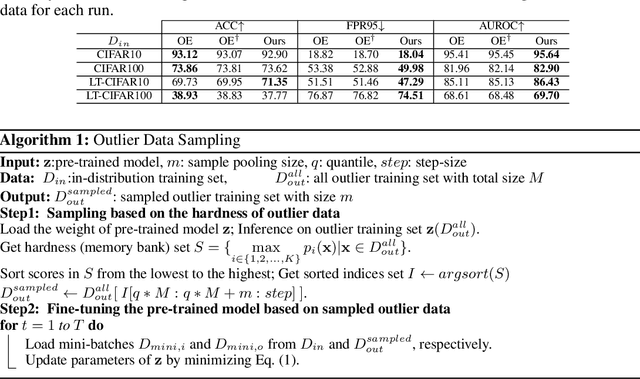

In the problem of out-of-distribution (OOD) detection, the usage of auxiliary data as outlier data for fine-tuning has demonstrated encouraging performance. However, previous methods have suffered from a trade-off between classification accuracy (ACC) and OOD detection performance (AUROC, FPR, AUPR). To improve this trade-off, we make three contributions: (i) Incorporating a self-knowledge distillation loss can enhance the accuracy of the network; (ii) Sampling semi-hard outlier data for training can improve OOD detection performance with minimal impact on accuracy; (iii) The introduction of our novel supervised contrastive learning can simultaneously improve OOD detection performance and the accuracy of the network. By incorporating all three factors, our approach enhances both accuracy and OOD detection performance by addressing the trade-off between classification and OOD detection. Our method achieves improvements over previous approaches in both performance metrics.
Balanced Energy Regularization Loss for Out-of-distribution Detection
Jun 18, 2023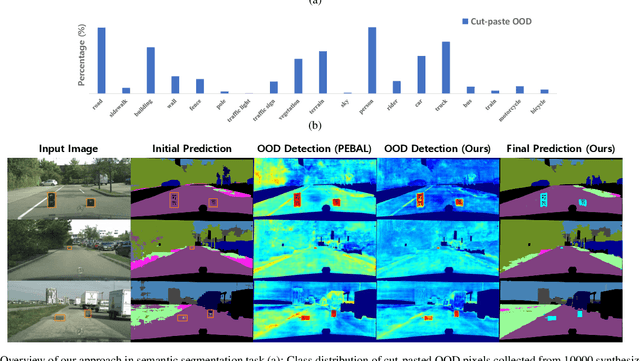
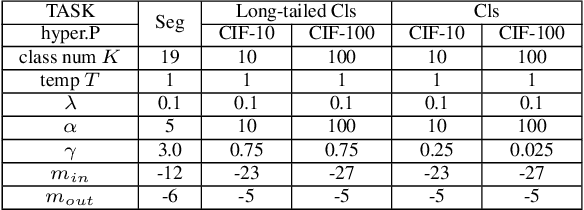
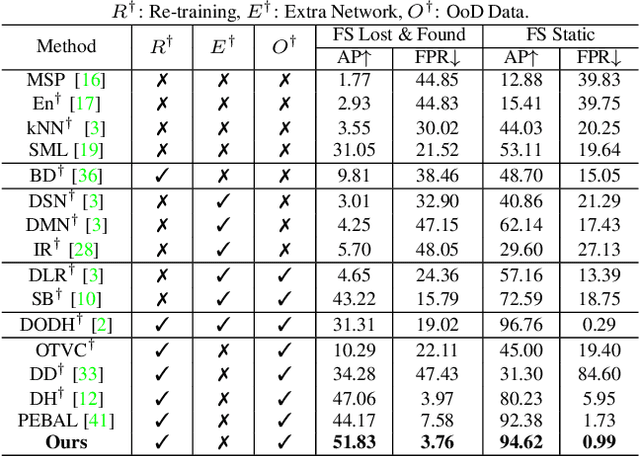
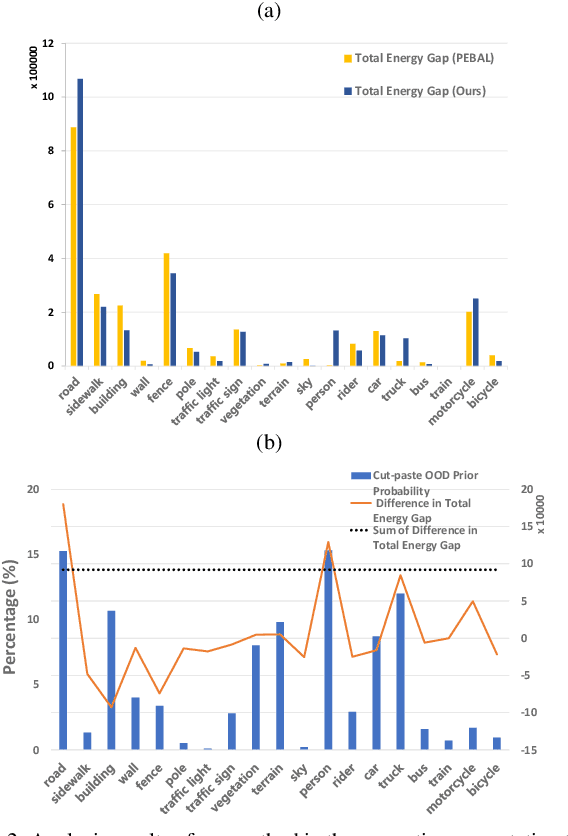
In the field of out-of-distribution (OOD) detection, a previous method that use auxiliary data as OOD data has shown promising performance. However, the method provides an equal loss to all auxiliary data to differentiate them from inliers. However, based on our observation, in various tasks, there is a general imbalance in the distribution of the auxiliary OOD data across classes. We propose a balanced energy regularization loss that is simple but generally effective for a variety of tasks. Our balanced energy regularization loss utilizes class-wise different prior probabilities for auxiliary data to address the class imbalance in OOD data. The main concept is to regularize auxiliary samples from majority classes, more heavily than those from minority classes. Our approach performs better for OOD detection in semantic segmentation, long-tailed image classification, and image classification than the prior energy regularization loss. Furthermore, our approach achieves state-of-the-art performance in two tasks: OOD detection in semantic segmentation and long-tailed image classification. Code is available at https://github.com/hyunjunChhoi/Balanced_Energy.
Faster Convergence with Lexicase Selection in Tree-based Automated Machine Learning
Feb 01, 2023In many evolutionary computation systems, parent selection methods can affect, among other things, convergence to a solution. In this paper, we present a study comparing the role of two commonly used parent selection methods in evolving machine learning pipelines in an automated machine learning system called Tree-based Pipeline Optimization Tool (TPOT). Specifically, we demonstrate, using experiments on multiple datasets, that lexicase selection leads to significantly faster convergence as compared to NSGA-II in TPOT. We also compare the exploration of parts of the search space by these selection methods using a trie data structure that contains information about the pipelines explored in a particular run.