 Add to Chrome
 Add to Firefox
 Add to Edge
Generalized Linear Bandits with Memory
Aug 16, 2026
We study generalized linear bandits with memory, an endogenous non-stationary setting in which rewards depend on past actions through a finite memory matrix. Building on prior work for linear models (Clerici et al., 2024), we show that the previously known $\tilde{O}(T^{3/4})$ regret bound stems from a loose analysis, and we provide a sharpened analysis that recovers a $\tilde{O}(\sqrt{T})$ regret rate in the linear case. We then extend this improvement to generalized linear models and propose a block-wise algorithm based on shrunken confidence bounds. Our algorithm achieves a regret bound of $\tilde{O}\left(\sqrt{mT} + d\sqrt{T} + \sqrtκ\, d^{2} m^{1/4} T^{1/4} + κd^{2} \right)$, where $d$ denotes the feature dimension, $m$ the memory length, and $κ$ a curvature parameter of the link function. This attains a $\sqrt{T}$-type rate despite nonlinear rewards and memory effects. To the best of our knowledge, this analysis provides a unified treatment of memory-induced non-stationarity and nonlinear link functions, while ensuring that the leading regret term is independent of the curvature of the link function. We conduct numerical experiments that are consistent with our theoretical findings.

Diversified Multinomial Logit Contextual Bandits
Jul 13, 2026Existing contextual multinomial logit (MNL) bandits model relevance-driven choice but ignore the potential benefits of within-assortment diversity, while submodular/combinatorial bandits encode diversity in rewards but lack structured choice probabilities. We bridge this gap with the $\textit{diversified multinomial logit}$ (DMNL) contextual bandit, which augments MNL choice probabilities with a generally submodular diversity function, thereby formalizing the relevance--diversity trade-off within a single model. Incorporating diversity renders exact MNL assortment optimization intractable. We propose a $\textit{white-box}$ UCB-based algorithm, $\texttt{OFU-DMNL}$, that constructs assortments item-wise by maximizing optimistic marginal gains, avoids black-box optimization oracles. We show that $\texttt{OFU-DMNL}$ achieves at least a $(1-\frac{1}{e+1})$-$\textit{approximate}$ regret bound $\tilde{O}\left(d \sqrt{T/K}\right)$, where $d$ is the context dimension, $K$ the maximum assortment size, and $T$ the horizon, and attains an improved approximation factor over standard submodular baselines. Experiments demonstrate consistent gains and, relative to exhaustive enumeration, comparable regret with substantially lower runtime. Overall, DMNL bandits provide a practical foundation for diversity-aware assortment optimization under uncertainty, and $\texttt{OFU-DMNL}$ offers a statistically and computationally efficient solution.
Tractable Multinomial Logit Contextual Bandits with Non-Linear Utilities
Jan 11, 2026We study the multinomial logit (MNL) contextual bandit problem for sequential assortment selection. Although most existing research assumes utility functions to be linear in item features, this linearity assumption restricts the modeling of intricate interactions between items and user preferences. A recent work (Zhang & Luo, 2024) has investigated general utility function classes, yet its method faces fundamental trade-offs between computational tractability and statistical efficiency. To address this limitation, we propose a computationally efficient algorithm for MNL contextual bandits leveraging the upper confidence bound principle, specifically designed for non-linear parametric utility functions, including those modeled by neural networks. Under a realizability assumption and a mild geometric condition on the utility function class, our algorithm achieves a regret bound of $\tilde{O}(\sqrt{T})$, where $T$ denotes the total number of rounds. Our result establishes that sharp $\tilde{O}(\sqrt{T})$-regret is attainable even with neural network-based utilities, without relying on strong assumptions such as neural tangent kernel approximations. To the best of our knowledge, our proposed method is the first computationally tractable algorithm for MNL contextual bandits with non-linear utilities that provably attains $\tilde{O}(\sqrt{T})$ regret. Comprehensive numerical experiments validate the effectiveness of our approach, showing robust performance not only in realizable settings but also in scenarios with model misspecification.
Lasso Bandit with Compatibility Condition on Optimal Arm
Jun 02, 2024We consider a stochastic sparse linear bandit problem where only a sparse subset of context features affects the expected reward function, i.e., the unknown reward parameter has sparse structure. In the existing Lasso bandit literature, the compatibility conditions together with additional diversity conditions on the context features are imposed to achieve regret bounds that only depend logarithmically on the ambient dimension $d$. In this paper, we demonstrate that even without the additional diversity assumptions, the compatibility condition only on the optimal arm is sufficient to derive a regret bound that depends logarithmically on $d$, and our assumption is strictly weaker than those used in the lasso bandit literature under the single parameter setting. We propose an algorithm that adapts the forced-sampling technique and prove that the proposed algorithm achieves $O(\text{poly}\log dT)$ regret under the margin condition. To our knowledge, the proposed algorithm requires the weakest assumptions among Lasso bandit algorithms under a single parameter setting that achieve $O(\text{poly}\log dT)$ regret. Through the numerical experiments, we confirm the superior performance of our proposed algorithm.
Combinatorial Neural Bandits
May 31, 2023We consider a contextual combinatorial bandit problem where in each round a learning agent selects a subset of arms and receives feedback on the selected arms according to their scores. The score of an arm is an unknown function of the arm's feature. Approximating this unknown score function with deep neural networks, we propose algorithms: Combinatorial Neural UCB ($\texttt{CN-UCB}$) and Combinatorial Neural Thompson Sampling ($\texttt{CN-TS}$). We prove that $\texttt{CN-UCB}$ achieves $\tilde{\mathcal{O}}(\tilde{d} \sqrt{T})$ or $\tilde{\mathcal{O}}(\sqrt{\tilde{d} T K})$ regret, where $\tilde{d}$ is the effective dimension of a neural tangent kernel matrix, $K$ is the size of a subset of arms, and $T$ is the time horizon. For $\texttt{CN-TS}$, we adapt an optimistic sampling technique to ensure the optimism of the sampled combinatorial action, achieving a worst-case (frequentist) regret of $\tilde{\mathcal{O}}(\tilde{d} \sqrt{TK})$. To the best of our knowledge, these are the first combinatorial neural bandit algorithms with regret performance guarantees. In particular, $\texttt{CN-TS}$ is the first Thompson sampling algorithm with the worst-case regret guarantees for the general contextual combinatorial bandit problem. The numerical experiments demonstrate the superior performances of our proposed algorithms.
Model-Based Reinforcement Learning with Multinomial Logistic Function Approximation
Dec 27, 2022
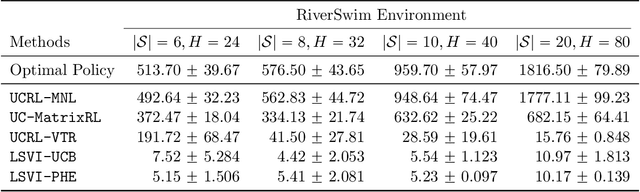
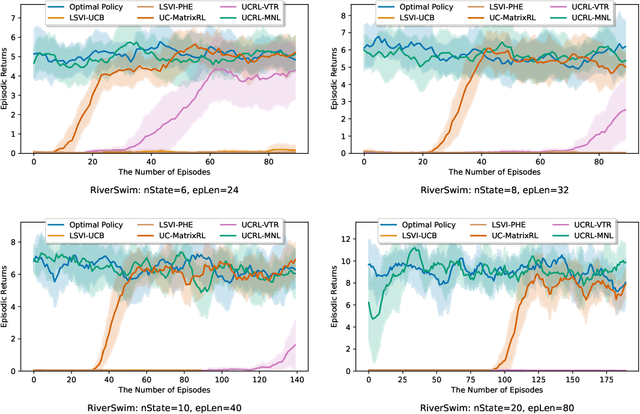

We study model-based reinforcement learning (RL) for episodic Markov decision processes (MDP) whose transition probability is parametrized by an unknown transition core with features of state and action. Despite much recent progress in analyzing algorithms in the linear MDP setting, the understanding of more general transition models is very restrictive. In this paper, we establish a provably efficient RL algorithm for the MDP whose state transition is given by a multinomial logistic model. To balance the exploration-exploitation trade-off, we propose an upper confidence bound-based algorithm. We show that our proposed algorithm achieves $\tilde{\mathcal{O}}(d \sqrt{H^3 T})$ regret bound where $d$ is the dimension of the transition core, $H$ is the horizon, and $T$ is the total number of steps. To the best of our knowledge, this is the first model-based RL algorithm with multinomial logistic function approximation with provable guarantees. We also comprehensively evaluate our proposed algorithm numerically and show that it consistently outperforms the existing methods, hence achieving both provable efficiency and practical superior performance.