 Add to Chrome
 Add to Firefox
 Add to Edge
DRIFT: Difficulty-aware Rectified Flows for Through-plane MRI Super-Resolution
Jul 18, 2026
Magnetic Resonance Imaging (MRI) is often acquired with anisotropic resolution to reduce scan time, producing stair-step artifacts along the through-plane direction. In through-plane MRI super-resolution, an efficiency-fidelity trade-off arises: feed-forward regressors are fast but oversmooth at large slice-thicknesses, while sampling-based methods improve fidelity at high inference cost. We propose DRIFT, a two-stage thickness-conditioned rectified flow framework for through-plane MRI super-resolution with continuous input slice-thickness. Stage 1 employs an Anatomical Projection Network (APN) to map low-resolution patches to a coarse high-resolution manifold, providing a deterministic anatomical initialization that shortens the residual transport of Stage 2 and stabilizes slice-wise refinement. Stage 2 refines details via rectified flow and introduces a Physics-Aware Difficulty (PAD) metric derived from slice-thickness induced through-plane bandwidth deficit to guide an Adaptive Integration Scheduler (AIS), allocating ODE steps by thickness. A Consistent Endpoint Trajectory Alignment (CETA) loss enforces thickness-consistent reconstructions. Experiments show that DRIFT outperforms super-resolution baselines while reducing inference cost. Code, models, and interactive demos are available at https://yoonseokchoi-ai.github.io/drift-eccv2026/.

Controlling Motion Transfer in Diffusion Transformers via Attention Heads
Jul 13, 2026Diffusion Transformers (DiTs) have advanced video generation with high-quality, temporally coherent results. However, extending them to motion transfer, which requires following reference motion while aligning with a target prompt, remains challenging due to limited understanding of motion and structure representations within DiTs. We analyze video DiTs at the attention-head level and identify distinct heads specialized for motion and spatial structure. Based on this insight, we propose a head-aware controllable motion transfer framework that requires no parameter updates. Our method refines motion cues from motion-specialized heads via semantic correspondence guidance and preserves structure through selective feature injection. This head-level control not only enables accurate motion transfer but also provides an interpretable foundation for controllable video generation with DiTs.
Concept Removal Guidance: Evidence-Calibrated Negative Guidance for Safe Diffusion Sampling
Jun 29, 2026Text-to-image diffusion models remain vulnerable to adversarial prompts that elicit disallowed content, motivating reliable inference-time controls. A popular approach is negative guidance, which subtracts a negative prompt direction with a fixed weight. However, it often forces a safety-fidelity trade-off, causing artifacts or prompt drift when over-applied and failing under attacks when under-applied. Dynamic variants reweight guidance using posterior-odds signals, which can be brittle for open-vocabulary compositional prompts, while lightweight similarity-based methods ignore the evolving image evidence along the denoising trajectory. We introduce Concept Removal Guidance (CRG), a training-free method that estimates unwanted-concept presence at each diffusion step from the model's noise predictions, and adaptively calibrates negative guidance via a closed-form constrained update enforcing a target presence threshold while minimally perturbing the conditional trajectory. Across red-teaming benchmarks, CRG reduces attack success rates while preserving benign fidelity, and extends to additional suppression targets such as artist style and violence without fine-tuning or external classifiers.
Dynamic VLM-Guided Negative Prompting for Diffusion Models
Oct 30, 2025We propose a novel approach for dynamic negative prompting in diffusion models that leverages Vision-Language Models (VLMs) to adaptively generate negative prompts during the denoising process. Unlike traditional Negative Prompting methods that use fixed negative prompts, our method generates intermediate image predictions at specific denoising steps and queries a VLM to produce contextually appropriate negative prompts. We evaluate our approach on various benchmark datasets and demonstrate the trade-offs between negative guidance strength and text-image alignment.
Deformation-Aware Segmentation Network Robust to Motion Artifacts for Brain Tissue Segmentation using Disentanglement Learning
Dec 05, 2024Motion artifacts caused by prolonged acquisition time are a significant challenge in Magnetic Resonance Imaging (MRI), hindering accurate tissue segmentation. These artifacts appear as blurred images that mimic tissue-like appearances, making segmentation difficult. This study proposes a novel deep learning framework that demonstrates superior performance in both motion correction and robust brain tissue segmentation in the presence of artifacts. The core concept lies in a complementary process: a disentanglement learning network progressively removes artifacts, leading to cleaner images and consequently, more accurate segmentation by a jointly trained motion estimation and segmentation network. This network generates three outputs: a motioncorrected image, a motion deformation map that identifies artifact-affected regions, and a brain tissue segmentation mask. This deformation serves as a guidance mechanism for the disentanglement process, aiding the model in recovering lost information or removing artificial structures introduced by the artifacts. Extensive in-vivo experiments on pediatric motion data demonstrate that our proposed framework outperforms state-of-the-art methods in segmenting motion-corrupted MRI scans.
* Medical Image Computing and Computer Assisted Intervention, MICCAI 2024
Deep Learning Can Reverse Photon Migration for Diffuse Optical Tomography
Dec 04, 2017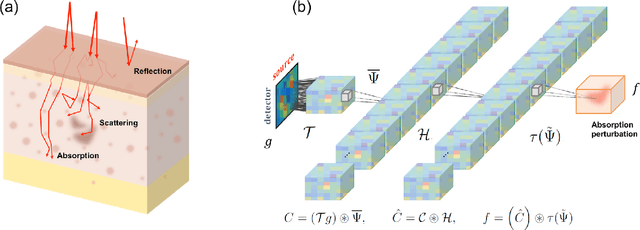

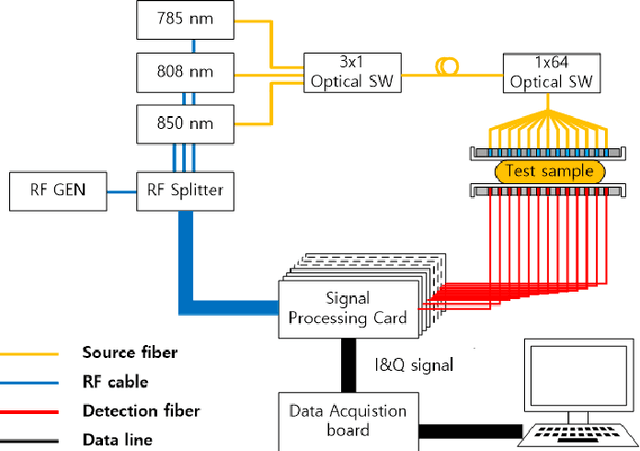
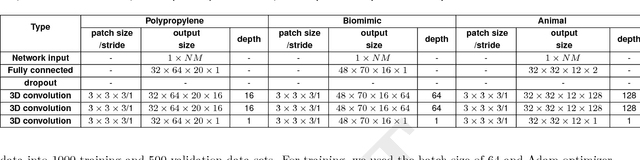
Can artificial intelligence (AI) learn complicated non-linear physics? Here we propose a novel deep learning approach that learns non-linear photon scattering physics and obtains accurate 3D distribution of optical anomalies. In contrast to the traditional black-box deep learning approaches to inverse problems, our deep network learns to invert the Lippmann-Schwinger integral equation which describes the essential physics of photon migration of diffuse near-infrared (NIR) photons in turbid media. As an example for clinical relevance, we applied the method to our prototype diffuse optical tomography (DOT). We show that our deep neural network, trained with only simulation data, can accurately recover the location of anomalies within biomimetic phantoms and live animals without the use of an exogenous contrast agent.