 Add to Chrome
 Add to Firefox
 Add to Edge
One-Sided Quantile Coupling for Flow Matching
Aug 02, 2026
Flow Matching trains continuous-time generative models by regressing the velocity field of a probability path between a simple source distribution and a target data distribution. The coupling that pairs source and target samples strongly affects optimization and sample quality, but structured couplings typically rely on mini-batch transport or assignment procedures whose cost grows at least quadratically in batch size. We propose Quantile Coupling Flow Matching (QC-FM), a lightweight one-sided coupling: rather than matching two pre-sampled batches, it samples only the data batch and constructs each paired source directly. Data ranks projected along a small number of random orthogonal directions are mapped to Gaussian quantiles, and the latent code is completed in the orthogonal complement by conditional Gaussian sampling. The construction is one-dimensional per slice, so the coupling requires no pairwise cost matrix and no assignment to solve. We show that, for each drawn frame, this coupling eliminates the irreducible regression variance along every selected slice and makes the ideal flow exactly straight there, while leaving the sampling prior unchanged: generation still starts from the standard Gaussian, and the training source deviates from it only through the copula of the slice codes, whose transport cost we bound. For training, we apply QC to an anchor subset and complete the remaining source slots with exact Gaussian samples, retaining the QC bias while preserving an explicit signal from the Baseline coupling. Across CIFAR-10, CelebA, FFHQ, and ImageNet-64, QC-FM improves over the Baseline under matched training budgets, reducing FID by up to 12.9%, and outperforms OT-CFM on all four datasets. These results suggest that preserving projected rank structure is a simple and scalable way to inject useful geometric bias into FM couplings without solving a mini-batch transport problem.

MarketGANs: Multivariate financial time-series data augmentation using generative adversarial networks
Jan 25, 2026This paper introduces MarketGAN, a factor-based generative framework for high-dimensional asset return generation under severe data scarcity. We embed an explicit asset-pricing factor structure as an economic inductive bias and generate returns as a single joint vector, thereby preserving cross-sectional dependence and tail co-movement alongside inter-temporal dynamics. MarketGAN employs generative adversarial learning with a temporal convolutional network (TCN) backbone, which models stochastic, time-varying factor loadings and volatilities and captures long-range temporal dependence. Using daily returns of large U.S. equities, we find that MarketGAN more closely matches empirical stylized facts of asset returns, including heavy-tailed marginal distributions, volatility clustering, leverage effects, and, most notably, high-dimensional cross-sectional correlation structures and tail co-movement across assets, than conventional factor-model-based bootstrap approaches. In portfolio applications, covariance estimates derived from MarketGAN-generated samples outperform those derived from other methods when factor information is at least weakly informative, demonstrating tangible economic value.
Diffolio: A Diffusion Model for Multivariate Probabilistic Financial Time-Series Forecasting and Portfolio Construction
Nov 10, 2025Probabilistic forecasting is crucial in multivariate financial time-series for constructing efficient portfolios that account for complex cross-sectional dependencies. In this paper, we propose Diffolio, a diffusion model designed for multivariate financial time-series forecasting and portfolio construction. Diffolio employs a denoising network with a hierarchical attention architecture, comprising both asset-level and market-level layers. Furthermore, to better reflect cross-sectional correlations, we introduce a correlation-guided regularizer informed by a stable estimate of the target correlation matrix. This structure effectively extracts salient features not only from historical returns but also from asset-specific and systematic covariates, significantly enhancing the performance of forecasts and portfolios. Experimental results on the daily excess returns of 12 industry portfolios show that Diffolio outperforms various probabilistic forecasting baselines in multivariate forecasting accuracy and portfolio performance. Moreover, in portfolio experiments, portfolios constructed from Diffolio's forecasts show consistently robust performance, thereby outperforming those from benchmarks by achieving higher Sharpe ratios for the mean-variance tangency portfolio and higher certainty equivalents for the growth-optimal portfolio. These results demonstrate the superiority of our proposed Diffolio in terms of not only statistical accuracy but also economic significance.
Forecasting VIX using interpretable Kolmogorov-Arnold networks
Feb 03, 2025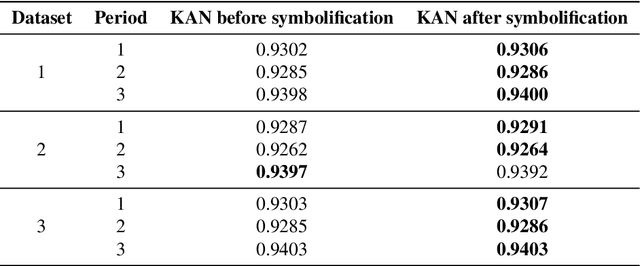
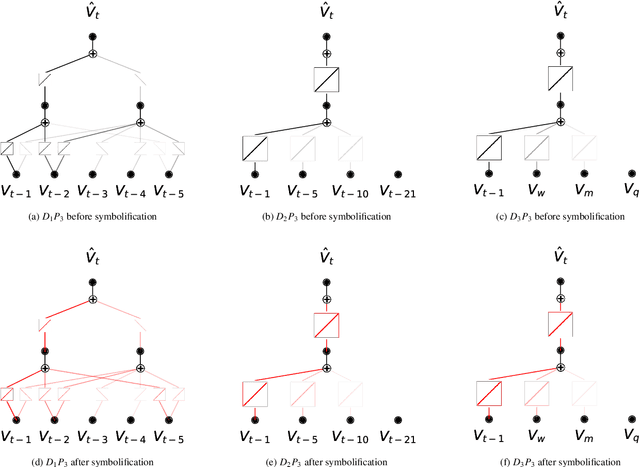
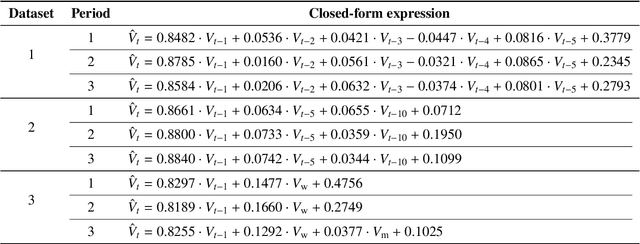
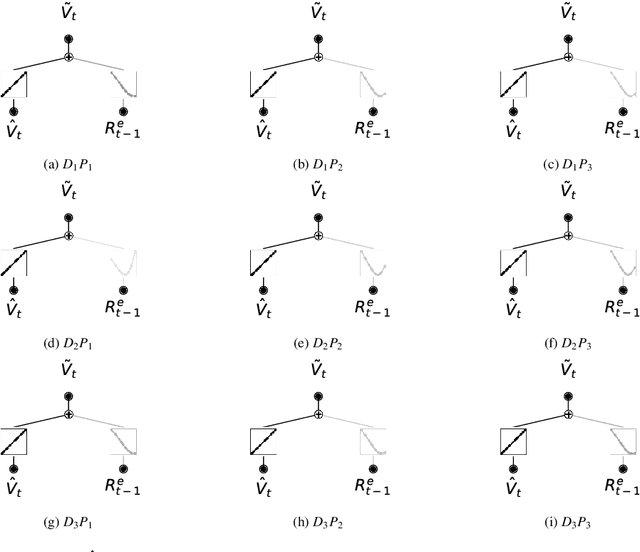
This paper presents the use of Kolmogorov-Arnold Networks (KANs) for forecasting the CBOE Volatility Index (VIX). Unlike traditional MLP-based neural networks that are often criticized for their black-box nature, KAN offers an interpretable approach via learnable spline-based activation functions and symbolification. Based on a parsimonious architecture with symbolic functions, KAN expresses a forecast of the VIX as a closed-form in terms of explanatory variables, and provide interpretable insights into key characteristics of the VIX, including mean reversion and the leverage effect. Through in-depth empirical analysis across multiple datasets and periods, we show that KANs achieve competitive forecasting performance while requiring significantly fewer parameters compared to MLP-based neural network models. Our findings demonstrate the capacity and potential of KAN as an interpretable financial time-series forecasting method.
Denoising Task Difficulty-based Curriculum for Training Diffusion Models
Mar 15, 2024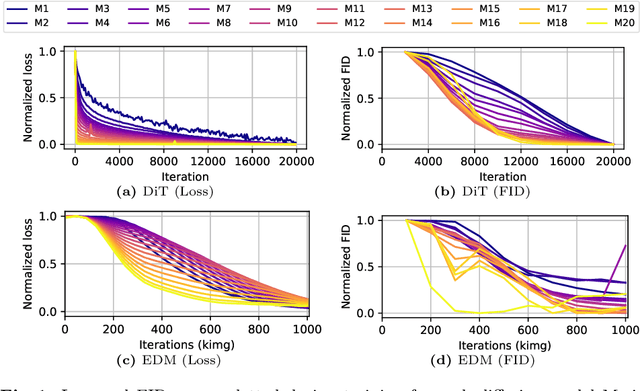
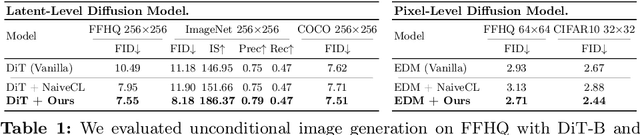
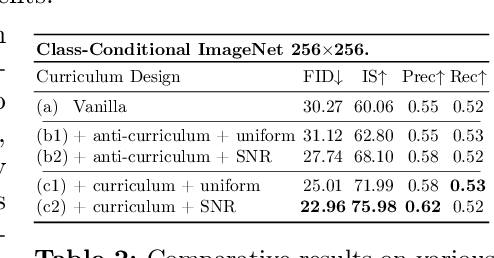
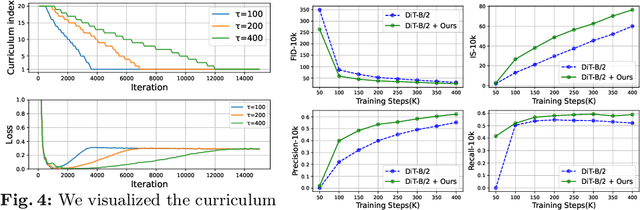
Diffusion-based generative models have emerged as powerful tools in the realm of generative modeling. Despite extensive research on denoising across various timesteps and noise levels, a conflict persists regarding the relative difficulties of the denoising tasks. While various studies argue that lower timesteps present more challenging tasks, others contend that higher timesteps are more difficult. To address this conflict, our study undertakes a comprehensive examination of task difficulties, focusing on convergence behavior and changes in relative entropy between consecutive probability distributions across timesteps. Our observational study reveals that denoising at earlier timesteps poses challenges characterized by slower convergence and higher relative entropy, indicating increased task difficulty at these lower timesteps. Building on these observations, we introduce an easy-to-hard learning scheme, drawing from curriculum learning, to enhance the training process of diffusion models. By organizing timesteps or noise levels into clusters and training models with descending orders of difficulty, we facilitate an order-aware training regime, progressing from easier to harder denoising tasks, thereby deviating from the conventional approach of training diffusion models simultaneously across all timesteps. Our approach leads to improved performance and faster convergence by leveraging the benefits of curriculum learning, while maintaining orthogonality with existing improvements in diffusion training techniques. We validate these advantages through comprehensive experiments in image generation tasks, including unconditional, class-conditional, and text-to-image generation.