 Add to Chrome
 Add to Firefox
 Add to Edge
SlotGCG: Exploiting the Positional Vulnerability in LLMs for Jailbreak Attacks
Jun 04, 2026
As large language models (LLMs) are widely deployed, identifying their vulnerability through jailbreak attacks becomes increasingly critical. Optimization-based attacks like Greedy Coordinate Gradient (GCG) have focused on inserting adversarial tokens to the end of prompts. However, GCG restricts adversarial tokens to a fixed insertion point (typically the prompt suffix), leaving the effect of inserting tokens at other positions unexplored. In this paper, we empirically investigate \emph{slots}, i.e., candidate positions within a prompt where tokens can be inserted. We find that vulnerability to jailbreaking is highly related to the selection of the \emph{slots}. Based on these findings, we introduce the \textit{Vulnerable Slot Score} (VSS) to quantify the positional vulnerability to jailbreaking. We then propose SlotGCG, which evaluates all slots with VSS, selects the most vulnerable slots for insertion, and runs a targeted optimization attack at those slots. Our approach provides a position-search mechanism that is attack-agnostic and can be plugged into any optimization-based attack, adding only 200ms of preprocessing time. Experiments across multiple models demonstrate that SlotGCG significantly outperforms existing methods. Specifically, it achieves 14\% higher Attack Success Rates (ASR) over GCG-based attacks, converges faster, and shows superior robustness against defense methods with 42\% higher ASR than baseline approaches. Our implementation is available at \href{https://github.com/youai058/SlotGCG}{https://github.com/youai058/SlotGCG}

Machine Unlearning for Masked Diffusion Language Models
May 18, 2026Recent masked diffusion language models (MDLMs), such as LLaDA and Dream, have achieved performance comparable to autoregressive large language models. Unlike autoregressive models, which generate text sequentially, MDLMs generate text by iteratively denoising masked positions in parallel. During fine-tuning, MDLMs learn to recover responses from masked response states conditioned on a prompt, thereby shifting their predictions from a prompt-masked unconditional distribution toward a prompt-conditional distribution. Despite this distinct generative and fine-tuning mechanism, machine unlearning for MDLMs remains largely unexplored. In this paper, we propose Masked Diffusion Unlearning (MDU), the first unlearning framework for MDLMs, by revisiting the process of learning specific knowledge in terms of diffusion. Specifically, MDU minimizes a forward KL divergence from the prompt-conditional prediction to a prompt-masked unconditional anchor at every masked response position, with a temperature scaling parameter to control the privacy-utility trade-off. Our empirical results on standard benchmarks and MDLM backbones show that MDU achieves high unlearning performance compared to existing LLM unlearning methods. Code is available at https://github.com/leegeoru/MDU.
MarketGANs: Multivariate financial time-series data augmentation using generative adversarial networks
Jan 25, 2026This paper introduces MarketGAN, a factor-based generative framework for high-dimensional asset return generation under severe data scarcity. We embed an explicit asset-pricing factor structure as an economic inductive bias and generate returns as a single joint vector, thereby preserving cross-sectional dependence and tail co-movement alongside inter-temporal dynamics. MarketGAN employs generative adversarial learning with a temporal convolutional network (TCN) backbone, which models stochastic, time-varying factor loadings and volatilities and captures long-range temporal dependence. Using daily returns of large U.S. equities, we find that MarketGAN more closely matches empirical stylized facts of asset returns, including heavy-tailed marginal distributions, volatility clustering, leverage effects, and, most notably, high-dimensional cross-sectional correlation structures and tail co-movement across assets, than conventional factor-model-based bootstrap approaches. In portfolio applications, covariance estimates derived from MarketGAN-generated samples outperform those derived from other methods when factor information is at least weakly informative, demonstrating tangible economic value.
Posting Bot Detection on Blockchain-based Social Media Platform using Machine Learning Techniques
Aug 28, 2020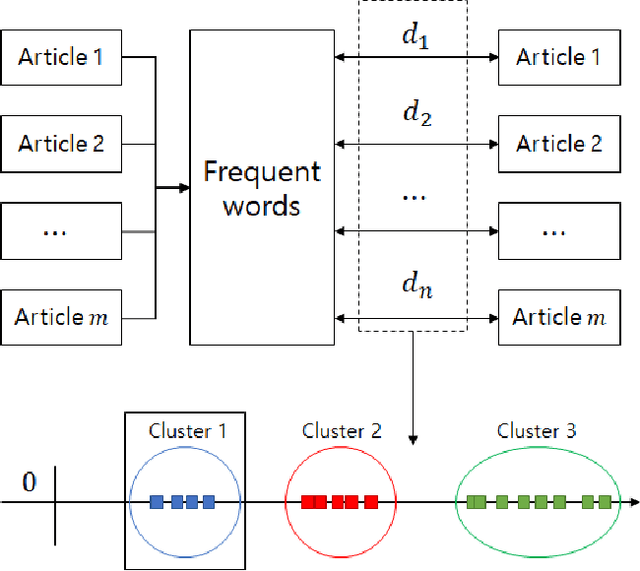
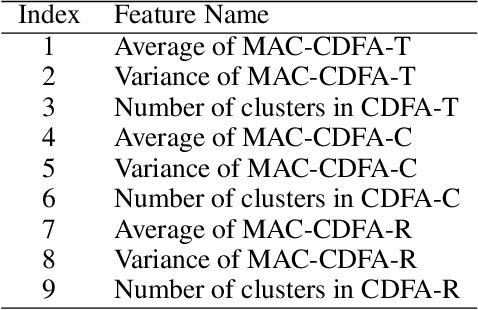
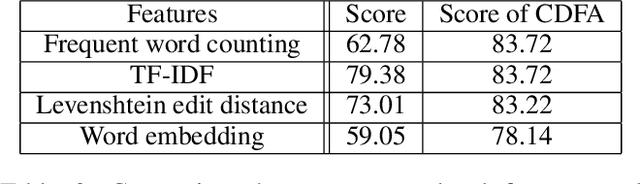
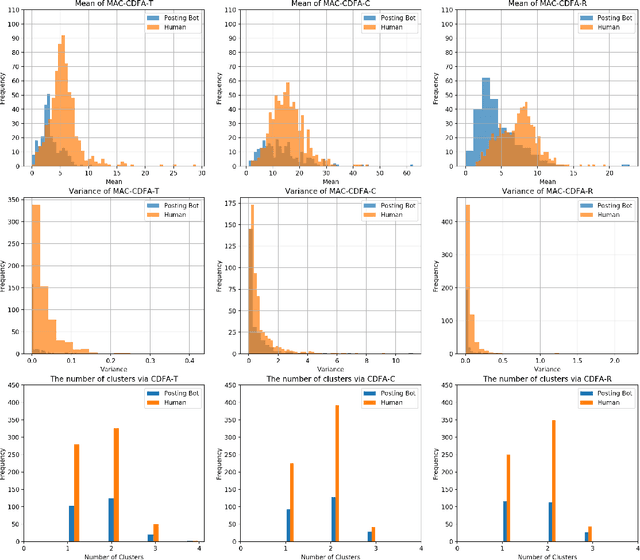
Steemit is a blockchain-based social media platform, where authors can get author rewards in the form of cryptocurrencies called STEEM and SBD (Steem Blockchain Dollars) if their posts are upvoted. Interestingly, curators (or voters) can also get rewards by voting others' posts, which is called a curation reward. A reward is proportional to a curator's STEEM stakes. Throughout this process, Steemit hopes "good" content will be automatically discovered by users in a decentralized way, which is known as the Proof-of-Brain (PoB). However, there are many bot accounts programmed to post automatically and get rewards, which discourages real human users from creating good content. We call this type of bot a posting bot. While there are many papers that studied bots on traditional centralized social media platforms such as Facebook and Twitter, we are the first to study posting bots on a blockchain-based social media platform. Compared with the bot detection on the usual social media platforms, the features we created have an advantage that posting bots can be detected without limiting the number or length of posts. We can extract the features of posts by clustering distances between blog data or replies. These features are obtained from the Minimum Average Cluster from Clustering Distance between Frequent words and Articles (MAC-CDFA), which is not used in any of the previous social media research. Based on the enriched features, we enhanced the quality of classification tasks. Comparing the F1-scores, the features we created outperformed the features used for bot detection on Facebook and Twitter.