 Add to Chrome
 Add to Firefox
 Add to Edge
Out of Sight, Still in Mind: Token Compression for Omni-LLMs
Jul 23, 2026
The goal of this paper is to reduce the input token cost of Omni-modal large language models (Omni-LLMs) at inference time. Omni-LLMs reason jointly over audio, video and text, but the cost of the three streams is highly unbalanced: visual tokens account for the vast majority of the input, and are highly redundant. In this paper, we propose ReMo, a training-free framework that compresses visual tokens by redistributing their information across modalities: a visual token is kept only if its information appears nowhere else. ReMo achieves this in two ways: (i) it aligns audio and video in a common embedding space, and removes visual tokens already explained by the audio or by other visual tokens; and (ii) it replaces object-level visual tokens with compact text proxies, short descriptions of each object and its location, conveying the same content in far fewer tokens. On Qwen2.5-Omni at two model scales, ReMo removes 54% of the input tokens with no loss in accuracy. Indeed, it slightly exceeds the full-token model, reaching 101.2% and 101.3% of its average accuracy over five audio-visual benchmarks.

Acoustic Prompting via Stage-wise Modulation for Few-Shot Learning in Audio Language Models
Jun 14, 2026Audio-Language Models (ALMs) have shown remarkable success in zero-shot audio classification by aligning audio waveforms with text. Recent efforts to improve downstream performance focus on learning optimal text prompts. However, previous approaches focus on the text encoder, leaving the potential of learnable prompts within the audio encoder unexplored. In this paper, we propose a novel framework that introduces trainable prompts into the audio encoder to capture task-specific acoustic features. We demonstrate that integrating audio-side prompt learning with existing text-side approaches enhances few-shot adaptation. Through extensive experiments across 11 datasets show that integrating our method as a plug-and-play module alongside existing text prompt tuning generally leads to performance improvements. These findings suggest that explicitly modulating the audio representation space effectively complements text-only prompting approaches. The code is available at https://github.com/hyebin-c/aspl.
Realistic Bokeh Effect Rendering on Mobile GPUs, Mobile AI & AIM 2022 challenge: Report
Nov 07, 2022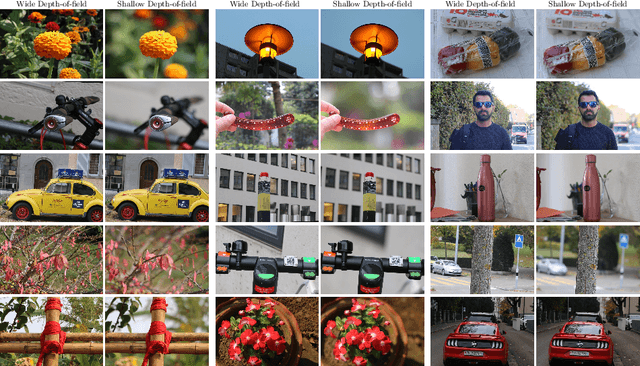

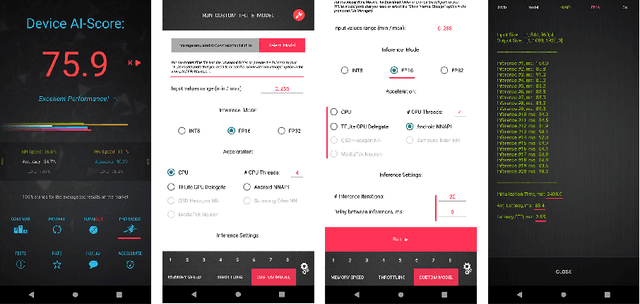

As mobile cameras with compact optics are unable to produce a strong bokeh effect, lots of interest is now devoted to deep learning-based solutions for this task. In this Mobile AI challenge, the target was to develop an efficient end-to-end AI-based bokeh effect rendering approach that can run on modern smartphone GPUs using TensorFlow Lite. The participants were provided with a large-scale EBB! bokeh dataset consisting of 5K shallow / wide depth-of-field image pairs captured using the Canon 7D DSLR camera. The runtime of the resulting models was evaluated on the Kirin 9000's Mali GPU that provides excellent acceleration results for the majority of common deep learning ops. A detailed description of all models developed in this challenge is provided in this paper.