 Add to Chrome
 Add to Firefox
 Add to Edge
SwinAD: Multi-stage feature reconstruction for unsupervised industrial anomaly detection
Jul 16, 2026
Industrial anomaly detection aims to identify and localize defective regions without relying on exhaustive annotations of all possible defect types. Although recent unsupervised methods have achieved strong performance, most are primarily designed for single-class settings and often struggle in multi-class scenarios, where diverse normal patterns may lead to over-generalization and reduce the discriminative capability between normal and anomalous regions. In this paper, we propose SwinAD, a reconstruction-based framework for multi-class unsupervised anomaly detection that leverages a frozen pretrained Swin Transformer V2 encoder and a feature diversity-preserving reconstruction decoder. The hierarchical encoder provides semantically rich multi-scale features, while stage-wise bottleneck modules with dropout prevent trivial identity mapping and encourage robust reconstruction of normal patterns. To further improve localization, we introduce a feature diversity-preserving reconstruction framework that maintains complementary reconstruction hypotheses instead of relying on a single decoding branch. The discrepancies between encoder features and the two reconstructed features are then aggregated across multiple scales to produce the final anomaly map. Experiments conducted on three industrial anomaly detection benchmarks, including MVTec AD, VisA, and Real-IAD, demonstrate that SwinAD achieves competitive image-level performance and strong pixel-level localization accuracy, with particularly notable improvements in pixel-level AP and 1 on MVTec AD. These results indicate that combining hierarchical Swin features with diverse multi-scale reconstruction substantially improve pixel-level localization in multi-class unsupervised anomaly setting.

Ensemble Learning of Myocardial Displacements for Myocardial Infarction Detection in Echocardiography
Mar 12, 2023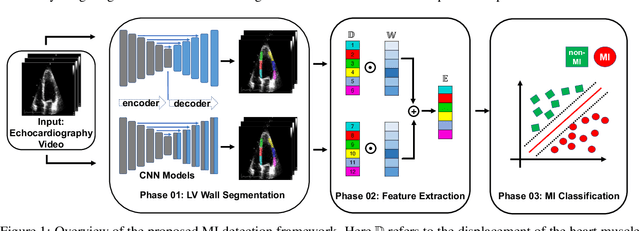
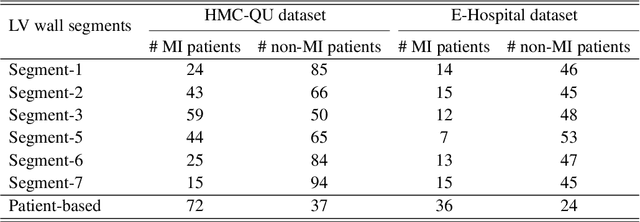
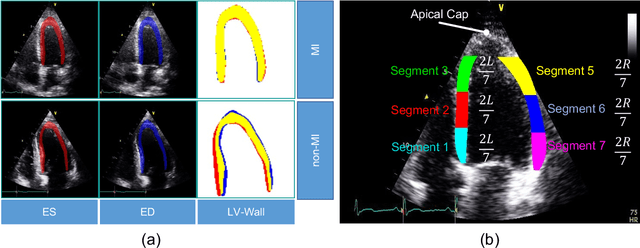
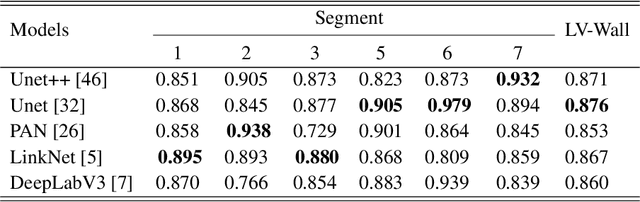
Early detection and localization of myocardial infarction (MI) can reduce the severity of cardiac damage through timely treatment interventions. In recent years, deep learning techniques have shown promise for detecting MI in echocardiographic images. However, there has been no examination of how segmentation accuracy affects MI classification performance and the potential benefits of using ensemble learning approaches. Our study investigates this relationship and introduces a robust method that combines features from multiple segmentation models to improve MI classification performance by leveraging ensemble learning. Our method combines myocardial segment displacement features from multiple segmentation models, which are then input into a typical classifier to estimate the risk of MI. We validated the proposed approach on two datasets: the public HMC-QU dataset (109 echocardiograms) for training and validation, and an E-Hospital dataset (60 echocardiograms) from a local clinical site in Vietnam for independent testing. Model performance was evaluated based on accuracy, sensitivity, and specificity. The proposed approach demonstrated excellent performance in detecting MI. The results showed that the proposed approach outperformed the state-of-the-art feature-based method. Further research is necessary to determine its potential use in clinical settings as a tool to assist cardiologists and technicians with objective assessments and reduce dependence on operator subjectivity. Our research codes are available on GitHub at https://github.com/vinuni-vishc/mi-detection-echo.