 Add to Chrome
 Add to Firefox
 Add to Edge
Adaptive MPPI with Online Disturbance Covariance Estimation: Provable Stability Tightening via Spatial Smoothing
Jul 09, 2026
We study Model Predictive Path Integral (MPPI) control for nonlinear systems with additive process disturbances whose covariance is unknown, spatially varying, and slowly time-varying. A mismatched disturbance covariance produces a persistent penalty in closed-loop stability certificates, while online estimation can reduce this penalty as data are collected. We propose a cell-wise recursive covariance estimator with spatial diffusion and prove a finite-horizon error bound that separates stochastic-approximation error, spatial-smoothing bias, and temporal-drift effects. The diffusion kernel is chosen to be reversible with respect to the stationary visitation measure, making the diffusion operator dissipative in the weighted Lyapunov analysis. We then substitute the resulting covariance estimate into the MPPI sampling distribution and derive an adaptive stability certificate with an explicit learning penalty. The main result is a payoff theorem: after a computable crossover time, the adaptive controller achieves a strictly tighter certified stability bound than any fixed covariance choice whose mismatch exceeds the residual smoothing and drift allowance. Numerical experiments illustrate the estimator convergence and the resulting stability-tightening effect.

Residual-Conservative Model Predictive Path Integral Control
Jul 08, 2026Sampling-based model predictive control methods handle nonlinear dynamics and complex cost landscapes through Monte Carlo rollouts, yet typically employ fixed constraint penalties that do not adapt to model-plant mismatch. This paper proposes Residual-Conservative Model Predictive Path Integral Control (RC-MPPI), a sampling-based MPC framework that modulates safety conservatism online using the prediction-execution residual. RC-MPPI combines three coupled mechanisms: residual-dependent constraint tightening, adaptive safety-cost shaping, and residual-adaptive sampling modulation through exploration contraction and temperature relaxation. The temperature adaptation reflects a key insight: when the model is inaccurate, rollout cost evaluations become unreliable, and increasing temperature reduces overcommitment to apparent cost rankings. Under Lipschitz dynamics and sub-Gaussian disturbances, we derive probabilistic bounds on constraint violation and show that the joint effect of the adaptive mechanisms reduces violation probability as the residual grows. A rollout-cost uncertainty analysis further shows that model-plant mismatch perturbs MPPI importance weights in proportion to residual magnitude and inversely with temperature, providing theoretical justification for residual-adaptive temperature relaxation. Simulations on an LTI point-mass system and a planar 2R manipulator show improved safety margin, success rate, and control efficiency compared with vanilla MPPI under significant model-plant mismatch.
Finite-Sample Closed-Loop Stability of Model Predictive Path Integral Control for Linear Time-Invariant Systems
Jul 04, 2026We establish finite-sample closed-loop stability guarantees for Model Predictive Path Integral (MPPI) control applied to discrete-time Linear Time-Invariant (LTI) systems with additive Gaussian process disturbances. The key observation is that, for unconstrained LTI/quadratic systems with the DARE terminal cost, the exact finite-horizon MPC law has the same first control action as the infinite-horizon LQR law for every planning horizon. Thus, finite-sample MPPI can be analyzed as a stochastic perturbation of LQR. First, we show that the MPPI control law approximates the LQR feedback with high probability. The approximation error decomposes into a Monte Carlo term that decreases with the sample count and an infinite-sample temperature bias that persists at finite temperature but vanishes as the temperature is reduced. The resulting constants are written in terms of the horizon-dependent stacked cost matrices, making explicit that the finite-sample certificate is parametrized by the selected planning horizon. Second, we use a Lyapunov perturbation argument to prove practical exponential stability in expectation. On sample paths that remain in a compact Lyapunov sublevel set over a finite operating horizon, the expected state norm decays exponentially up to three residual floors: a process-noise floor, an MPPI approximation floor, and a confidence floor from the per-step sampling failure probability. The sufficient sample threshold is explicit and computable from the DARE solution, LQR stability margin, MPPI sampling parameters, temperature, and planning horizon. In the joint limit of infinite samples and vanishing temperature bias, the result recovers the stochastic LQR stability bound.
Finite Reliability Representations: Noise-Calibrated Belief-Space Covers for Reliable Decision-Making
Jul 04, 2026Physical sensing and actuation noise floors should inform how much belief resolution a decision-making system can reliably use. We introduce Finite Reliability Representations (FRR), a framework for covering belief spaces by reliability cells: regions within which the optimal action-value function Q*(b,u) varies by at most a tolerance epsilon, uniformly over actions. The framework is formulated on beliefs rather than states and uses a cover rather than an equivalence quotient, because approximate decision-closeness is not transitive in general. A central technical point is that noisy Bayesian updates should not be treated as globally contractive on arbitrary beliefs. We therefore separate three objects: the fixed-observation filter map, the predictive observation law, and the controlled belief-transition kernel. For nonlinear continuous-state systems, FRR is obtained under a reachable-set Lipschitz modulus for the belief-transition kernel. For finite-state POMDPs, the same construction becomes exact on the belief simplex: prediction is linear, Bayesian correction is a normalized positive linear map, sensor noise enters through observation-distribution distinguishability, and actuation uncertainty enters through an action-execution channel. Under the corresponding action-value Lipschitz condition, an FRR cover supports a cell-constant policy whose suboptimality is bounded by 2 epsilon/(1 - gamma). We also introduce reliability entropy, the logarithm of the minimal number of reliability cells, as a measure of certified decision-relevant belief complexity. The framework distinguishes representation sufficiency from fundamental performance floors imposed by sensing, process, and actuation noise. It applies to finite POMDPs, linear-Gaussian filters, locally linearized nonlinear filters, and particle-filter implementations through analytic or empirical certification of reliability cells.
Addressing Behavior Model Inaccuracies for Safe Motion Control in Uncertain Dynamic Environments
Jul 26, 2024


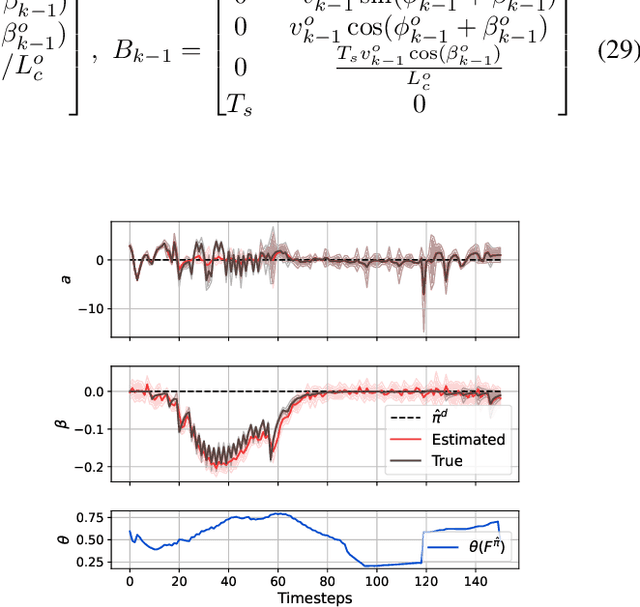
Uncertainties in the environment and behavior model inaccuracies compromise the state estimation of a dynamic obstacle and its trajectory predictions, introducing biases in estimation and shifts in predictive distributions. Addressing these challenges is crucial to safely control an autonomous system. In this paper, we propose a novel algorithm SIED-MPC, which synergistically integrates Simultaneous State and Input Estimation (SSIE) and Distributionally Robust Model Predictive Control (DR-MPC) using model confidence evaluation. The SSIE process produces unbiased state estimates and optimal input gap estimates to assess the confidence of the behavior model, defining the ambiguity radius for DR-MPC to handle predictive distribution shifts. This systematic confidence evaluation leads to producing safe inputs with an adequate level of conservatism. Our algorithm demonstrated a reduced collision rate in autonomous driving simulations through improved state estimation, with a 54% shorter average computation time.
Resilient Estimator-based Control Barrier Functions for Dynamical Systems with Disturbances and Noise
Jun 28, 2024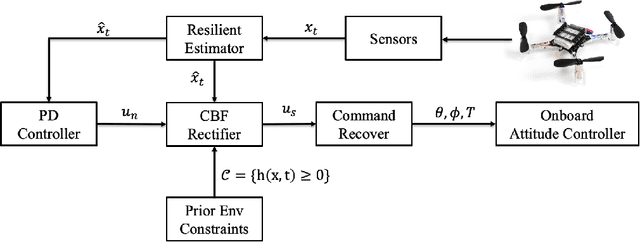
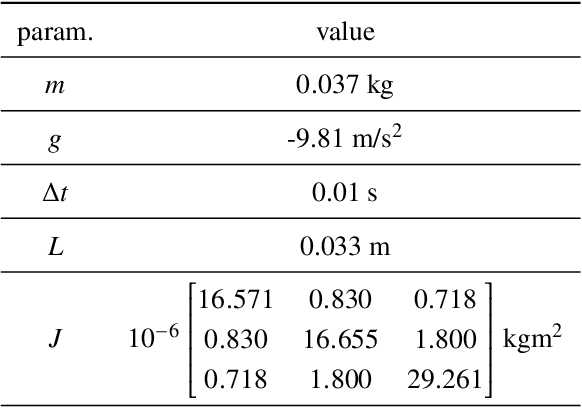
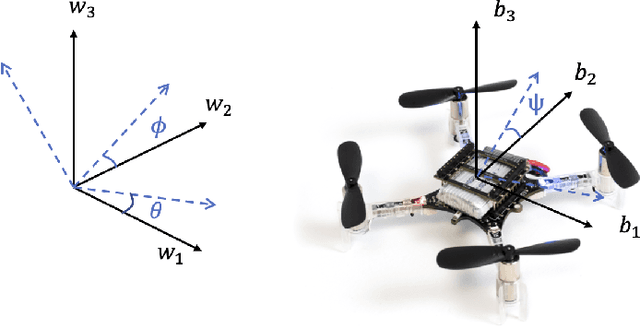
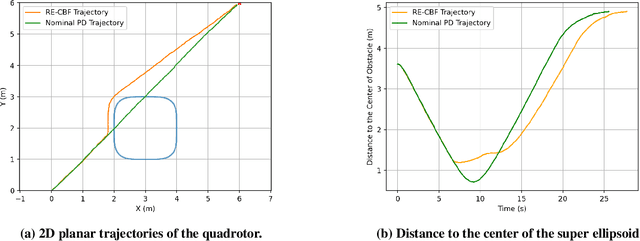
Control Barrier Function (CBF) is an emerging method that guarantees safety in path planning problems by generating a control command to ensure the forward invariance of a safety set. Most of the developments up to date assume availability of correct state measurements and absence of disturbances on the system. However, if the system incurs disturbances and is subject to noise, the CBF cannot guarantee safety due to the distorted state estimate. To improve the resilience and adaptability of the CBF, we propose a resilient estimator-based control barrier function (RE-CBF), which is based on a novel stochastic CBF optimization and resilient estimator, to guarantee the safety of systems with disturbances and noise in the path planning problems. The proposed algorithm uses the resilient estimation algorithm to estimate disturbances and counteract their effect using novel stochastic CBF optimization, providing safe control inputs for dynamical systems with disturbances and noise. To demonstrate the effectiveness of our algorithm in handling both noise and disturbances in dynamics and measurement, we design a quadrotor testing pipeline to simulate the proposed algorithm and then implement the algorithm on a real drone in our flying arena. Both simulations and real-world experiments show that the proposed method can guarantee safety for systems with disturbances and noise.
Synergistic Perception and Control Simplex for Verifiable Safe Vertical Landing
Dec 05, 2023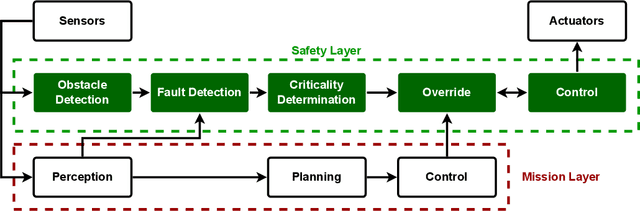
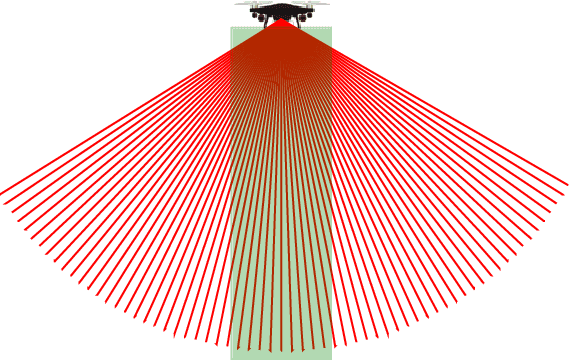
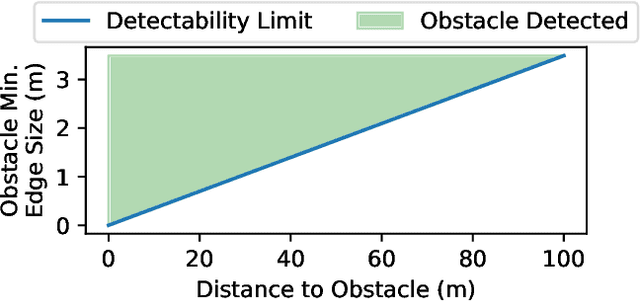
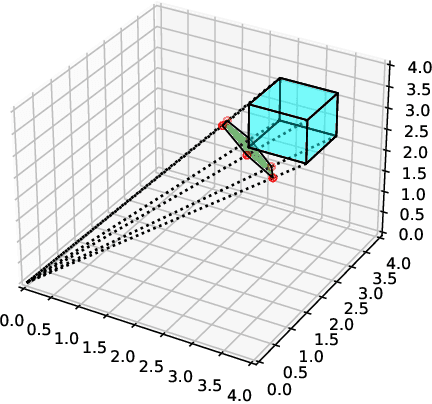
Perception, Planning, and Control form the essential components of autonomy in advanced air mobility. This work advances the holistic integration of these components to enhance the performance and robustness of the complete cyber-physical system. We adapt Perception Simplex, a system for verifiable collision avoidance amidst obstacle detection faults, to the vertical landing maneuver for autonomous air mobility vehicles. We improve upon this system by replacing static assumptions of control capabilities with dynamic confirmation, i.e., real-time confirmation of control limitations of the system, ensuring reliable fulfillment of safety maneuvers and overrides, without dependence on overly pessimistic assumptions. Parameters defining control system capabilities and limitations, e.g., maximum deceleration, are continuously tracked within the system and used to make safety-critical decisions. We apply these techniques to propose a verifiable collision avoidance solution for autonomous aerial mobility vehicles operating in cluttered and potentially unsafe environments.
Certified Robust Control under Adversarial Perturbations
Feb 04, 2023Autonomous systems increasingly rely on machine learning techniques to transform high-dimensional raw inputs into predictions that are then used for decision-making and control. However, it is often easy to maliciously manipulate such inputs and, as a result, predictions. While effective techniques have been proposed to certify the robustness of predictions to adversarial input perturbations, such techniques have been disembodied from control systems that make downstream use of the predictions. We propose the first approach for composing robustness certification of predictions with respect to raw input perturbations with robust control to obtain certified robustness of control to adversarial input perturbations. We use a case study of adaptive vehicle control to illustrate our approach and show the value of the resulting end-to-end certificates through extensive experiments.
RRT Guided Model Predictive Path Integral Method
Jan 30, 2023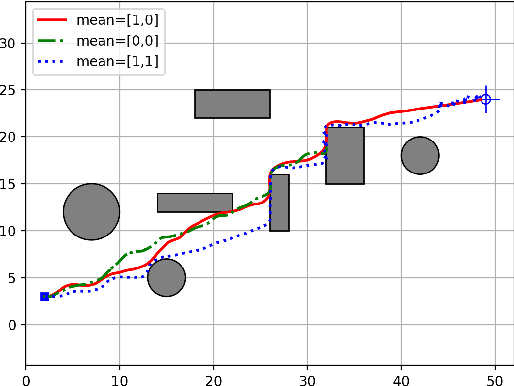
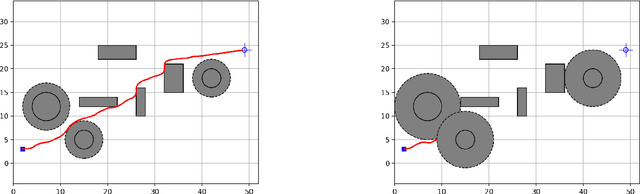
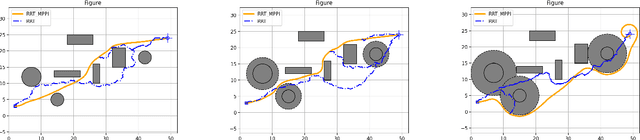
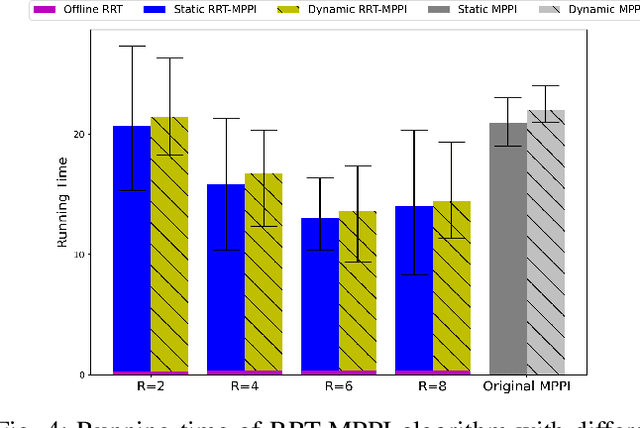
This work presents an optimal sampling-based method to solve the real-time motion planning problem in static and dynamic environments, exploiting the Rapid-exploring Random Trees (RRT) algorithm and the Model Predictive Path Integral (MPPI) algorithm. The RRT algorithm provides a nominal mean value of the random control distribution in the MPPI algorithm, resulting in satisfactory control performance in static and dynamic environments without a need for fine parameter tuning. We also discuss the importance of choosing the right mean of the MPPI algorithm, which balances exploration and optimality gap, given a fixed sample size. In particular, a sufficiently large mean is required to explore the state space enough, and a sufficiently small mean is required to guarantee that the samples reconstruct the optimal controls. The proposed methodology automates the procedure of choosing the right mean by incorporating the RRT algorithm. The simulations demonstrate that the proposed algorithm can solve the motion planning problem in real-time for static or dynamic environments.
Synergistic Redundancy: Towards Verifiable Safety for Autonomous Vehicles
Sep 04, 2022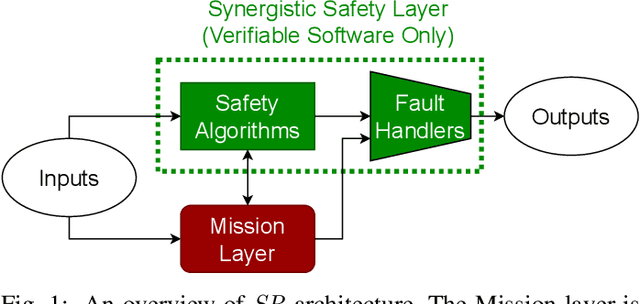
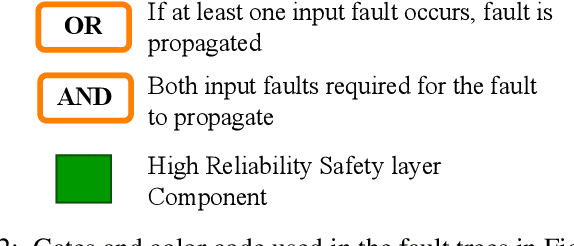
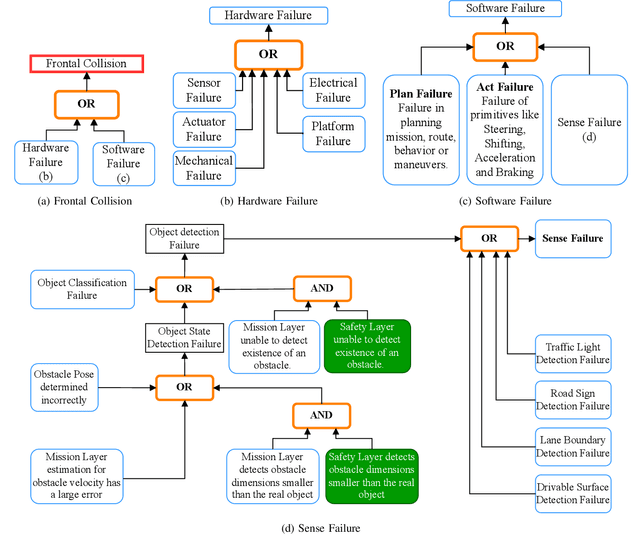
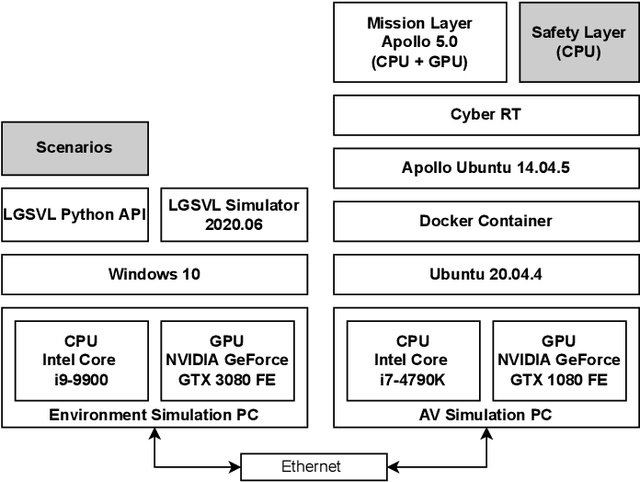
As Autonomous Vehicle (AV) development has progressed, concerns regarding the safety of passengers and agents in their environment have risen. Each real world traffic collision involving autonomously controlled vehicles has compounded this concern. Open source autonomous driving implementations show a software architecture with complex interdependent tasks, heavily reliant on machine learning and Deep Neural Networks (DNN), which are vulnerable to non deterministic faults and corner cases. These complex subsystems work together to fulfill the mission of the AV while also maintaining safety. Although significant improvements are being made towards increasing the empirical reliability and confidence in these systems, the inherent limitations of DNN verification create an, as yet, insurmountable challenge in providing deterministic safety guarantees in AV. We propose Synergistic Redundancy (SR), a safety architecture for complex cyber physical systems, like AV. SR provides verifiable safety guarantees against specific faults by decoupling the mission and safety tasks of the system. Simultaneous to independently fulfilling their primary roles, the partially functionally redundant mission and safety tasks are able to aid each other, synergistically improving the combined system. The synergistic safety layer uses only verifiable and logically analyzable software to fulfill its tasks. Close coordination with the mission layer allows easier and early detection of safety critical faults in the system. SR simplifies the mission layer's optimization goals and improves its design. SR provides safe deployment of high performance, although inherently unverifiable, machine learning software. In this work, we first present the design and features of the SR architecture and then evaluate the efficacy of the solution, focusing on the crucial problem of obstacle existence detection faults in AV.