 Add to Chrome
 Add to Firefox
 Add to Edge
Ling and Ring 2.6 Technical Report: Efficient and Instant Agentic Intelligence at Trillion-Parameter Scale
Jun 13, 2026
Efficient and scalable agentic intelligence requires models that can deliver both low-latency responses and strong reasoning capabilities while remaining practical to train, serve, and deploy. In this report, we present Ling-2.6 and Ring-2.6, a family of models designed to address this challenge at scale. Ling-2.6 is optimized for instant response generation and high capability per output token, whereas Ring-2.6 is tailored for deeper reasoning and more advanced agentic workflows. Instead of training from scratch, we upgrade the Ling-2.0 base model through architectural migration pre-training and large-scale post-training. This upgrade is guided by a unified co-design of model architecture, optimization objectives, serving systems, and agent training environments, enabling improvements in both model capability and deployment efficiency. At the architectural level, we introduce a hybrid linear attention design that integrates Lightning Attention with MLA, improving the efficiency of long-context training and decoding. To further enhance token efficiency, we optimize capability per output token through Evolutionary Chain-of-Thought, Linguistic Unit Policy Optimization, bidirectional preference alignment, and shortest-correct-response distillation. For agentic capabilities, we propose KPop, a reinforcement learning framework designed to support stable training of Ring-2.6-1T on large-scale environment-grounded data. KPop improves training efficiency through asynchronous scheduling across coding, search, tool use, and workflow execution, enabling scalable learning from complex agent-environment interactions. Together, Ling-2.6 and Ring-2.6 provide a practical pathway toward efficient, scalable, and open agentic systems. We open-source all checkpoints in the 2.6 family to support further research and development in practical agentic intelligence.

Closed Loop Dynamic Driving Data Mixture for Real-Synthetic Co-Training
May 20, 2026Data scaling is fundamental to modern deep learning, and grows increasingly critical as autonomous driving shifts to end-to-end learning. Real-world driving data is expensive to annotate and scene-biased, making real-synthetic co-training with near-infinite synthetic data a promising direction. However, naively incorporating all available synthetic data is inefficient and leads to distribution shifts, and optimizing data mixture under practical training budgets remains a critical yet under-explored problem. In this sense, we claim that the mixture of training data requires clear guidance in terms of scene types and quantities. Particularly in this work, we conceptualize the data mixture approximately as a dynamic optimization process that iteratively adjusts the training data mixture to maximize model performance, guided by closed-loop evaluation feedback, and propose AutoScale, a fully automated closed-loop data engine unifying scene representation, data mixture optimization and retrieval, as well as model training and evaluation. Specifically, we propose Graph Regularized AutoEncoder (Graph-RAE) for driving scene representations, introduce Cluster-aware Gradient Ascent (Cluster-GA) for cluster-wise importance estimation and reweighting, and perform cluster-guided vector retrieval to select high-value samples. Experiments on NavSim demonstrate that AutoScale outperforms vanilla co-training and cross-domain baselines, achieving better performance with fewer synthetic samples under constrained budgets.
Learning Cooperative Trajectory Representations for Motion Forecasting
Nov 01, 2023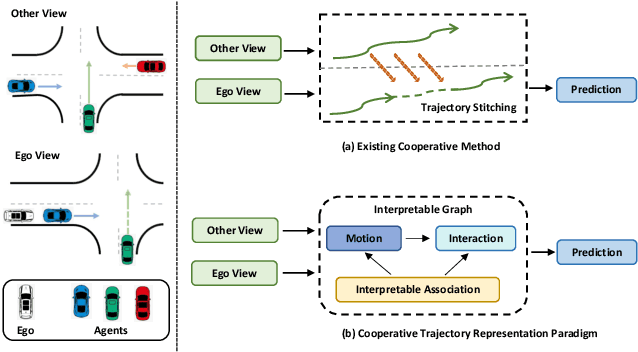
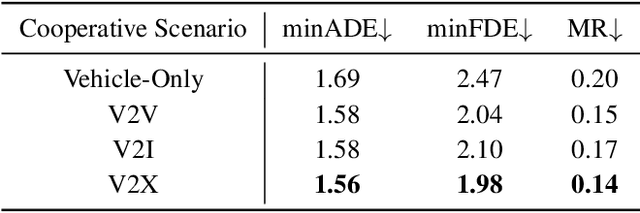
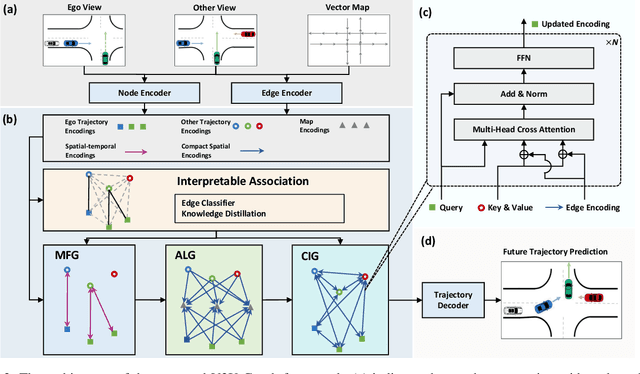
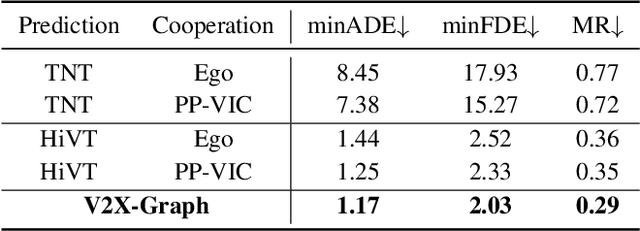
Motion forecasting is an essential task for autonomous driving, and the effective information utilization from infrastructure and other vehicles can enhance motion forecasting capabilities. Existing research have primarily focused on leveraging single-frame cooperative information to enhance the limited perception capability of the ego vehicle, while underutilizing the motion and interaction information of traffic participants observed from cooperative devices. In this paper, we first propose the cooperative trajectory representations learning paradigm. Specifically, we present V2X-Graph, the first interpretable and end-to-end learning framework for cooperative motion forecasting. V2X-Graph employs an interpretable graph to fully leverage the cooperative motion and interaction contexts. Experimental results on the vehicle-to-infrastructure (V2I) motion forecasting dataset, V2X-Seq, demonstrate the effectiveness of V2X-Graph. To further evaluate on V2X scenario, we construct the first real-world vehicle-to-everything (V2X) motion forecasting dataset V2X-Traj, and the performance shows the advantage of our method. We hope both V2X-Graph and V2X-Traj can facilitate the further development of cooperative motion forecasting. Find project at https://github.com/AIR-THU/V2X-Graph, find data at https://github.com/AIR-THU/DAIR-V2X-Seq.
V2X-Seq: A Large-Scale Sequential Dataset for Vehicle-Infrastructure Cooperative Perception and Forecasting
May 10, 2023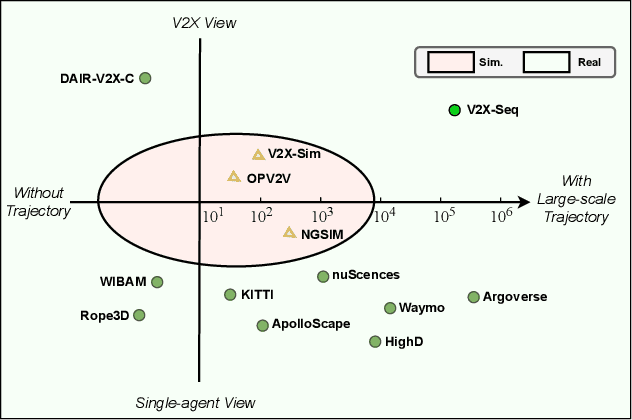
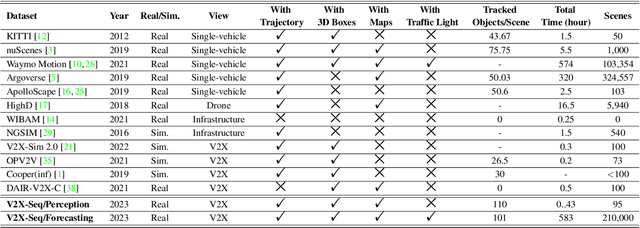
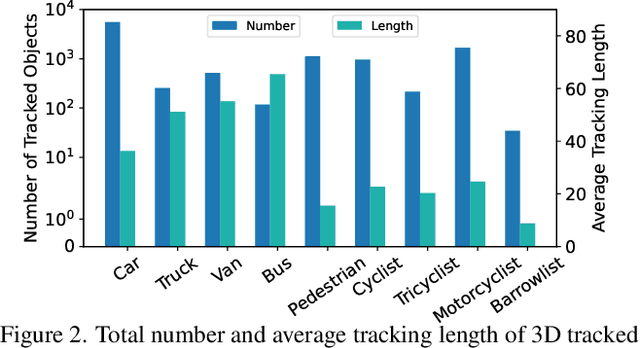
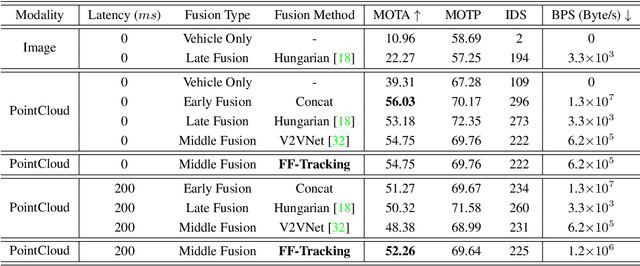
Utilizing infrastructure and vehicle-side information to track and forecast the behaviors of surrounding traffic participants can significantly improve decision-making and safety in autonomous driving. However, the lack of real-world sequential datasets limits research in this area. To address this issue, we introduce V2X-Seq, the first large-scale sequential V2X dataset, which includes data frames, trajectories, vector maps, and traffic lights captured from natural scenery. V2X-Seq comprises two parts: the sequential perception dataset, which includes more than 15,000 frames captured from 95 scenarios, and the trajectory forecasting dataset, which contains about 80,000 infrastructure-view scenarios, 80,000 vehicle-view scenarios, and 50,000 cooperative-view scenarios captured from 28 intersections' areas, covering 672 hours of data. Based on V2X-Seq, we introduce three new tasks for vehicle-infrastructure cooperative (VIC) autonomous driving: VIC3D Tracking, Online-VIC Forecasting, and Offline-VIC Forecasting. We also provide benchmarks for the introduced tasks. Find data, code, and more up-to-date information at \href{https://github.com/AIR-THU/DAIR-V2X-Seq}{https://github.com/AIR-THU/DAIR-V2X-Seq}.