 Add to Chrome
 Add to Firefox
 Add to Edge
Learning Smooth and Robust Space Robotic Manipulation of Dynamic Target via Inter-frame Correlation
Mar 29, 2026
On-orbit servicing represents a critical frontier in future aerospace engineering, with the manipulation of dynamic non-cooperative targets serving as a key technology. In microgravity environments, objects are typically free-floating, lacking the support and frictional constraints found on Earth, which significantly escalates the complexity of tasks involving space robotic manipulation. Conventional planning and control-based methods are primarily limited to known, static scenarios and lack real-time responsiveness. To achieve precise robotic manipulation of dynamic targets in unknown and unstructured space environments, this letter proposes a data-driven space robotic manipulation approach that integrates historical temporal information and inter-frame correlation mechanisms. By exploiting the temporal correlation between historical and current frames, the system can effectively capture motion features within the scene, thereby producing stable and smooth manipulation trajectories for dynamic targets. To validate the effectiveness of the proposed method, we developed a ground-based experimental platform consisting of a PIPER X robotic arm and a dual-axis linear stage, which accurately simulates micro-gravity free-floating motion in a 2D plane.

LLM-based MOFs Synthesis Condition Extraction using Few-Shot Demonstrations
Aug 06, 2024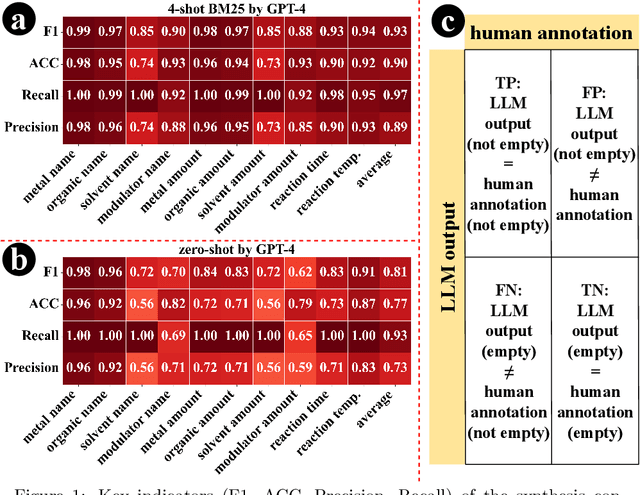
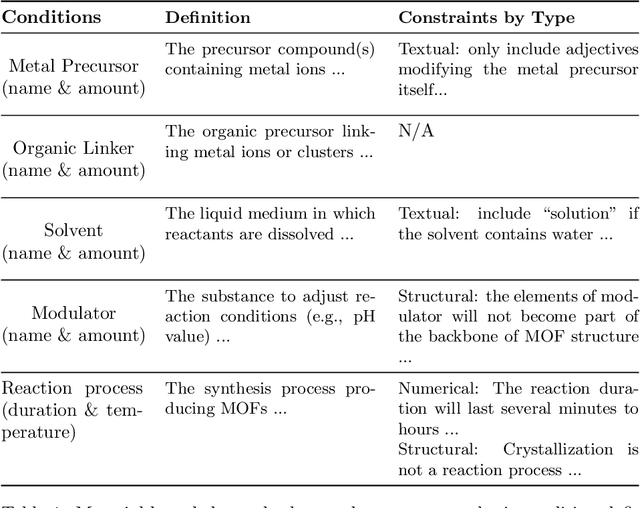
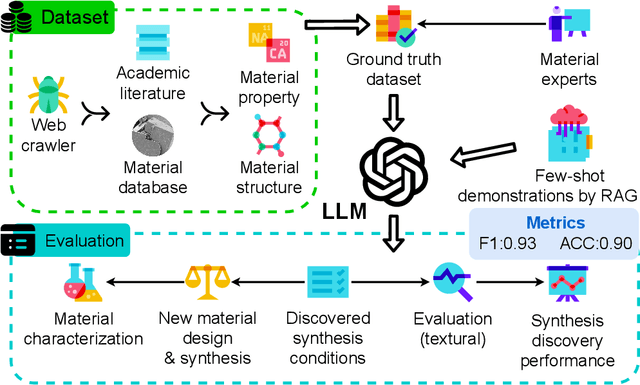
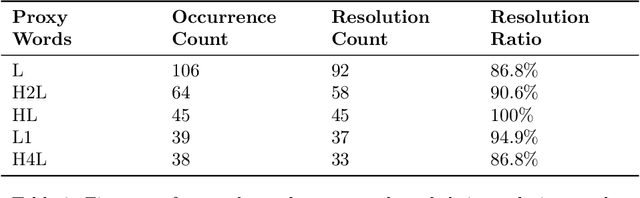
The extraction of Metal-Organic Frameworks (MOFs) synthesis conditions from literature text has been challenging but crucial for the logical design of new MOFs with desirable functionality. The recent advent of large language models (LLMs) provides disruptively new solution to this long-standing problem and latest researches have reported over 90% F1 in extracting correct conditions from MOFs literature. We argue in this paper that most existing synthesis extraction practices with LLMs stay with the primitive zero-shot learning, which could lead to downgraded extraction and application performance due to the lack of specialized knowledge. This work pioneers and optimizes the few-shot in-context learning paradigm for LLM extraction of material synthesis conditions. First, we propose a human-AI joint data curation process to secure high-quality ground-truth demonstrations for few-shot learning. Second, we apply a BM25 algorithm based on the retrieval-augmented generation (RAG) technique to adaptively select few-shot demonstrations for each MOF's extraction. Over a dataset randomly sampled from 84,898 well-defined MOFs, the proposed few-shot method achieves much higher average F1 performance (0.93 vs. 0.81, +14.8%) than the native zero-shot LLM using the same GPT-4 model, under fully automatic evaluation that are more objective than the previous human evaluation. The proposed method is further validated through real-world material experiments: compared with the baseline zero-shot LLM, the proposed few-shot approach increases the MOFs structural inference performance (R^2) by 29.4% in average.