 Add to Chrome
 Add to Firefox
 Add to Edge
DisCo: World Models with Discrete Camera Motion Control
Jun 06, 2026
Controllable video world models target interactive world exploration, where models must faithfully execute explicit action commands while preserving visual quality and temporal coherence. However, most existing approaches rely on continuous camera trajectories as action conditions, which often lead to unreliable action following, especially under complex motion sequences. In this work, we identify action representation entanglement as a key bottleneck in controllable video generation, and show that continuous camera representations lead to high feature similarity across distinct motion patterns, degrading action controllability. Based on this insight, we propose DisCo, a controllable video world model that conditions generation on a compact set of discrete action primitives to improve action separability. We further introduce DisCoBench, a comprehensive benchmark for evaluating the ability of models in short-term, long-horizon, and highly dynamic exploration scenarios. Extensive experiments demonstrate that DisCo achieves significantly more reliable action following while preserving visual quality.

Evolution of Video Generative Foundations
Apr 07, 2026The rapid advancement of Artificial Intelligence Generated Content (AIGC) has revolutionized video generation, enabling systems ranging from proprietary pioneers like OpenAI's Sora, Google's Veo3, and Bytedance's Seedance to powerful open-source contenders like Wan and HunyuanVideo to synthesize temporally coherent and semantically rich videos. These advancements pave the way for building "world models" that simulate real-world dynamics, with applications spanning entertainment, education, and virtual reality. However, existing reviews on video generation often focus on narrow technical fields, e.g., Generative Adversarial Networks (GAN) and diffusion models, or specific tasks (e. g., video editing), lacking a comprehensive perspective on the field's evolution, especially regarding Auto-Regressive (AR) models and integration of multimodal information. To address these gaps, this survey firstly provides a systematic review of the development of video generation technology, tracing its evolution from early GANs to dominant diffusion models, and further to emerging AR-based and multimodal techniques. We conduct an in-depth analysis of the foundational principles, key advancements, and comparative strengths/limitations. Then, we explore emerging trends in multimodal video generation, emphasizing the integration of diverse data types to enhance contextual awareness. Finally, by bridging historical developments and contemporary innovations, this survey offers insights to guide future research in video generation and its applications, including virtual/augmented reality, personalized education, autonomous driving simulations, digital entertainment, and advanced world models, in this rapidly evolving field. For more details, please refer to the project at https://github.com/sjtuplayer/Awesome-Video-Foundations.
SaRA: High-Efficient Diffusion Model Fine-tuning with Progressive Sparse Low-Rank Adaptation
Sep 10, 2024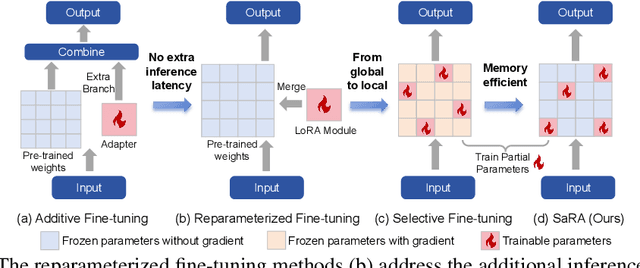
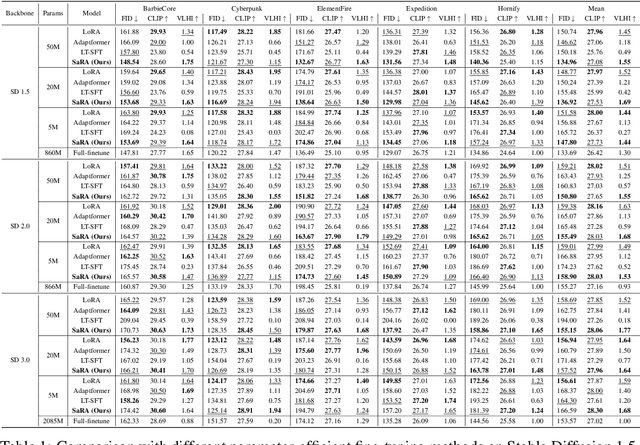
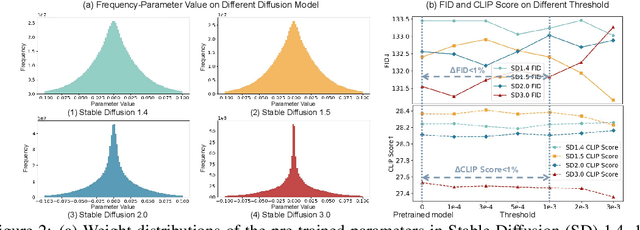
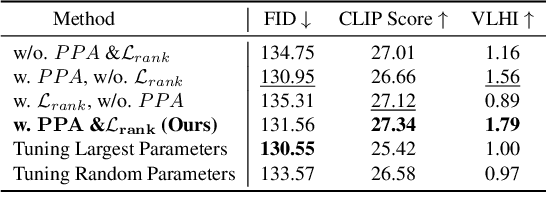
In recent years, the development of diffusion models has led to significant progress in image and video generation tasks, with pre-trained models like the Stable Diffusion series playing a crucial role. Inspired by model pruning which lightens large pre-trained models by removing unimportant parameters, we propose a novel model fine-tuning method to make full use of these ineffective parameters and enable the pre-trained model with new task-specified capabilities. In this work, we first investigate the importance of parameters in pre-trained diffusion models, and discover that the smallest 10% to 20% of parameters by absolute values do not contribute to the generation process. Based on this observation, we propose a method termed SaRA that re-utilizes these temporarily ineffective parameters, equating to optimizing a sparse weight matrix to learn the task-specific knowledge. To mitigate overfitting, we propose a nuclear-norm-based low-rank sparse training scheme for efficient fine-tuning. Furthermore, we design a new progressive parameter adjustment strategy to make full use of the re-trained/finetuned parameters. Finally, we propose a novel unstructural backpropagation strategy, which significantly reduces memory costs during fine-tuning. Our method enhances the generative capabilities of pre-trained models in downstream applications and outperforms traditional fine-tuning methods like LoRA in maintaining model's generalization ability. We validate our approach through fine-tuning experiments on SD models, demonstrating significant improvements. SaRA also offers a practical advantage that requires only a single line of code modification for efficient implementation and is seamlessly compatible with existing methods.
MotionMaster: Training-free Camera Motion Transfer For Video Generation
May 01, 2024

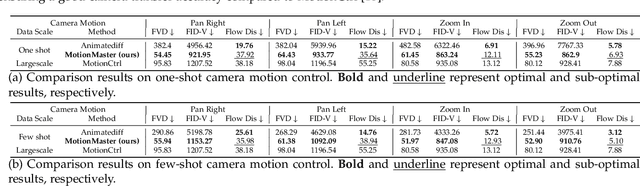

The emergence of diffusion models has greatly propelled the progress in image and video generation. Recently, some efforts have been made in controllable video generation, including text-to-video generation and video motion control, among which camera motion control is an important topic. However, existing camera motion control methods rely on training a temporal camera module, and necessitate substantial computation resources due to the large amount of parameters in video generation models. Moreover, existing methods pre-define camera motion types during training, which limits their flexibility in camera control. Therefore, to reduce training costs and achieve flexible camera control, we propose COMD, a novel training-free video motion transfer model, which disentangles camera motions and object motions in source videos and transfers the extracted camera motions to new videos. We first propose a one-shot camera motion disentanglement method to extract camera motion from a single source video, which separates the moving objects from the background and estimates the camera motion in the moving objects region based on the motion in the background by solving a Poisson equation. Furthermore, we propose a few-shot camera motion disentanglement method to extract the common camera motion from multiple videos with similar camera motions, which employs a window-based clustering technique to extract the common features in temporal attention maps of multiple videos. Finally, we propose a motion combination method to combine different types of camera motions together, enabling our model a more controllable and flexible camera control. Extensive experiments demonstrate that our training-free approach can effectively decouple camera-object motion and apply the decoupled camera motion to a wide range of controllable video generation tasks, achieving flexible and diverse camera motion control.