 Add to Chrome
 Add to Firefox
 Add to Edge
Coverage-Driven RTL Assertion Generation with Formal Exploration and Neuro-Symbolic Refinement
Aug 19, 2026
Hardware functional verification relies on high-quality assertions to expose design bugs and establish confidence in Register Transfer Level (RTL) designs. Yet existing assertion mining methods still struggle to produce complete and reliable assertion sets: random or limited traces fail to cover hard-to-reach behaviors, and one-shot generation provides little feedback about what remains unverified or how the assertion set should be improved. As a result, critical design behaviors can remain uncovered even when many assertions are generated. We present NeuroAssertion, a coverage-driven assertion generation framework that combines formal trace generation, syntax-guided synthesis (SyGuS), and an agent-inspired refinement process within a unified framework. Our framework first converts hard-to-reach control-flow conditions into formal reachability objectives, uses model checking to generate behaviorally diverse traces, and mines initial assertions from these traces with SyGuS. It then performs targeted agent-inspired refinement under verification feedback: one LLM first proposes candidate assertions for uncovered regions, and if a candidate fails formal checking, a second LLM generates a repair grammar that guides constrained symbolic synthesis in a neuro-symbolic repair procedure. Experimental results show that this framework delivers around 2X more assertions and about 2X higher mutation coverage than traditional assertion mining methods.

NeuroAbs: A Neuro-Symbolic RTL Abstraction Framework for Property Checking Acceleration
Aug 18, 2026Formal verification is a crucial technique for ensuring the functional correctness of hardware designs. In the context of property checking, a key challenge is how to efficiently prove a user-specified property in the face of increasingly complex RTL designs. To address this challenge, abstraction techniques are often employed to reduce system complexity and accelerate the verification process. However, prior RTL abstraction methods either require significant manual effort or rely on rule-based techniques that lack flexibility. This paper introduces NeuroAbs, a neuro-symbolic framework for RTL abstraction. NeuroAbs first uses LLM-assisted RTL analysis to identify signals suitable for abstraction. It then combines LLM-based abstraction with an AST-based symbolic RTL representation to better align the generated abstraction with the intended transformation. The soundness of each abstraction is checked using satisfiability modulo theories (SMT) solving. If the abstraction is too coarse for a successful proof, NeuroAbs applies counterexample-guided abstraction refinement (CEGAR) to iteratively refine the model. Experimental results show that NeuroAbs significantly improves the efficiency of hardware property checking across a range of verification tasks.
A-IC3: Learning-Guided Adaptive Inductive Generalization for Hardware Model Checking
Apr 23, 2026The IC3 algorithm represents the state-of-the-art (SOTA) hardware model checking technique, owing to its robust performance and scalability. A significant body of research has focused on enhancing the solving efficiency of the IC3 algorithm, with particular attention to the inductive generalization process: a critical phase wherein the algorithm seeks to generalize a counterexample to inductiveness (CTI), which typically is a state leading to a bad state, into a broader set of states. This inductive generalization is a primary source of clauses in IC3 and thus plays a pivotal role in determining the overall effectiveness of the algorithm. Despite its importance, existing approaches often rely on fixed inductive generalization strategies, overlooking the dynamic and context-sensitive nature of the verification environment in which spurious counterexamples arise. This rigidity can limit the quality of generated clauses and, consequently, the performance of IC3. To address this limitation, we propose a lightweight machine-learning-based framework that dynamically selects appropriate inductive generalization strategies in response to the evolving verification context. Specifically, we employ a multi-armed bandit (MAB) algorithm to adaptively choose inductive generalization strategies based on real-time feedback from the verification process. The agent is updated by evaluating the quality of generalization outcomes, thereby refining its strategy selection over time. Empirical evaluation on a benchmark suite comprising 914 instances, primarily drawn from the latest HWMCC collection, demonstrates the efficacy of our approach. When implemented on the state-of-the-art model checker rIC3, our method solves 26 to 50 more cases than the baselines and improves the PAR-2 score by 194.72 to 389.29.
EvolveGen: Algorithmic Level Hardware Model Checking Benchmark Generation through Reinforcement Learning
Feb 26, 2026Progress in hardware model checking depends critically on high-quality benchmarks. However, the community faces a significant benchmark gap: existing suites are limited in number, often distributed only in representations such as BTOR2 without access to the originating register-transfer-level (RTL) designs, and biased toward extreme difficulty where instances are either trivial or intractable. These limitations hinder rigorous evaluation of new verification techniques and encourage overfitting of solver heuristics to a narrow set of problems. To address this, we introduce EvolveGen, a framework for generating hardware model checking benchmarks by combining reinforcement learning (RL) with high-level synthesis (HLS). Our approach operates at an algorithmic level of abstraction in which an RL agent learns to construct computation graphs. By compiling these graphs under different synthesis directives, we produce pairs of functionally equivalent but structurally distinct hardware designs, inducing challenging model checking instances. Solver runtime is used as the reward signal, enabling the agent to autonomously discover and generate small-but-hard instances that expose solver-specific weaknesses. Experiments show that EvolveGen efficiently creates a diverse benchmark set in standard formats (e.g., AIGER and BTOR2) and effectively reveals performance bottlenecks in state-of-the-art model checkers.
ReVEAL: GNN-Guided Reverse Engineering for Formal Verification of Optimized Multipliers
Dec 24, 2025We present ReVEAL, a graph-learning-based method for reverse engineering of multiplier architectures to improve algebraic circuit verification techniques. Our framework leverages structural graph features and learning-driven inference to identify architecture patterns at scale, enabling robust handling of large optimized multipliers. We demonstrate applicability across diverse multiplier benchmarks and show improvements in scalability and accuracy compared to traditional rule-based approaches. The method integrates smoothly with existing verification flows and supports downstream algebraic proof strategies.
BDD2Seq: Enabling Scalable Reversible-Circuit Synthesis via Graph-to-Sequence Learning
Nov 11, 2025Binary Decision Diagrams (BDDs) are instrumental in many electronic design automation (EDA) tasks thanks to their compact representation of Boolean functions. In BDD-based reversible-circuit synthesis, which is critical for quantum computing, the chosen variable ordering governs the number of BDD nodes and thus the key metrics of resource consumption, such as Quantum Cost. Because finding an optimal variable ordering for BDDs is an NP-complete problem, existing heuristics often degrade as circuit complexity grows. We introduce BDD2Seq, a graph-to-sequence framework that couples a Graph Neural Network encoder with a Pointer-Network decoder and Diverse Beam Search to predict high-quality orderings. By treating the circuit netlist as a graph, BDD2Seq learns structural dependencies that conventional heuristics overlooked, yielding smaller BDDs and faster synthesis. Extensive experiments on three public benchmarks show that BDD2Seq achieves around 1.4 times lower Quantum Cost and 3.7 times faster synthesis than modern heuristic algorithms. To the best of our knowledge, this is the first work to tackle the variable-ordering problem in BDD-based reversible-circuit synthesis with a graph-based generative model and diversity-promoting decoding.
NetTAG: A Multimodal RTL-and-Layout-Aligned Netlist Foundation Model via Text-Attributed Graph
Apr 12, 2025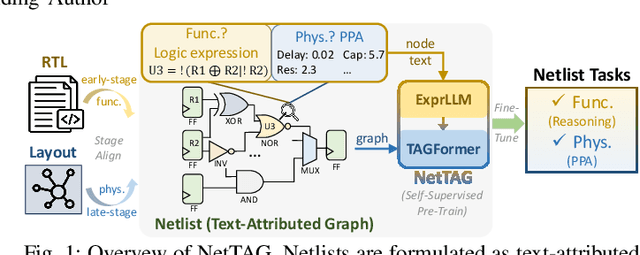
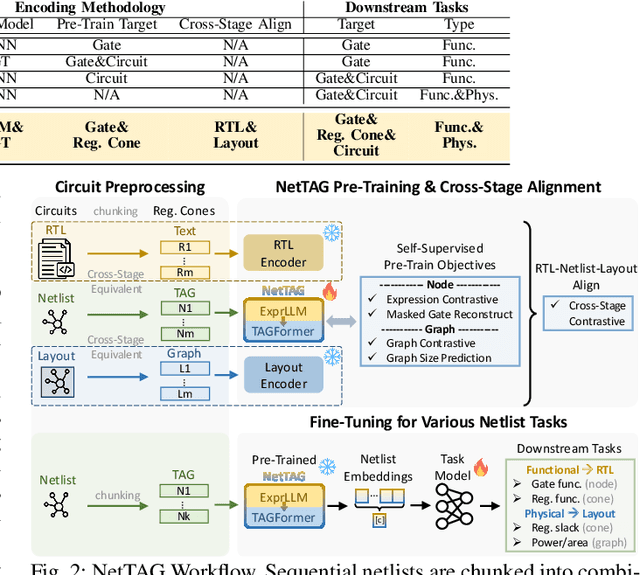
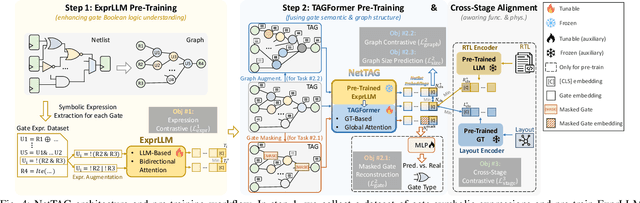
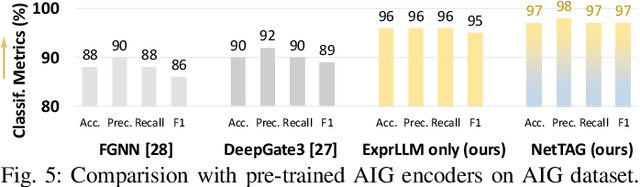
Circuit representation learning has shown promise in advancing Electronic Design Automation (EDA) by capturing structural and functional circuit properties for various tasks. Existing pre-trained solutions rely on graph learning with complex functional supervision, such as truth table simulation. However, they only handle simple and-inverter graphs (AIGs), struggling to fully encode other complex gate functionalities. While large language models (LLMs) excel at functional understanding, they lack the structural awareness for flattened netlists. To advance netlist representation learning, we present NetTAG, a netlist foundation model that fuses gate semantics with graph structure, handling diverse gate types and supporting a variety of functional and physical tasks. Moving beyond existing graph-only methods, NetTAG formulates netlists as text-attributed graphs, with gates annotated by symbolic logic expressions and physical characteristics as text attributes. Its multimodal architecture combines an LLM-based text encoder for gate semantics and a graph transformer for global structure. Pre-trained with gate and graph self-supervised objectives and aligned with RTL and layout stages, NetTAG captures comprehensive circuit intrinsics. Experimental results show that NetTAG consistently outperforms each task-specific method on four largely different functional and physical tasks and surpasses state-of-the-art AIG encoders, demonstrating its versatility.
Addressing Variable Dependency in GNN-based SAT Solving
Apr 18, 2023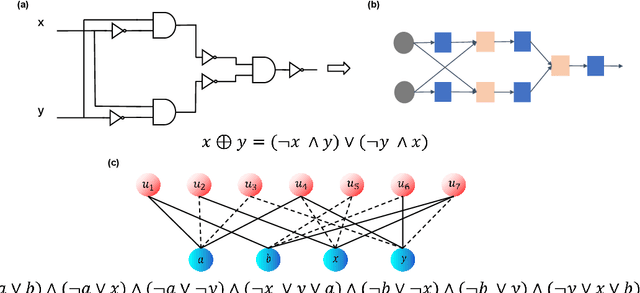
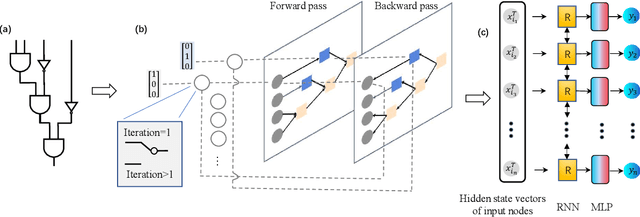
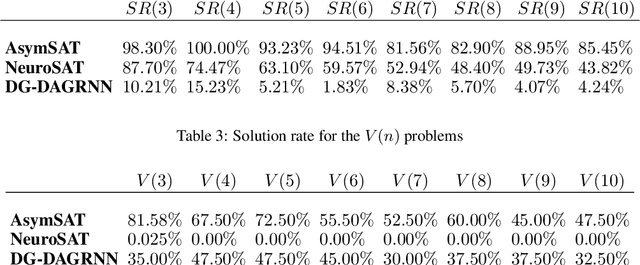

Boolean satisfiability problem (SAT) is fundamental to many applications. Existing works have used graph neural networks (GNNs) for (approximate) SAT solving. Typical GNN-based end-to-end SAT solvers predict SAT solutions concurrently. We show that for a group of symmetric SAT problems, the concurrent prediction is guaranteed to produce a wrong answer because it neglects the dependency among Boolean variables in SAT problems. % We propose AsymSAT, a GNN-based architecture which integrates recurrent neural networks to generate dependent predictions for variable assignments. The experiment results show that dependent variable prediction extends the solving capability of the GNN-based method as it improves the number of solved SAT instances on large test sets.