 Add to Chrome
 Add to Firefox
 Add to Edge
RTL-Sequencer: Towards Scalable RTL Timing Prediction with the Sequence-based Paradigm
Jul 17, 2026
Accurate timing prediction at the register-transfer level (RTL) is a longstanding challenge in design automation. Existing graph-based methods struggle with limited receptive fields, high complexity, and a lack of signal directionality. We present RTL-Sequencer, a novel sequence-based paradigm that enables scalable RTL timing prediction via linearizing logic cones by breadth-first traversal and applying modern linear sequence models. Furthermore, sequence models are customized by four synergistic techniques, including sequence shuffling, bidirectional modeling, differentiable modeling, and a hybrid graph-sequence architecture. Extensive experiments demonstrate significant improvements of RTL-Sequencer over state-of-the-art baselines, advancing early-stage timing optimization.

RTL-BenchLS: A Large-Scale Benchmark for RTL Reasoning and Generation with Large Language Models
Jun 08, 2026LLM-based RTL generation and reasoning is a promising direction for hardware design automation. High-quality benchmarks are critical infrastructure for tracking progress in this direction. However, existing RTL benchmarks face inherent limitations in both scale and task scope. The designs they cover are typically small and simple, and the tasks focus almost entirely on specification-to-RTL generation. Frontier models' performance already saturates on the existing benchmarks. Scaling these benchmarks up is fundamentally difficult because aligned labels are required for benchmarking, such as specifications and testbenches. Such aligned high-quality data are rarely available for real-world designs. We introduce RTL-BenchLS, a large-scale benchmark addressing both limitations above. It contains over 10,000 formally verified Verilog designs, covering substantially larger and more complex designs than existing benchmarks. Beyond specification-to-RTL generation, we propose three novel tasks that jointly evaluate reasoning and generation: round-trip reasoning, masked-content reasoning, and repository-issue reasoning. The first two are self-supervised, which directly resolves the scaling bottleneck. All tasks are verified through formal equivalence checking without any manual testbenches. We evaluate eight LLMs on RTL-BenchLS. Even the best model reaches only 23% on natural-language round-trip reasoning, 28% on masked-content reasoning, and 12% on repository-issue fixing. RTL-BenchLS is substantially more challenging than existing benchmarks. It leaves ample room for future improvement and offers guidance for developing LLM-based methods for hardware design.
AssertLLM2: A Comprehensive LLM Benchmark for Assertion Generation from Design Specifications
May 26, 2026Assertion-based verification (ABV) is a cornerstone of modern hardware design, yet manually translating design intent into formal SystemVerilog Assertions (SVAs) remains labor-intensive and error-prone. While Large Language Models (LLMs) show promise for automating this process, existing benchmarks remain limited by unrealistic task formulations, weak specification inputs, and oversimplified evaluation. To address these limitations, we introduce AssertLLM2, an open-source benchmark for realistic assertion generation in hardware verification. AssertLLM2 contains 83 real-world designs across 13 functional categories. For each design, the benchmark provides a structured design specification, a verified dependency-complete golden RTL, and systematically mutated buggy RTL variants. These support two practical settings: bug-prevention, where assertions are generated from specifications to guard against design errors, and bug-hunting, where assertions are generated to expose discrepancies between intended behavior and faulty implementations. To the best of our knowledge, AssertLLM2 is the first benchmark to explicitly use buggy RTL as input to evaluate bug-detection capability. AssertLLM2 further adopts a more rigorous evaluation framework spanning syntactic validity, formal provability, coverage, and mutation-based bug detection. Our benchmark enables a more realistic and extensive assessment of assertion generation and establishes rigorous baselines for state-of-the-art LLMs in practical hardware verification.
Dr.~RTL: Autonomous Agentic RTL Optimization through Tool-Grounded Self-Improvement
Apr 16, 2026Recent advances in large language models (LLMs) have sparked growing interest in automatic RTL optimization for better performance, power, and area (PPA). However, existing methods are still far from realistic RTL optimization. Their evaluation settings are often unrealistic: they are tested on manually degraded, small-scale RTL designs and rely on weak open-source tools. Their optimization methods are also limited, relying on coarse design-level feedback and simple pre-defined rewriting rules. To address these limitations, we present Dr. RTL, an agentic framework for RTL timing optimization in a realistic evaluation environment, with continual self-improvement through reusable optimization skills. We establish a realistic evaluation setting with more challenging RTL designs and an industrial EDA workflow. Within this setting, Dr. RTL performs closed-loop optimization through a multi-agent framework for critical-path analysis, parallel RTL rewriting, and tool-based evaluation. We further introduce group-relative skill learning, which compares parallel RTL rewrites and distills the optimization experience into an interpretable skill library. Currently, this library contains 47 pattern--strategy entries for cross-design reuse to improve PPA and accelerate convergence, and it can continue evolving over time. Evaluated on 20 real-world RTL designs, Dr. RTL achieves average WNS/TNS improvements of 21\%/17\% with a 6\% area reduction over the industry-leading commercial synthesis tool.
A New Benchmark for the Appropriate Evaluation of RTL Code Optimization
Jan 05, 2026The rapid progress of artificial intelligence increasingly relies on efficient integrated circuit (IC) design. Recent studies have explored the use of large language models (LLMs) for generating Register Transfer Level (RTL) code, but existing benchmarks mainly evaluate syntactic correctness rather than optimization quality in terms of power, performance, and area (PPA). This work introduces RTL-OPT, a benchmark for assessing the capability of LLMs in RTL optimization. RTL-OPT contains 36 handcrafted digital designs that cover diverse implementation categories including combinational logic, pipelined datapaths, finite state machines, and memory interfaces. Each task provides a pair of RTL codes, a suboptimal version and a human-optimized reference that reflects industry-proven optimization patterns not captured by conventional synthesis tools. Furthermore, RTL-OPT integrates an automated evaluation framework to verify functional correctness and quantify PPA improvements, enabling standardized and meaningful assessment of generative models for hardware design optimization.
GenEDA: Unleashing Generative Reasoning on Netlist via Multimodal Encoder-Decoder Aligned Foundation Model
Apr 13, 2025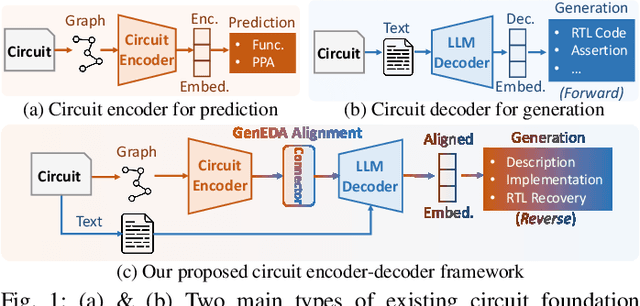
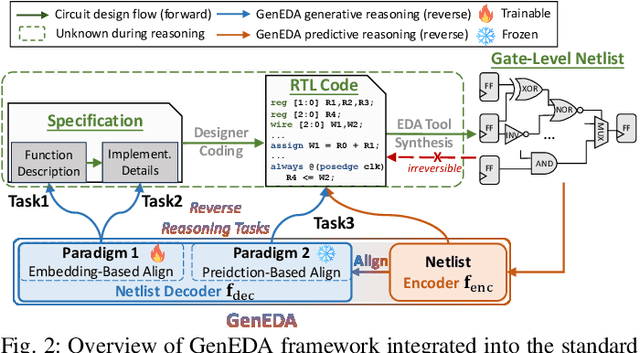
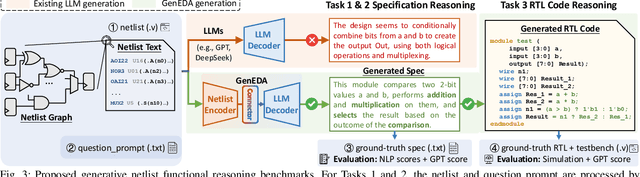
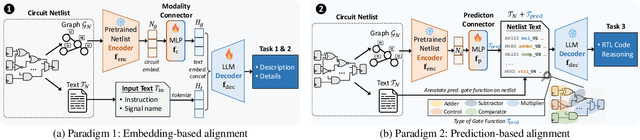
The success of foundation AI has motivated the research of circuit foundation models, which are customized to assist the integrated circuit (IC) design process. However, existing pre-trained circuit models are typically limited to standalone encoders for predictive tasks or decoders for generative tasks. These two model types are developed independently, operate on different circuit modalities, and reside in separate latent spaces, which restricts their ability to complement each other for more advanced applications. In this work, we present GenEDA, the first framework that aligns circuit encoders with decoders within a shared latent space. GenEDA bridges the gap between graph-based circuit representations and text-based large language models (LLMs), enabling communication between their respective latent spaces. To achieve the alignment, we propose two paradigms that support both open-source trainable LLMs and commercial frozen LLMs. Built on this aligned architecture, GenEDA enables three unprecedented generative reasoning tasks over netlists, where the model reversely generates the high-level functionality from low-level netlists in different granularities. These tasks extend traditional gate-type prediction to direct generation of full-circuit functionality. Experiments demonstrate that GenEDA significantly boosts advanced LLMs' (e.g., GPT-4o and DeepSeek-V3) performance in all tasks.
NetTAG: A Multimodal RTL-and-Layout-Aligned Netlist Foundation Model via Text-Attributed Graph
Apr 12, 2025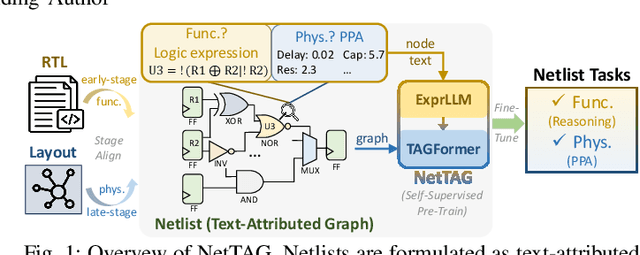
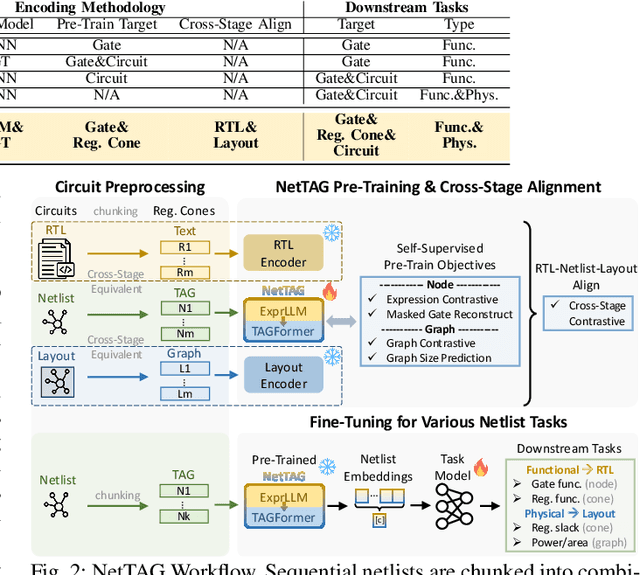
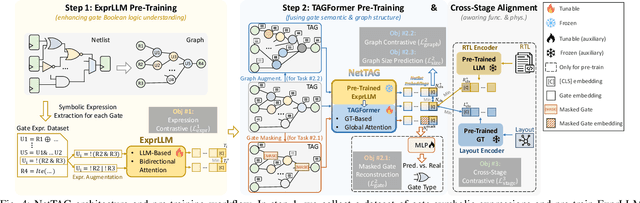
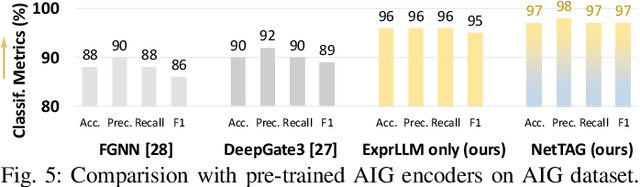
Circuit representation learning has shown promise in advancing Electronic Design Automation (EDA) by capturing structural and functional circuit properties for various tasks. Existing pre-trained solutions rely on graph learning with complex functional supervision, such as truth table simulation. However, they only handle simple and-inverter graphs (AIGs), struggling to fully encode other complex gate functionalities. While large language models (LLMs) excel at functional understanding, they lack the structural awareness for flattened netlists. To advance netlist representation learning, we present NetTAG, a netlist foundation model that fuses gate semantics with graph structure, handling diverse gate types and supporting a variety of functional and physical tasks. Moving beyond existing graph-only methods, NetTAG formulates netlists as text-attributed graphs, with gates annotated by symbolic logic expressions and physical characteristics as text attributes. Its multimodal architecture combines an LLM-based text encoder for gate semantics and a graph transformer for global structure. Pre-trained with gate and graph self-supervised objectives and aligned with RTL and layout stages, NetTAG captures comprehensive circuit intrinsics. Experimental results show that NetTAG consistently outperforms each task-specific method on four largely different functional and physical tasks and surpasses state-of-the-art AIG encoders, demonstrating its versatility.