 Add to Chrome
 Add to Firefox
 Add to Edge
EVA-Bench: A New End-to-end Framework for Evaluating Voice Agents
May 13, 2026
Voice agents, artificial intelligence systems that conduct spoken conversations to complete tasks, are increasingly deployed across enterprise applications. However, no existing benchmark jointly addresses two core evaluation challenges: generating realistic simulated conversations, and measuring quality across the full scope of voice-specific failure modes. We present EVA-Bench, an end-to-end evaluation framework that addresses both. On the simulation side, EVA-Bench orchestrates bot-to-bot audio conversations over dynamic multi-turn dialogues, with automatic simulation validation that detects user simulator error and appropriately regenerates conversations before scoring. On the measurement side, EVA-Bench introduces two composite metrics: EVA-A (Accuracy), capturing task completion, faithfulness, and audio-level speech fidelity; and EVA-X (Experience), capturing conversation progression, spoken conciseness, and turn-taking timing. Both metrics apply to different agent architectures, enabling direct cross-architecture comparison. EVA-Bench includes 213 scenarios across three enterprise domains, a controlled perturbation suite for accent and noise robustness, and pass@1, pass@k, pass^k measurements that distinguish peak from reliable capability. Across 12 systems spanning all three architectures, we find: (1) no system simultaneously exceeds 0.5 on both EVA-A pass@1 and EVA-X pass@1; (2) peak and reliable performance diverge substantially (median pass@k - pass^k gap of 0.44 on EVA-A); and (3) accent and noise perturbations expose substantial robustness gaps, with effects varying across architectures, systems, and metrics (mean up to 0.314). We release the full framework, evaluation suite, and benchmark data under an open-source license.

Azimuth: Systematic Error Analysis for Text Classification
Dec 19, 2022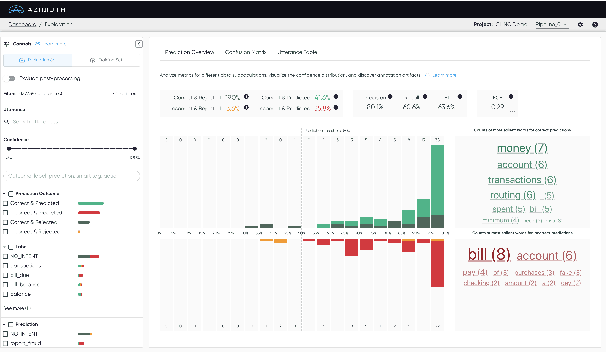

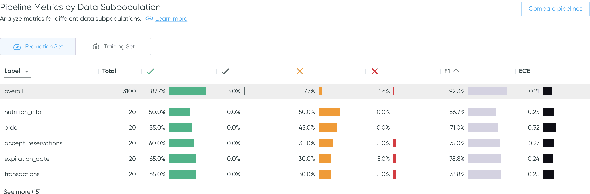
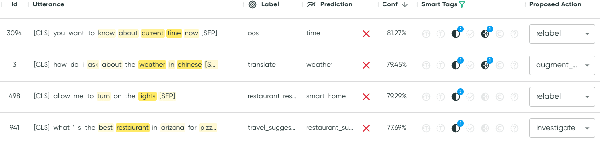
We present Azimuth, an open-source and easy-to-use tool to perform error analysis for text classification. Compared to other stages of the ML development cycle, such as model training and hyper-parameter tuning, the process and tooling for the error analysis stage are less mature. However, this stage is critical for the development of reliable and trustworthy AI systems. To make error analysis more systematic, we propose an approach comprising dataset analysis and model quality assessment, which Azimuth facilitates. We aim to help AI practitioners discover and address areas where the model does not generalize by leveraging and integrating a range of ML techniques, such as saliency maps, similarity, uncertainty, and behavioral analyses, all in one tool. Our code and documentation are available at github.com/servicenow/azimuth.