 Add to Chrome
 Add to Firefox
 Add to Edge
Eureka: Task-Conditioned Meta-Agent Orchestration for Scientific Discovery
Aug 19, 2026
We present Eureka, a task-conditioned Meta-Agent architecture that compiles long-horizon tasks into dynamic obligation graphs with explicit acceptance semantics. During execution, Eureka forms Macro-Agents with specialized state, memory, operators, tools, verifiers, and local topology via receding-horizon planning, architecture promotion, and minimal-sufficient compilation. When bottlenecks recur, cost-benefit-gated evolution updates the local architecture under constraints. Theoretically, we establish results on regret, planning invalidation, amortization, subtree interfaces, serializability, and verification. Experimentally, Eureka completes 170/170 recursive tasks and generates 3,948 certificates with no false acceptances. Active context compresses median input from 9,490 to 4,005 tokens; incremental processing avoids 65.38% recomputation across 12,000 tasks; 16,000 concurrent executions serialize consistently. The same Meta-Agent instantiates a Theory-Discovery Agent and a Math/Conjecture Agent. The former yields structural results in quantum-process and spacetime theory. The latter identifies bottlenecks in Riemann Hypothesis research and advances a positivity certificate for Suzuki's localized Weil quadratic form to 0 < a <= 69/200 = 0.345, reaching ~99.55% of (log 2)/2. These results suggest that scientific-agent capability depends not only on the base model but on whether an architecture can be formed to match the task's cognitive structure.

Your UnEmbedding Matrix is Secretly a Feature Lens for Text Embeddings
Jun 05, 2026Large language models exhibit impressive zero-shot capabilities across a wide range of downstream tasks. However, they struggle to function as off-the-shelf embedding models, leading to suboptimal performance on massive text embedding benchmarks. In this paper, we identify a potential cause underlying this deficiency. Our motivation stems from an unexpected observation: text embeddings tend to align with frequent but uninformative tokens when projected onto the vocabulary space. We argue that this excessive expression of high-frequency tokens suppresses the model's ability to capture nuanced semantics. To address this, we introduce EmbedFilter, a simple linear transformation designed to refine text embeddings derived from LLMs directly. Specifically, we uncover that the unembedding matrix within LLMs encodes a latent space that is actively writing these frequent tokens into embedding space. By filtering out this subspace, EmbedFilter suppress the influence of high-frequency tokens, thereby enhancing semantic representations. As a compelling byproduct, this enables an inherent dimensionality reduction, lowering index storage and speedup retrieval while fully preserving the refined embedding quality. Our experiments across multiple LLM backbones demonstrate that LLMs equipped with EmbedFilter achieve superior zero-shot downstream performance even with significantly reduced embedding dimensions. We hope our findings provide deeper insights into the mechanisms of LLM-based representations and inspire more principled designs to improve text embeddings training. Our code is available at https://github.com/CentreChen/EmbFilter.
Contrastive masked auto-encoders based self-supervised hashing for 2D image and 3D point cloud cross-modal retrieval
Aug 11, 2024
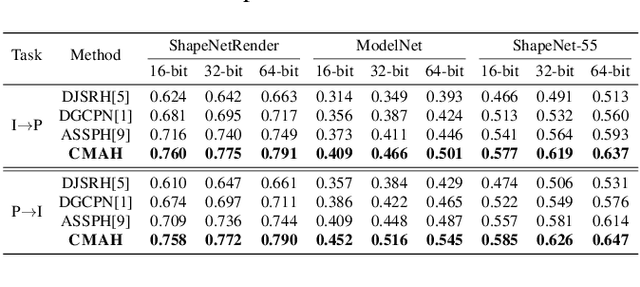
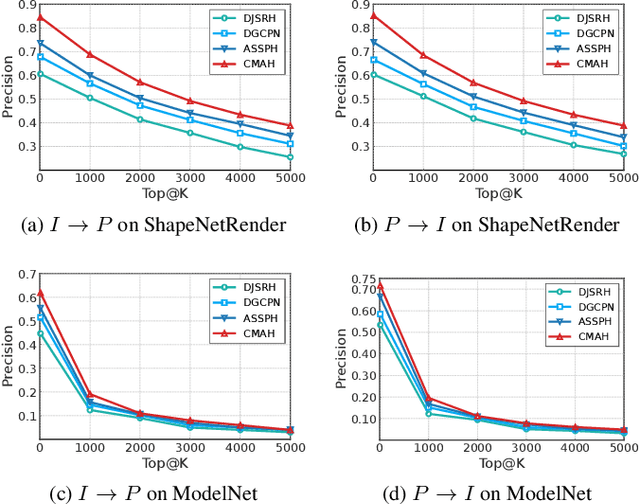
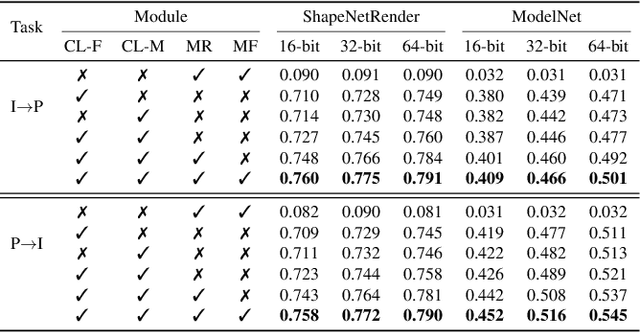
Implementing cross-modal hashing between 2D images and 3D point-cloud data is a growing concern in real-world retrieval systems. Simply applying existing cross-modal approaches to this new task fails to adequately capture latent multi-modal semantics and effectively bridge the modality gap between 2D and 3D. To address these issues without relying on hand-crafted labels, we propose contrastive masked autoencoders based self-supervised hashing (CMAH) for retrieval between images and point-cloud data. We start by contrasting 2D-3D pairs and explicitly constraining them into a joint Hamming space. This contrastive learning process ensures robust discriminability for the generated hash codes and effectively reduces the modality gap. Moreover, we utilize multi-modal auto-encoders to enhance the model's understanding of multi-modal semantics. By completing the masked image/point-cloud data modeling task, the model is encouraged to capture more localized clues. In addition, the proposed multi-modal fusion block facilitates fine-grained interactions among different modalities. Extensive experiments on three public datasets demonstrate that the proposed CMAH significantly outperforms all baseline methods.
CHAIN: Exploring Global-Local Spatio-Temporal Information for Improved Self-Supervised Video Hashing
Oct 29, 2023Compressing videos into binary codes can improve retrieval speed and reduce storage overhead. However, learning accurate hash codes for video retrieval can be challenging due to high local redundancy and complex global dependencies between video frames, especially in the absence of labels. Existing self-supervised video hashing methods have been effective in designing expressive temporal encoders, but have not fully utilized the temporal dynamics and spatial appearance of videos due to less challenging and unreliable learning tasks. To address these challenges, we begin by utilizing the contrastive learning task to capture global spatio-temporal information of videos for hashing. With the aid of our designed augmentation strategies, which focus on spatial and temporal variations to create positive pairs, the learning framework can generate hash codes that are invariant to motion, scale, and viewpoint. Furthermore, we incorporate two collaborative learning tasks, i.e., frame order verification and scene change regularization, to capture local spatio-temporal details within video frames, thereby enhancing the perception of temporal structure and the modeling of spatio-temporal relationships. Our proposed Contrastive Hashing with Global-Local Spatio-temporal Information (CHAIN) outperforms state-of-the-art self-supervised video hashing methods on four video benchmark datasets. Our codes will be released.