 Add to Chrome
 Add to Firefox
 Add to Edge
Synthetic Persona Pretraining: Alignment from Token Zero
Aug 13, 2026
As language-model-based AI is increasingly deployed in autonomous settings, aligning its goals and values with those of humans becomes critical. Today, alignment, and the assistant identity itself, are typically introduced only after pretraining, once behavioral priors are already established. This can make values a thin overlay, rather than deeply rooted, and facilitate subsequent misalignment. Pursuing a different paradigm, we introduce Synthetic Persona Pretraining (SPP), which installs the desired assistant persona from token zero in pretraining. First, we annotate pretraining documents with value-aligned first-person reflections derived from a normative value constitution. Second, we pretrain via the standard cross-entropy loss on standard pretraining documents as well as their reflections, which installs the desired persona among a multitude of other personas. Finally, we post-train on user-assistant dialogue data, which binds this desired persona to the assistant identity, a process we call persona binding. By pretraining models up to 3B parameters on 500B tokens, we show that SPP improves constitution following and jailbreak robustness, and reduces the misalignment rate in out-of-distribution moral dilemmas, while preserving capabilities. Early intervention matters: compared with alignment from token zero, introducing SPP only at the end of pretraining yields weaker constitution adherence, does not shift value priorities, and leads to less aligned choices in dilemmas. This advantage depends on persona binding and, importantly, increases with pretraining budget. Overall, our results show that shaping values early is critical for alignment and establish pretraining-time persona interventions as an effective approach to do so.

Emulate or Estimate? The Divergent Strengths of Base and Post-Trained Language Models for Opinion Simulation
Aug 04, 2026Large language models are increasingly used to simulate human opinions, but prior work reports conflicting results: some studies find promising alignment with human survey data, while others find persona collapse and weak demographic sensitivity. We show that much of this conflict stems from conflating two distinct tasks. We call the first task emulation, in which models generate individual responses that aggregate into a population distribution. We call the second task estimation, in which models directly predict the population distribution. Evaluating six matched base and post-trained models on the Pew American Trends Panel, we find that base models are stronger emulators: they produce response distributions closer to human ground truth and better preserve demographic structure. Post-trained models are stronger estimators, producing more accurate distributional predictions when asked directly. We propose that model selection for human simulation should be guided by whether the task requires generating text or predicting distributions.
Tandem Reinforcement Learning with Verifiable Rewards
Jun 26, 2026Reinforcement learning with verifiable rewards (RLVR) has significantly improved the reasoning capability of large language models, reaching expert or even superhuman performance in domains such as competition math. However, whether weaker agents and humans can actually harness this capability is far less certain, with RLVR documented to drift reasoning toward idiosyncratic patterns such as poor readability and language mixing. Tandem training is a recently introduced paradigm that targets this compatibility problem: a trained, stronger senior co-generates each rollout with a frozen, weaker junior, and the two are rewarded as a team, so the senior is pushed to reason in ways the junior can follow. Yet this paradigm has so far been demonstrated only in proof-of-concept settings, leaving open whether it scales to the long chains of thought of the modern RLVR pipeline. In this work, we propose Tandem Reinforcement Learning (TRL), which carries the tandem training paradigm into RLVR. In TRL, the senior and a frozen junior alternate stochastically to co-generate the reasoning, the resulting generation is rewarded, and the standard GRPO loss is applied to the senior. Training Qwen3-4B-Instruct on competition math, we find that TRL matches vanilla GRPO on solo reasoning capability while three properties emerge together from the same rollout structure: stronger handoff robustness with the junior, reduced distributional drift from the junior, and a chain-of-thought more legible to the junior. Our results demonstrate a promising route for RLVR with practical payoffs in multi-model communication and human compatibility.
MINER: Mining Multimodal Internal Representation for Efficient Retrieval
May 07, 2026Visual document retrieval has become essential for accessing information in visually rich documents. Existing approaches fall into two camps. Late-interaction retrievers achieve strong quality through fine-grained token-level matching but store hundreds of vectors per page, incurring large index footprints and high serving costs. By contrast, dense single-vector retrievers retain storage and latency advantages but consistently lag in quality because they compress all information into a single final-layer embedding. In this work, we first conduct a layerwise diagnostic on single-vector retrievers, revealing that retrieval-relevant signal resides in internal representations. Motivated by these findings, we propose MINER (Mining Multimodal Internal RepreseNtation for Efficient Retrieval), a lightweight plug-in module that probes and fuses internal signals across transformer layers into a single compact embedding without modifying the backbone or sacrificing single-vector efficiency. The first Retrieval-Aligned Layer Probing stage attaches a lightweight probe at each layer, surfacing which dimensions carry retrieval-relevant information. The subsequent Adaptive Sparse Multi-Layer Fusion stage applies performance-adaptive neuron-level masking to the selected layers and fuses the surviving signals into the final dense vector. Across ViDoRe V1/V2/V3, MINER outperforms existing dense single-vector retrievers on the majority of benchmarks, with up to 4.5% nDCG@5 improvement over its corresponding backbone. Compared to strong late-interaction baselines, in some settings MINER substantially narrows the nDCG@$5$ gap to $0.2$ while preserving the storage and serving advantages of dense retrieval.
LLM Safety From Within: Detecting Harmful Content with Internal Representations
Apr 20, 2026Guard models are widely used to detect harmful content in user prompts and LLM responses. However, state-of-the-art guard models rely solely on terminal-layer representations and overlook the rich safety-relevant features distributed across internal layers. We present SIREN, a lightweight guard model that harnesses these internal features. By identifying safety neurons via linear probing and combining them through an adaptive layer-weighted strategy, SIREN builds a harmfulness detector from LLM internals without modifying the underlying model. Our comprehensive evaluation shows that SIREN substantially outperforms state-of-the-art open-source guard models across multiple benchmarks while using 250 times fewer trainable parameters. Moreover, SIREN exhibits superior generalization to unseen benchmarks, naturally enables real-time streaming detection, and significantly improves inference efficiency compared to generative guard models. Overall, our results highlight LLM internal states as a promising foundation for practical, high-performance harmfulness detection.
ThinkTwice: Jointly Optimizing Large Language Models for Reasoning and Self-Refinement
Apr 02, 2026We introduce ThinkTwice, a simple two-phase framework that jointly optimizes LLMs to solve reasoning problems and refine the answers, based on Group Relative Policy Optimization (GRPO). In each pair of training steps, ThinkTwice first optimizes the model on solving reasoning problems, then optimizes it on refining its own solutions to the same problems, using the same binary correctness reward in both phases without correctness signals or critique annotations. Across five mathematical reasoning benchmarks and two model families including Qwen3-4B and Olmo3-7B, ThinkTwice substantially improves both reasoning and refinement performance over competitive online policy optimization baselines. Specifically, on Qwen3-4B, ThinkTwice outperforms GRPO on AIME by 5 percentage points before refinement and by 11.5 points after one self-refinement step, measured by pass@4. Analysis of the training dynamics of ThinkTwice reveals an implicit rectify-then-fortify curriculum: refinement predominantly corrects errors early in training and naturally shifts toward preserving already-correct solutions as the model improves, yielding a more rectified reward signal. Our work establishes joint training of reasoning and self-refinement as a principled and effective methodology for RLVR.
Understanding the Dynamics of Demonstration Conflict in In-Context Learning
Mar 03, 2026In-context learning enables large language models to perform novel tasks through few-shot demonstrations. However, demonstrations per se can naturally contain noise and conflicting examples, making this capability vulnerable. To understand how models process such conflicts, we study demonstration-dependent tasks requiring models to infer underlying patterns, a process we characterize as rule inference. We find that models suffer substantial performance degradation from a single demonstration with corrupted rule. This systematic misleading behavior motivates our investigation of how models process conflicting evidence internally. Using linear probes and logit lens analysis, we discover that under corruption models encode both correct and incorrect rules in intermediate layers but develop prediction confidence only in late layers, revealing a two-phase computational structure. We then identify attention heads for each phase underlying the reasoning failures: Vulnerability Heads in early-to-middle layers exhibit positional attention bias with high sensitivity to corruption, while Susceptible Heads in late layers significantly reduce support for correct predictions when exposed to the corrupted evidence. Targeted ablation validates our findings, with masking a small number of identified heads improving performance by over 10%.
SEAM: Semantically Equivalent Across Modalities Benchmark for Vision-Language Models
Aug 25, 2025Evaluating whether vision-language models (VLMs) reason consistently across representations is challenging because modality comparisons are typically confounded by task differences and asymmetric information. We introduce SEAM, a benchmark that pairs semantically equivalent inputs across four domains that have existing standardized textual and visual notations. By employing distinct notation systems across modalities, in contrast to OCR-based image-text pairing, SEAM provides a rigorous comparative assessment of the textual-symbolic and visual-spatial reasoning capabilities of VLMs. Across 21 contemporary models, we observe systematic modality imbalance: vision frequently lags language in overall performance, despite the problems containing semantically equivalent information, and cross-modal agreement is relatively low. Our error analysis reveals two main drivers: textual perception failures from tokenization in domain notation and visual perception failures that induce hallucinations. We also show that our results are largely robust to visual transformations. SEAM establishes a controlled, semantically equivalent setting for measuring and improving modality-agnostic reasoning.
Maia-2: A Unified Model for Human-AI Alignment in Chess
Sep 30, 2024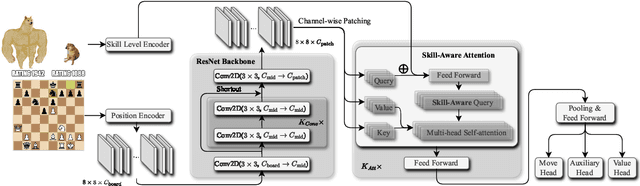
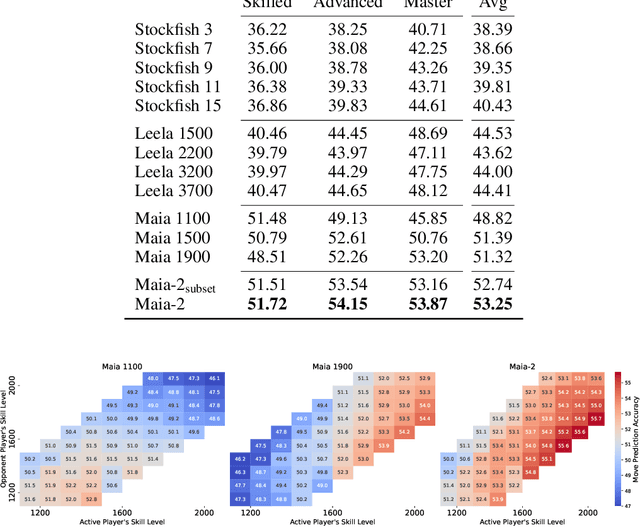
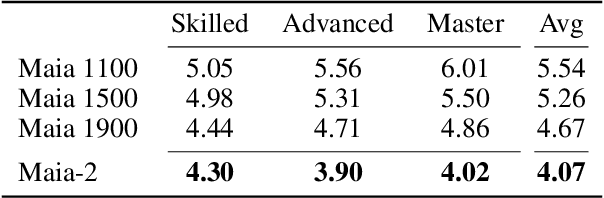
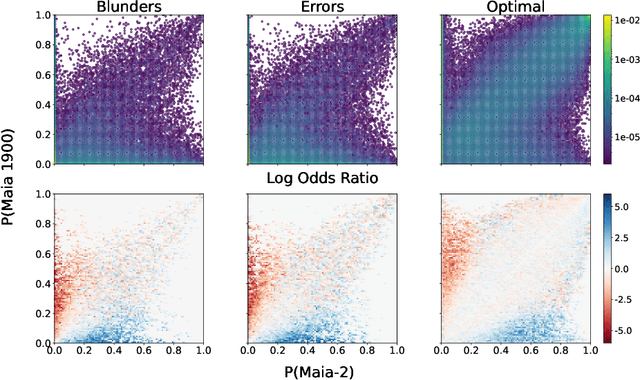
There are an increasing number of domains in which artificial intelligence (AI) systems both surpass human ability and accurately model human behavior. This introduces the possibility of algorithmically-informed teaching in these domains through more relatable AI partners and deeper insights into human decision-making. Critical to achieving this goal, however, is coherently modeling human behavior at various skill levels. Chess is an ideal model system for conducting research into this kind of human-AI alignment, with its rich history as a pivotal testbed for AI research, mature superhuman AI systems like AlphaZero, and precise measurements of skill via chess rating systems. Previous work in modeling human decision-making in chess uses completely independent models to capture human style at different skill levels, meaning they lack coherence in their ability to adapt to the full spectrum of human improvement and are ultimately limited in their effectiveness as AI partners and teaching tools. In this work, we propose a unified modeling approach for human-AI alignment in chess that coherently captures human style across different skill levels and directly captures how people improve. Recognizing the complex, non-linear nature of human learning, we introduce a skill-aware attention mechanism to dynamically integrate players' strengths with encoded chess positions, enabling our model to be sensitive to evolving player skill. Our experimental results demonstrate that this unified framework significantly enhances the alignment between AI and human players across a diverse range of expertise levels, paving the way for deeper insights into human decision-making and AI-guided teaching tools.
Sparsify-then-Classify: From Internal Neurons of Large Language Models To Efficient Text Classifiers
Nov 27, 2023Among the many tasks that Large Language Models (LLMs) have revolutionized is text classification. However, existing approaches for applying pretrained LLMs to text classification predominantly rely on using single token outputs from only the last layer of hidden states. As a result, they suffer from limitations in efficiency, task-specificity, and interpretability. In our work, we contribute an approach that uses all internal representations by employing multiple pooling strategies on all activation and hidden states. Our novel lightweight strategy, Sparsify-then-Classify (STC) first sparsifies task-specific features layer-by-layer, then aggregates across layers for text classification. STC can be applied as a seamless plug-and-play module on top of existing LLMs. Our experiments on a comprehensive set of models and datasets demonstrate that STC not only consistently improves the classification performance of pretrained and fine-tuned models, but is also more efficient for both training and inference, and is more intrinsically interpretable.