 Add to Chrome
 Add to Firefox
 Add to Edge
Joint Antenna Placement and Power Allocation for RSMA-Enabled Pinching Antenna Systems
Jun 14, 2026
This letter investigates a rate-splitting multiple access (RSMA)-enabled multi-user pinching antenna system (PASS). A fairness-aware sum-rate maximization problem is formulated to jointly optimize pinching antenna locations and common/private stream power allocation. The resulting mixed discrete-continuous non-convex problem is addressed using an alternating optimization framework that combines greedy antenna placement with successive convex approximation (SCA)-based power allocation. Numerical results demonstrate that the proposed RSMA-enabled PASS significantly improves achievable sum-rate, user fairness, and bit error rate (BER) performance compared with conventional non-RSMA PASS schemes.

RSMA Technique for Multi-User Downlink Single-Waveguide Multi-Pinching Antenna Systems
Jun 08, 2026Pinching antennas have recently emerged as a promising technology for reconfigurable wireless systems due to their ability to dynamically radiate signals from flexible positions along a waveguide. This letter investigates a multi-user communication framework by integrating rate-splitting multiple access (RSMA) into a single-input single-output (SISO) single-waveguide architecture equipped with multiple pinching antennas. Multiple antennas are activated along a shared waveguide to radiate a common guided signal toward distributed users, enabling strong near-field line-of-sight (LoS) links with low hardware complexity and a single radiofrequency (RF) chain. To manage multi-user interference, RSMA is employed within the proposed architecture. Simulation results show that the proposed framework improves system sum-rate, enhances user rate fairness, and achieves lower bit error rate (BER) while preserving the low-cost and scalable characteristics of pinching antenna systems (PASS).
An Analysis on Rate-Splitting Multiple Access for IRS Aided 6G Communication
Jun 05, 2021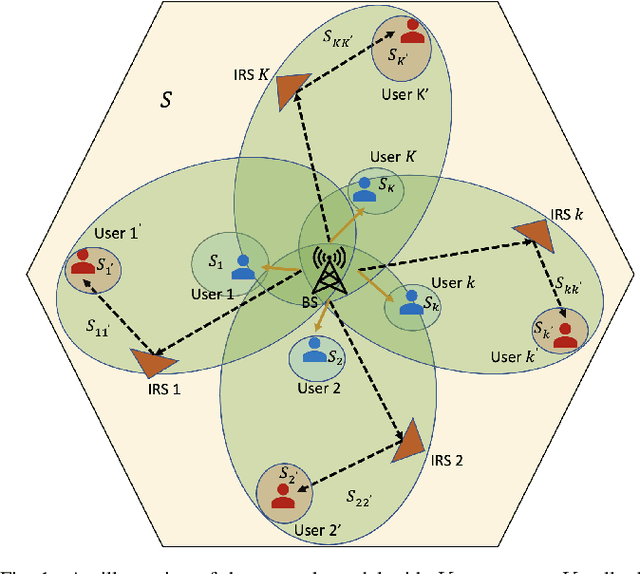
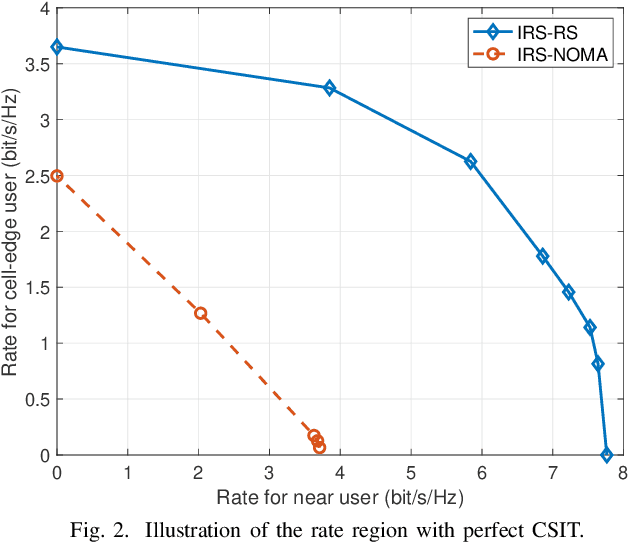
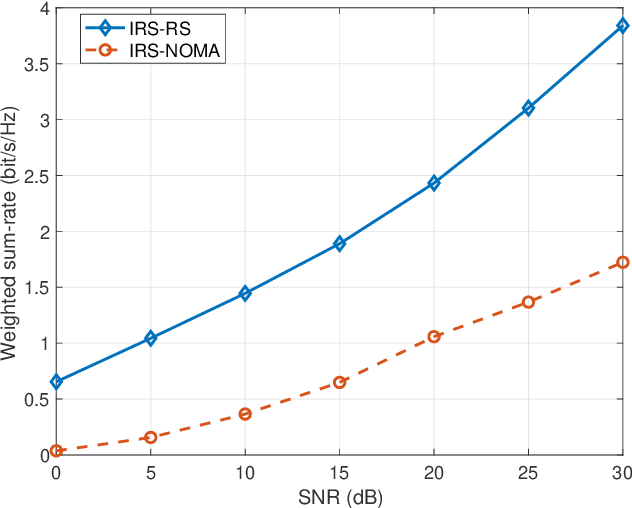
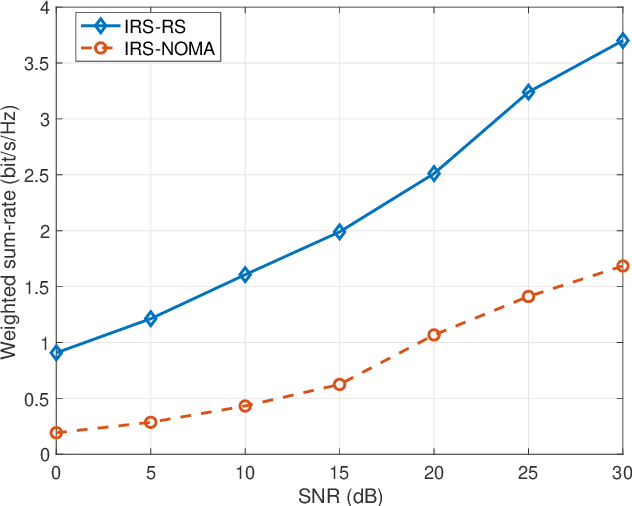
Integrating intelligent reflecting surface (IRS) and Rate-Splitting Multiple Access (RSMA) is an effective solution to improve the spectral/energy efficiency in next-generation (beyond 5G (B5G) and 6G) wireless networks. In this paper, we investigate a rate-splitting (RS)-based transmission technique for an IRS-aided communication network involving both near and cell-edge users. In particular, we derive a new architecture called IRS-RS that leverages the interplay between RS and IRS, with an aim to maximize the weighted sum-rate (WSR) of users by selecting the reflecting coefficients at the IRS and designing beamformers at the BS under the constraints of power at the base station (BS), quality of service (QoS) at each user and finite resolution at the IRS. To solve the non-convex WSR maximization problem, we propose an alternating algorithm and compare its performance with baseline non-orthogonal multiple access (NOMA) based transmission for an IRS-aided communication network for both perfect and imperfect CSIT cases. Through numerical results, it is shown that the proposed IRS-RS architecture yields better QoS with respect to the cell-edge users when compared to IRS-NOMA transmission scheme.
Multiple Antenna Selection and Successive Signal Detection for SM-based IRS-aided Communication
Apr 28, 2021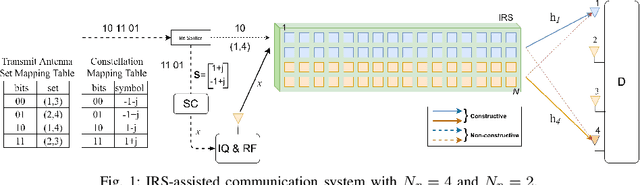
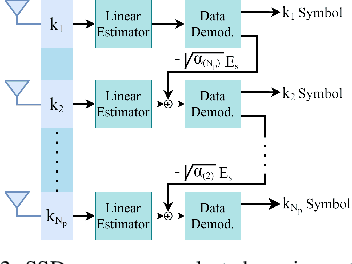
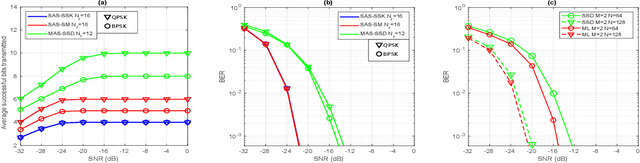
Intelligent reflecting surface (IRS) is being considered as a prospective candidate for next-generation wireless communication due to its ability to significantly improve coverage and spectral efficiency by controlling the propagation environment. One of the ways IRS increases spectral efficiency is by adjusting phase shifts to perform passive beamforming. In this letter, we integrate the concept of IRS-aided communication to the domain of multi-direction beamforming, whereby multiple receive antennas are selected to convey more information bits than existing spatial modulation (SM) techniques at any specific time. To complement this system, we also propose a successive signal detection (SSD) technique at the receiver. Numerical results show that the proposed design is able to improve the average successful bits transmitted (ASBT) by the system, which outperforms other state-of-the-art methods proposed in the literature.