 Add to Chrome
 Add to Firefox
 Add to Edge
STREAM: A Data-Centric Framework for Mining High-Value Task-Oriented Dialogues from Streaming Media
May 24, 2026
Large language models for vertical domains are bottlenecked by the scarcity of complex, domain-specific task-oriented dialogues. Existing data acquisition pipelines face a persistent trilemma: expert annotation is expensive, real-world service conversations are constrained by privacy and commercial restrictions, and static corpora quickly become temporally stale. We propose Stream, a data-centric framework that leverages publicly available streaming media (live streams and short videos) to synthesize high-value service dialogues at scale. Stream mines authentic interaction signals from noisy streams and synthesizes conversations by integrating role-grounded persona construction with Conversational Blueprint construction; it further adopts retrieval-augmented generation (RAG) to support knowledge-aware responses. Based on Stream, we release StreamDial, a large-scale multi-domain dataset covering Automotive, Restaurant, and Hotel. StreamDial contains 87,498 dialogue sessions and 1,497,320 turns in total, with an average of 17.11 turns per session and a comparable scale across domains. Each session is organized as a structured quadruplet $\langle P_u, P_a, B, H \rangle$ that pairs dialogue history with explicit user/agent personas and a Conversational Blueprint, capturing realistic service behaviors such as requirement mining, constraint conflicts, negotiation, and recovery. Evaluations with automatic judges and downstream tasks show that StreamDial improves intrinsic dialogue quality over strong baselines, and models trained with StreamDial improve Dialogue State Tracking across backbones; we further report a completed human-evaluation set and encouraging multilingual transfer on Qwen3-8B under a controlled training budget. The data is released in https://github.com/hitxueliang/DialogDataSetBySTREAM.

ManiFoundation Model for General-Purpose Robotic Manipulation of Contact Synthesis with Arbitrary Objects and Robots
May 11, 2024
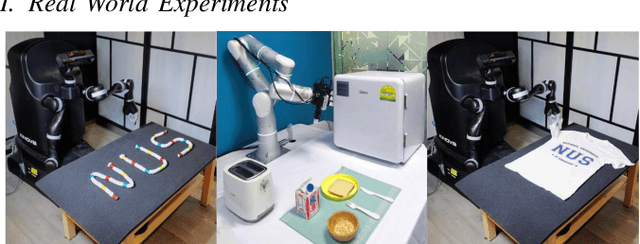


To substantially enhance robot intelligence, there is a pressing need to develop a large model that enables general-purpose robots to proficiently undertake a broad spectrum of manipulation tasks, akin to the versatile task-planning ability exhibited by LLMs. The vast diversity in objects, robots, and manipulation tasks presents huge challenges. Our work introduces a comprehensive framework to develop a foundation model for general robotic manipulation that formalizes a manipulation task as contact synthesis. Specifically, our model takes as input object and robot manipulator point clouds, object physical attributes, target motions, and manipulation region masks. It outputs contact points on the object and associated contact forces or post-contact motions for robots to achieve the desired manipulation task. We perform extensive experiments both in the simulation and real-world settings, manipulating articulated rigid objects, rigid objects, and deformable objects that vary in dimensionality, ranging from one-dimensional objects like ropes to two-dimensional objects like cloth and extending to three-dimensional objects such as plasticine. Our model achieves average success rates of around 90\%. Supplementary materials and videos are available on our project website at https://manifoundationmodel.github.io/.