 Add to Chrome
 Add to Firefox
 Add to Edge
Handling Feature Heterogeneity with Learnable Graph Patches
Jun 16, 2026
In recent years, the rapid development of foundation models and graph pre-training technologies has spurred increasing interest in constructing a universal pre-trained graph model or Graph Foundation Model (GFM). However, a significant challenge is that existing models are unable to address feature heterogeneity in graph data without textual information, which hinders the transferability of graph models across different datasets. To bridge this gap, we propose the concept of learnable graph patches, which we regard as the smallest semantic units of any graph data. We decompose the graph into learnable graph patches by unfolding the node features and constructing corresponding patch structures separately. We then design a framework that mines transferable information from graph data across domains. Specifically, after extracting graph patches, we propose a patch encoder to extract knowledge from each unit and a patch aggregator to learn how the units are combined into a whole. Due to its domain-agnostic nature, the model can be applied to downstream data across different domains. Furthermore, we analyze the connection between our method and existing graph models, as well as the transferability of the node embeddings it generates. Empirically, our method not only achieves the capability to use multi-domain graphs for pre-training, but also shows enhanced performance across various downstream datasets and tasks. Moreover, we observe consistent improvement in downstream performance as the volume of pre-training data increases.

A Unified Framework for Context-Aware and Relation-Aware Graph Retrieval-Augmented Generation
Jun 16, 2026Retrieval-Augmented Generation (RAG) has emerged as a paradigm for enhancing large language models (LLMs) with external knowledge, yet existing graph-based methods face a fundamental limitation: entity-centric and chunk-centric approaches operate on representations anchored to original text without true knowledge fusion. While entity-centric methods connect logically related content and chunk-centric methods preserve context, both retrieve information separately through similarity search, missing emergent understanding from their synthesis. In this paper, we propose HyGRAG, a hierarchical graph RAG framework that transcends source documents by addressing three core challenges: constructing summaries that genuinely integrate contextual and relational information, leveraging these synthesized representations to access emergent knowledge during retrieval, and efficiently updating hierarchical structures for dynamic corpora. Specifically, we design hierarchical index structures over hybrid graphs with both chunk and entity nodes, then iteratively cluster them and generate LLM-based summaries. Then, we design context and relation-aware retrieval that searches across all abstraction levels while expanding through community membership. Moreover, we enable dynamic knowledge update through attachment-based algorithms with only local re-summarization. Experimental results show that HyGRAG improves the average accuracy of multi-hop reasoning tasks by 9.7%, while maintaining reasonable efficiency.
SafeMove-RL: A Certifiable Reinforcement Learning Framework for Dynamic Motion Constraints in Trajectory Planning
May 19, 2025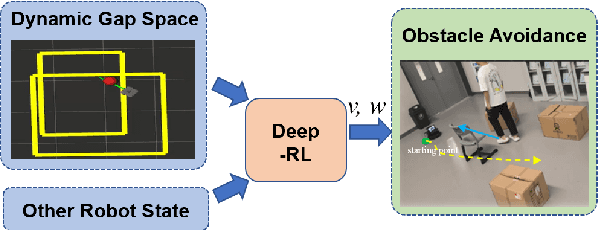

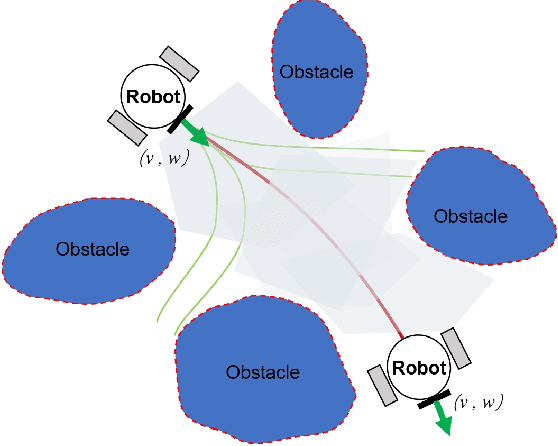
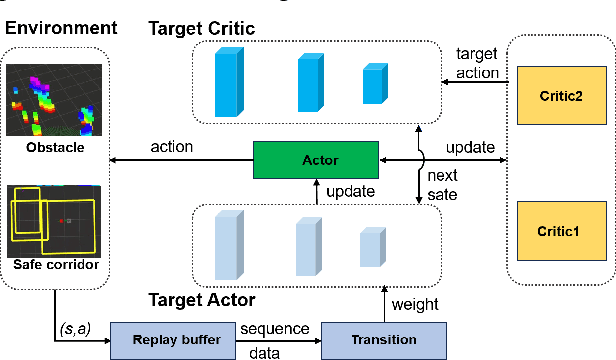
This study presents a dynamic safety margin-based reinforcement learning framework for local motion planning in dynamic and uncertain environments. The proposed planner integrates real-time trajectory optimization with adaptive gap analysis, enabling effective feasibility assessment under partial observability constraints. To address safety-critical computations in unknown scenarios, an enhanced online learning mechanism is introduced, which dynamically corrects spatial trajectories by forming dynamic safety margins while maintaining control invariance. Extensive evaluations, including ablation studies and comparisons with state-of-the-art algorithms, demonstrate superior success rates and computational efficiency. The framework's effectiveness is further validated on both simulated and physical robotic platforms.