 Add to Chrome
 Add to Firefox
 Add to Edge
A Unified Framework for Context-Aware and Relation-Aware Graph Retrieval-Augmented Generation
Jun 16, 2026
Retrieval-Augmented Generation (RAG) has emerged as a paradigm for enhancing large language models (LLMs) with external knowledge, yet existing graph-based methods face a fundamental limitation: entity-centric and chunk-centric approaches operate on representations anchored to original text without true knowledge fusion. While entity-centric methods connect logically related content and chunk-centric methods preserve context, both retrieve information separately through similarity search, missing emergent understanding from their synthesis. In this paper, we propose HyGRAG, a hierarchical graph RAG framework that transcends source documents by addressing three core challenges: constructing summaries that genuinely integrate contextual and relational information, leveraging these synthesized representations to access emergent knowledge during retrieval, and efficiently updating hierarchical structures for dynamic corpora. Specifically, we design hierarchical index structures over hybrid graphs with both chunk and entity nodes, then iteratively cluster them and generate LLM-based summaries. Then, we design context and relation-aware retrieval that searches across all abstraction levels while expanding through community membership. Moreover, we enable dynamic knowledge update through attachment-based algorithms with only local re-summarization. Experimental results show that HyGRAG improves the average accuracy of multi-hop reasoning tasks by 9.7%, while maintaining reasonable efficiency.

2060: Civilization, Energy, and Progression of Mankind on the Kardashev Scale
Aug 10, 2022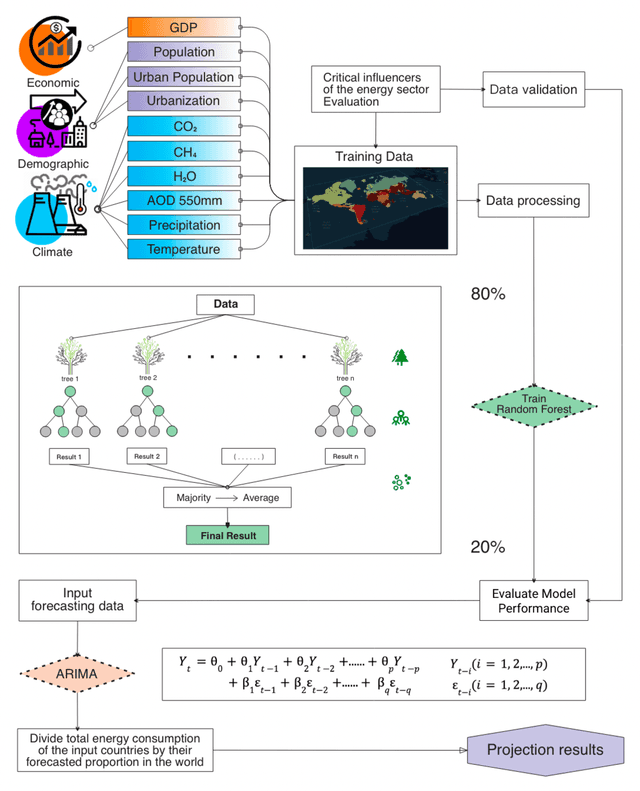
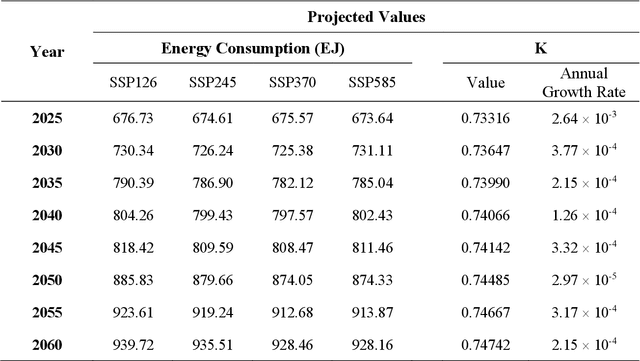
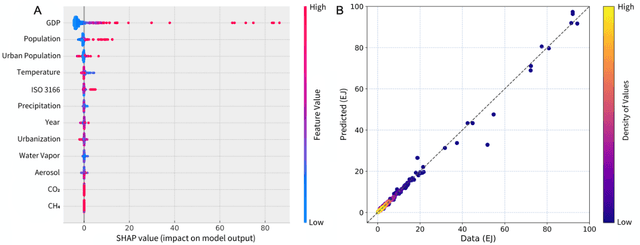
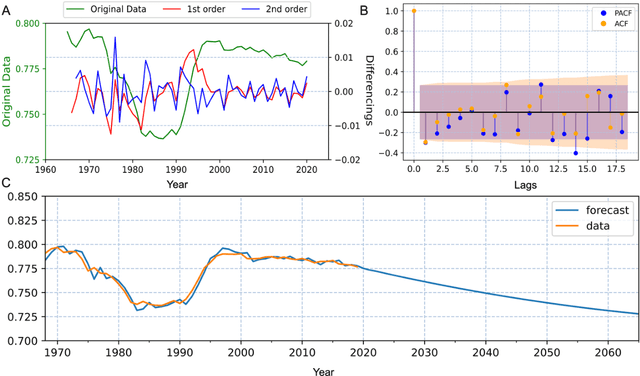
Energy has been propelling the development of human civilization for millennia, and technologies acquiring energy beyond human and animal power have been continuously advanced and transformed. In 1964, the Kardashev Scale was proposed to quantify the relationship between energy consumption and the development of civilizations. Human civilization presently stands at Type 0.7276 on this scale. Projecting the future energy consumption, estimating the change of its constituting structure, and evaluating the influence of possible technological revolutions are critical in the context of civilization development. In this study, we use two machine learning models, random forest (RF) and autoregressive integrated moving average (ARIMA), to simulate and predict energy consumption on a global scale. We further project the position of human civilization on the Kardashev Scale in 2060. The result shows that the global energy consumption is expected to reach 928-940 EJ in 2060, with a total growth of over 50% in the coming 40 years, and our civilization is expected to achieve Type 0.7474 on the Kardashev Scale, still far away from a Type 1 civilization. Additionally, we discuss the potential energy segmentation change before 2060 and present the influence of the advent of nuclear fusion in this context.