 Add to Chrome
 Add to Firefox
 Add to Edge
DisasterBench: A Multimodal Benchmark for UAV-Based Disaster Response in Complex Environments
Jun 04, 2026
When a disaster unfolds, responders must answer not only what is happening, but also why it is happening, what will happen next, and what to do now, often from noisy low-altitude UAV views and under tight on-site compute constraints. However, most existing multimodal benchmarks emphasize perception (e.g., recognition/description), cover limited disaster types, and provide insufficient support for the multi-stage reasoning required in practical emergency response. We introduce DisasterBench, a multi-stage multimodal reasoning benchmark for UAV-Based disaster response in complex environments. DisasterBench spans 14 disaster-related scene types and 9 response-critical tasks across pre-, during-, and post-disaster stages, with fine-grained disaster-task mappings that explicitly test causal attribution, propagation prediction, damage analysis, and decision-oriented reasoning. To enable reasoning on the edge, we further propose DisasterVL, a lightweight multimodal model optimized with a three-stage pipeline combining domain instruction tuning, chain-of-thought-guided multimodal alignment, and reinforcement learning-based policy optimization. Experiments across 21 popular MLLMs show that our 2B-parameter DisasterVL outperforms all evaluated open-source models and substantially narrows the gap to state-of-the-art closed-source models, achieving GPT-4o-comparable reasoning accuracy with superior efficiency. The project page is available at https://github.com/TanmouTT/DisasterBench.

SafeMove-RL: A Certifiable Reinforcement Learning Framework for Dynamic Motion Constraints in Trajectory Planning
May 19, 2025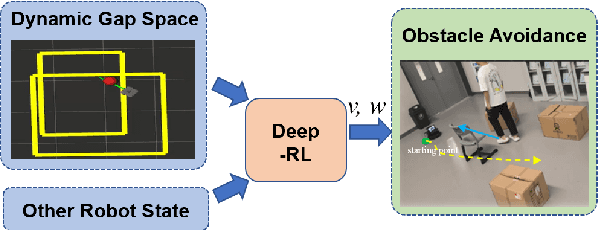

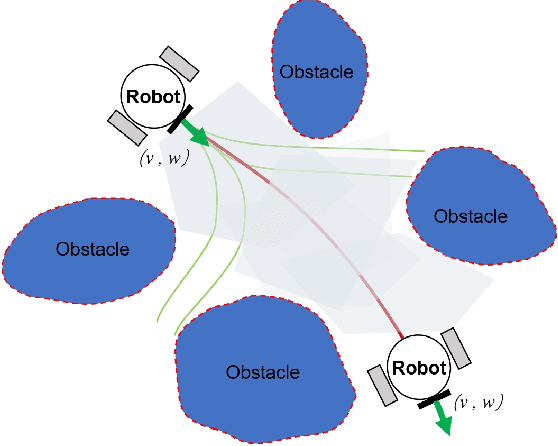
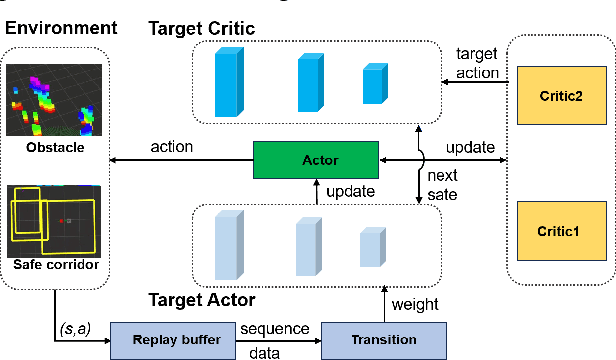
This study presents a dynamic safety margin-based reinforcement learning framework for local motion planning in dynamic and uncertain environments. The proposed planner integrates real-time trajectory optimization with adaptive gap analysis, enabling effective feasibility assessment under partial observability constraints. To address safety-critical computations in unknown scenarios, an enhanced online learning mechanism is introduced, which dynamically corrects spatial trajectories by forming dynamic safety margins while maintaining control invariance. Extensive evaluations, including ablation studies and comparisons with state-of-the-art algorithms, demonstrate superior success rates and computational efficiency. The framework's effectiveness is further validated on both simulated and physical robotic platforms.