 Add to Chrome
 Add to Firefox
 Add to Edge
RABot: Reinforcement-Guided Graph Augmentation for Imbalanced and Noisy Social Bot Detection
Feb 25, 2026
Social bot detection is pivotal for safeguarding the integrity of online information ecosystems. Although recent graph neural network (GNN) solutions achieve strong results, they remain hindered by two practical challenges: (i) severe class imbalance arising from the high cost of generating bots, and (ii) topological noise introduced by bots that skillfully mimic human behavior and forge deceptive links. We propose the Reinforcement-guided graph Augmentation social Bot detector (RABot), a multi-granularity graph-augmentation framework that addresses both issues in a unified manner. RABot employs a neighborhood-aware oversampling strategy that linearly interpolates minority-class embeddings within local subgraphs, thereby stabilizing the decision boundary under low-resource regimes. Concurrently, a reinforcement-learning-driven edge-filtering module combines similarity-based edge features with adaptive threshold optimization to excise spurious interactions during message passing, yielding a cleaner topology. Extensive experiments on three real-world benchmarks and four GNN backbones demonstrate that RABot consistently surpasses state-of-the-art baselines. In addition, since its augmentation and filtering modules are orthogonal to the underlying architecture, RABot can be seamlessly integrated into existing GNN pipelines to boost performance with minimal overhead.

Customized Subgraph Selection and Encoding for Drug-drug Interaction Prediction
Nov 03, 2024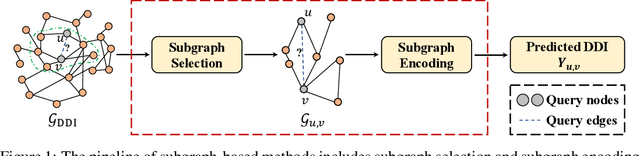


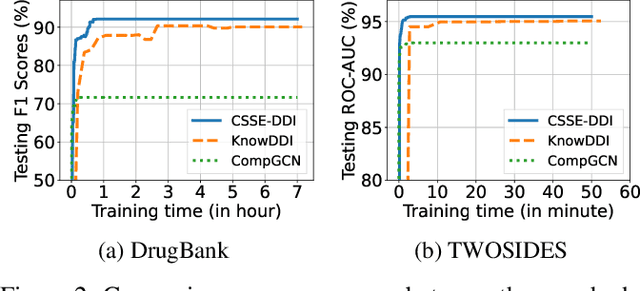
Subgraph-based methods have proven to be effective and interpretable in predicting drug-drug interactions (DDIs), which are essential for medical practice and drug development. Subgraph selection and encoding are critical stages in these methods, yet customizing these components remains underexplored due to the high cost of manual adjustments. In this study, inspired by the success of neural architecture search (NAS), we propose a method to search for data-specific components within subgraph-based frameworks. Specifically, we introduce extensive subgraph selection and encoding spaces that account for the diverse contexts of drug interactions in DDI prediction. To address the challenge of large search spaces and high sampling costs, we design a relaxation mechanism that uses an approximation strategy to efficiently explore optimal subgraph configurations. This approach allows for robust exploration of the search space. Extensive experiments demonstrate the effectiveness and superiority of the proposed method, with the discovered subgraphs and encoding functions highlighting the model's adaptability.
Search to Pass Messages for Temporal Knowledge Graph Completion
Oct 30, 2022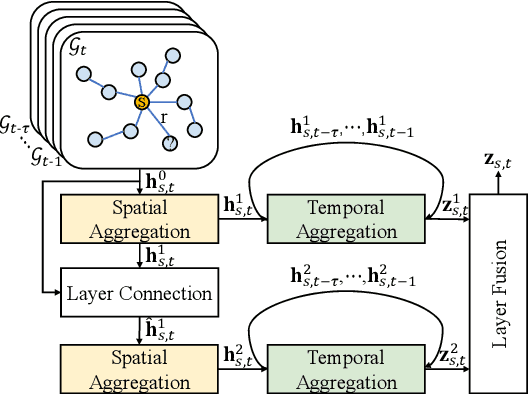
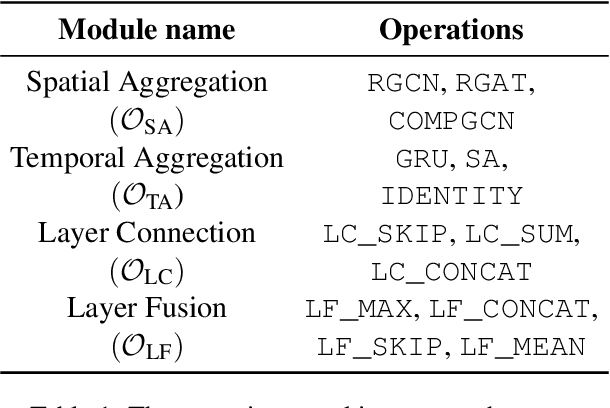
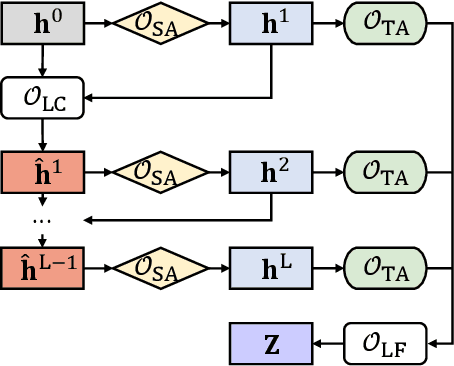
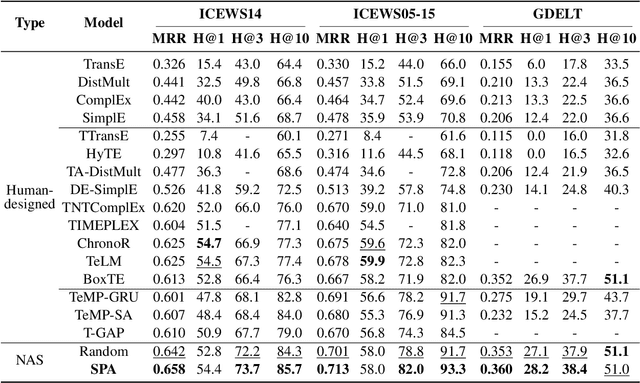
Completing missing facts is a fundamental task for temporal knowledge graphs (TKGs). Recently, graph neural network (GNN) based methods, which can simultaneously explore topological and temporal information, have become the state-of-the-art (SOTA) to complete TKGs. However, these studies are based on hand-designed architectures and fail to explore the diverse topological and temporal properties of TKG. To address this issue, we propose to use neural architecture search (NAS) to design data-specific message passing architecture for TKG completion. In particular, we develop a generalized framework to explore topological and temporal information in TKGs. Based on this framework, we design an expressive search space to fully capture various properties of different TKGs. Meanwhile, we adopt a search algorithm, which trains a supernet structure by sampling single path for efficient search with less cost. We further conduct extensive experiments on three benchmark datasets. The results show that the searched architectures by our method achieve the SOTA performances. Besides, the searched models can also implicitly reveal diverse properties in different TKGs. Our code is released in https://github.com/striderdu/SPA.