 Add to Chrome
 Add to Firefox
 Add to Edge
SegTune: Structured and Fine-Grained Control for Song Generation
May 31, 2026
Recent advances in neural song generation have enabled high-quality synthesis from lyrics and global textual prompts. However, most systems fail to model temporally varying attributes of songs, severely limiting fine-grained control over musical structure and dynamics. To address this, we propose SegTune, a Diffusion Transformer-based framework enabling structured and fine-grained controllability by allowing users or large language models (LLMs) to specify local musical descriptions aligned to song segments. These segment prompts are temporally broadcast to corresponding time windows, while global prompts ensure stylistic coherence. To support precise lyric-to-music alignment, we introduce an LLM-based duration predictor that autoregressively generates sentence-level timestamps in LyRiCs format. We further construct a large-scale data pipeline for high-quality song collection with aligned lyrics and prompts, and propose new metrics to evaluate segment alignment and vocal consistency. Experiments demonstrate that SegTune outperforms existing baselines in both musicality and controllability. Visit our project page (https://github.com/KlingAIResearch/SegTune) for codes and more generated songs.

Kling-Foley: Multimodal Diffusion Transformer for High-Quality Video-to-Audio Generation
Jun 24, 2025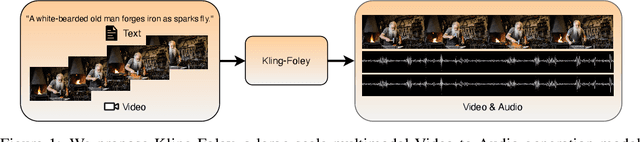
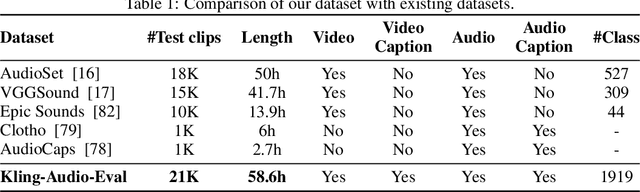
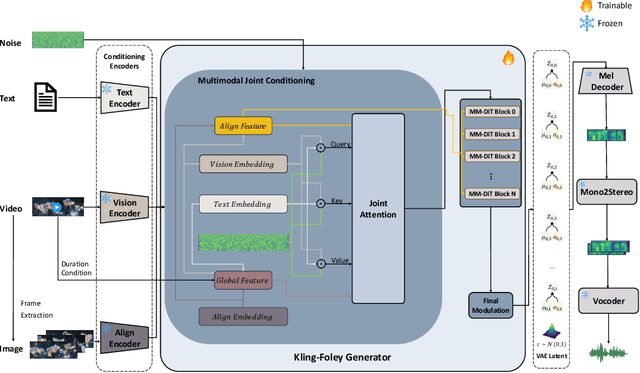
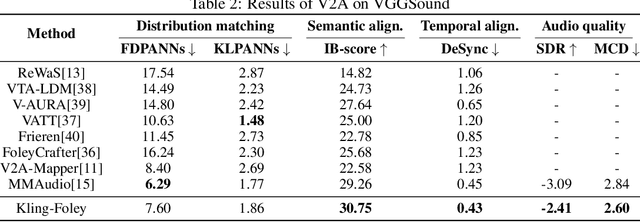
We propose Kling-Foley, a large-scale multimodal Video-to-Audio generation model that synthesizes high-quality audio synchronized with video content. In Kling-Foley, we introduce multimodal diffusion transformers to model the interactions between video, audio, and text modalities, and combine it with a visual semantic representation module and an audio-visual synchronization module to enhance alignment capabilities. Specifically, these modules align video conditions with latent audio elements at the frame level, thereby improving semantic alignment and audio-visual synchronization. Together with text conditions, this integrated approach enables precise generation of video-matching sound effects. In addition, we propose a universal latent audio codec that can achieve high-quality modeling in various scenarios such as sound effects, speech, singing, and music. We employ a stereo rendering method that imbues synthesized audio with a spatial presence. At the same time, in order to make up for the incomplete types and annotations of the open-source benchmark, we also open-source an industrial-level benchmark Kling-Audio-Eval. Our experiments show that Kling-Foley trained with the flow matching objective achieves new audio-visual SOTA performance among public models in terms of distribution matching, semantic alignment, temporal alignment and audio quality.