 Add to Chrome
 Add to Firefox
 Add to Edge
Stroke3D: Lifting 2D strokes into rigged 3D model via latent diffusion models
Feb 16, 2026
Rigged 3D assets are fundamental to 3D deformation and animation. However, existing 3D generation methods face challenges in generating animatable geometry, while rigging techniques lack fine-grained structural control over skeleton creation. To address these limitations, we introduce Stroke3D, a novel framework that directly generates rigged meshes from user inputs: 2D drawn strokes and a descriptive text prompt. Our approach pioneers a two-stage pipeline that separates the generation into: 1) Controllable Skeleton Generation, we employ the Skeletal Graph VAE (Sk-VAE) to encode the skeleton's graph structure into a latent space, where the Skeletal Graph DiT (Sk-DiT) generates a skeletal embedding. The generation process is conditioned on both the text for semantics and the 2D strokes for explicit structural control, with the VAE's decoder reconstructing the final high-quality 3D skeleton; and 2) Enhanced Mesh Synthesis via TextuRig and SKA-DPO, where we then synthesize a textured mesh conditioned on the generated skeleton. For this stage, we first enhance an existing skeleton-to-mesh model by augmenting its training data with TextuRig: a dataset of textured and rigged meshes with captions, curated from Objaverse-XL. Additionally, we employ a preference optimization strategy, SKA-DPO, guided by a skeleton-mesh alignment score, to further improve geometric fidelity. Together, our framework enables a more intuitive workflow for creating ready to animate 3D content. To the best of our knowledge, our work is the first to generate rigged 3D meshes conditioned on user-drawn 2D strokes. Extensive experiments demonstrate that Stroke3D produces plausible skeletons and high-quality meshes.

GenCP: Towards Generative Modeling Paradigm of Coupled Physics
Jan 27, 2026Real-world physical systems are inherently complex, often involving the coupling of multiple physics, making their simulation both highly valuable and challenging. Many mainstream approaches face challenges when dealing with decoupled data. Besides, they also suffer from low efficiency and fidelity in strongly coupled spatio-temporal physical systems. Here we propose GenCP, a novel and elegant generative paradigm for coupled multiphysics simulation. By formulating coupled-physics modeling as a probability modeling problem, our key innovation is to integrate probability density evolution in generative modeling with iterative multiphysics coupling, thereby enabling training on data from decoupled simulation and inferring coupled physics during sampling. We also utilize operator-splitting theory in the space of probability evolution to establish error controllability guarantees for this "conditional-to-joint" sampling scheme. We evaluate our paradigm on a synthetic setting and three challenging multi-physics scenarios to demonstrate both principled insight and superior application performance of GenCP. Code is available at this repo: github.com/AI4Science-WestlakeU/GenCP.
RealPDEBench: A Benchmark for Complex Physical Systems with Real-World Data
Jan 05, 2026Predicting the evolution of complex physical systems remains a central problem in science and engineering. Despite rapid progress in scientific Machine Learning (ML) models, a critical bottleneck is the lack of expensive real-world data, resulting in most current models being trained and validated on simulated data. Beyond limiting the development and evaluation of scientific ML, this gap also hinders research into essential tasks such as sim-to-real transfer. We introduce RealPDEBench, the first benchmark for scientific ML that integrates real-world measurements with paired numerical simulations. RealPDEBench consists of five datasets, three tasks, eight metrics, and ten baselines. We first present five real-world measured datasets with paired simulated datasets across different complex physical systems. We further define three tasks, which allow comparisons between real-world and simulated data, and facilitate the development of methods to bridge the two. Moreover, we design eight evaluation metrics, spanning data-oriented and physics-oriented metrics, and finally benchmark ten representative baselines, including state-of-the-art models, pretrained PDE foundation models, and a traditional method. Experiments reveal significant discrepancies between simulated and real-world data, while showing that pretraining with simulated data consistently improves both accuracy and convergence. In this work, we hope to provide insights from real-world data, advancing scientific ML toward bridging the sim-to-real gap and real-world deployment. Our benchmark, datasets, and instructions are available at https://realpdebench.github.io/.
GGBall: Graph Generative Model on Poincaré Ball
Jun 08, 2025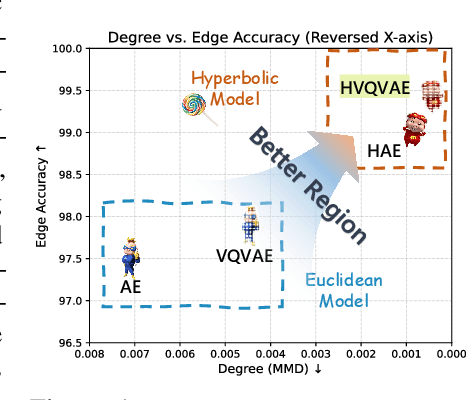
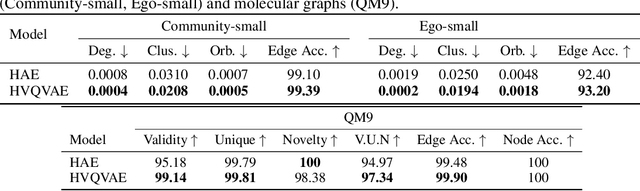
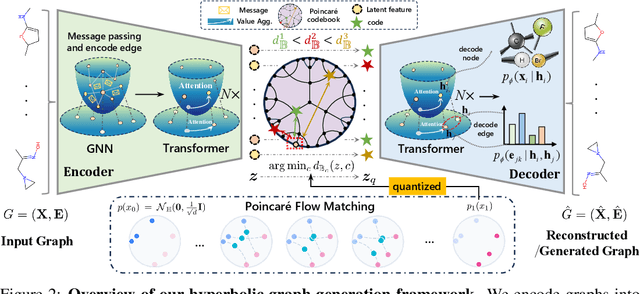
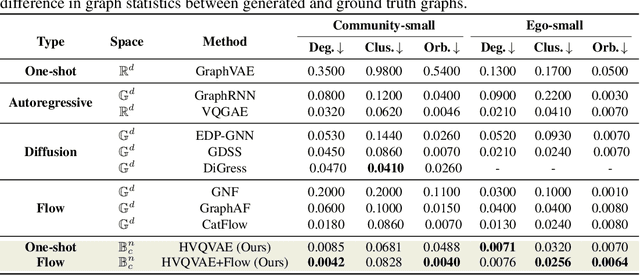
Generating graphs with hierarchical structures remains a fundamental challenge due to the limitations of Euclidean geometry in capturing exponential complexity. Here we introduce \textbf{GGBall}, a novel hyperbolic framework for graph generation that integrates geometric inductive biases with modern generative paradigms. GGBall combines a Hyperbolic Vector-Quantized Autoencoder (HVQVAE) with a Riemannian flow matching prior defined via closed-form geodesics. This design enables flow-based priors to model complex latent distributions, while vector quantization helps preserve the curvature-aware structure of the hyperbolic space. We further develop a suite of hyperbolic GNN and Transformer layers that operate entirely within the manifold, ensuring stability and scalability. Empirically, our model reduces degree MMD by over 75\% on Community-Small and over 40\% on Ego-Small compared to state-of-the-art baselines, demonstrating an improved ability to preserve topological hierarchies. These results highlight the potential of hyperbolic geometry as a powerful foundation for the generative modeling of complex, structured, and hierarchical data domains. Our code is available at \href{https://github.com/AI4Science-WestlakeU/GGBall}{here}.