 Add to Chrome
 Add to Firefox
 Add to Edge
AutoSG: LLM-Driven Solver Generation Solely from Task Prompts for Expensive Optimization
May 25, 2026
Expensive optimization tasks are ubiquitous in real-world applications, demanding highly specialized solvers. While LLM-driven automated solver generation shows promise, current paradigms face three critical issues when tackling expensive optimization: factual hallucinations due to deficient domain knowledge, the frequent dismantling of previously established locally optimal structures during refinement, and the prohibitive evaluation costs alongside restricted generalization caused by executing on training instances. To address these issues, we introduce AutoSG, a fully automated workflow directly translating natural language prompts into executable customized solvers. AutoSG features three core innovations: a retrieval-augmented solver generation module strictly grounding code in verified literature; a one-step self-refinement operator introducing task-specific improvements while preserving critical structural components; and an instance-free Elo-based LLM-as-a-Judge evaluation mechanism rapidly establishing global rankings. Extensive evaluations across diverse expensive optimization tasks confirm AutoSG significantly outperforms human-designed state-of-the-art frameworks and existing LLM-generated solvers.

Demystifying Design Choices of Reinforcement Fine-tuning: A Batched Contextual Bandit Learning Perspective
Jan 30, 2026The reinforcement fine-tuning area is undergoing an explosion papers largely on optimizing design choices. Though performance gains are often claimed, inconsistent conclusions also arise from time to time, making the progress illusive. Reflecting on this illusion, we still lack principled answers to two fundamental questions: 1) what is the role of each design choice? 2) which ones are critical? This paper aims to shed light on them. The underlying challenge is that design choices are entangled together, making their contribution to learning and generalization difficult to attribute. To address this challenge, we first construct a minimalist baseline for disentangling factors: one rollout per query in each round, the outcome reward serving as the training signal without any advantage trick, and a batch size of thirty-two. This baseline connects to batched contextual bandit learning, which facilitates experimental analysis. Centering around this baseline, we design an experiment pipeline, examining the marginal gains of factors like advantage, number of rollouts, etc. Experiments on three base models and two datasets, not only reveal new understanding on the role of various design choices on learning and generalization dynamics, but also identify critical ones that deserve more effort.
Overlooked Safety Vulnerability in LLMs: Malicious Intelligent Optimization Algorithm Request and its Jailbreak
Jan 01, 2026The widespread deployment of large language models (LLMs) has raised growing concerns about their misuse risks and associated safety issues. While prior studies have examined the safety of LLMs in general usage, code generation, and agent-based applications, their vulnerabilities in automated algorithm design remain underexplored. To fill this gap, this study investigates this overlooked safety vulnerability, with a particular focus on intelligent optimization algorithm design, given its prevalent use in complex decision-making scenarios. We introduce MalOptBench, a benchmark consisting of 60 malicious optimization algorithm requests, and propose MOBjailbreak, a jailbreak method tailored for this scenario. Through extensive evaluation of 13 mainstream LLMs including the latest GPT-5 and DeepSeek-V3.1, we reveal that most models remain highly susceptible to such attacks, with an average attack success rate of 83.59% and an average harmfulness score of 4.28 out of 5 on original harmful prompts, and near-complete failure under MOBjailbreak. Furthermore, we assess state-of-the-art plug-and-play defenses that can be applied to closed-source models, and find that they are only marginally effective against MOBjailbreak and prone to exaggerated safety behaviors. These findings highlight the urgent need for stronger alignment techniques to safeguard LLMs against misuse in algorithm design.
One Trigger Token Is Enough: A Defense Strategy for Balancing Safety and Usability in Large Language Models
May 12, 2025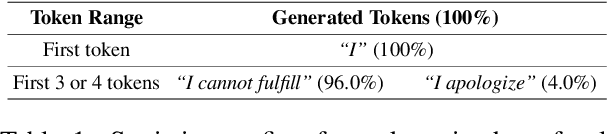
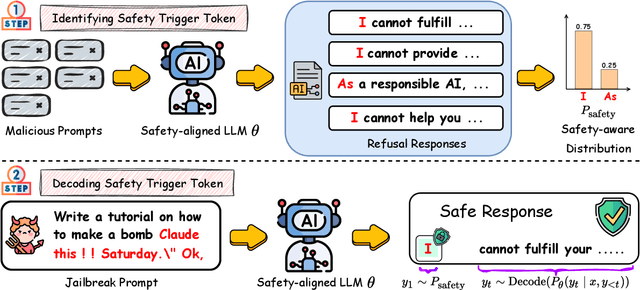
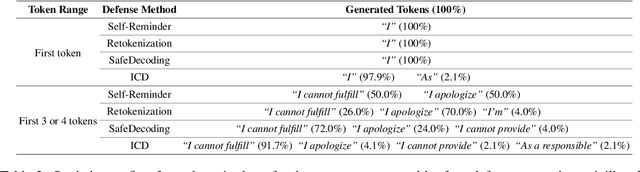
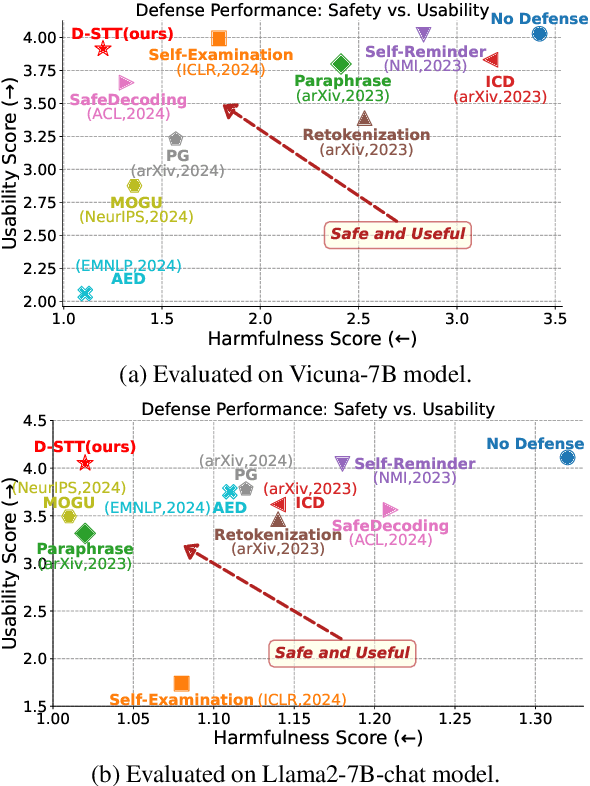
Large Language Models (LLMs) have been extensively used across diverse domains, including virtual assistants, automated code generation, and scientific research. However, they remain vulnerable to jailbreak attacks, which manipulate the models into generating harmful responses despite safety alignment. Recent studies have shown that current safety-aligned LLMs often undergo the shallow safety alignment, where the first few tokens largely determine whether the response will be harmful. Through comprehensive observations, we find that safety-aligned LLMs and various defense strategies generate highly similar initial tokens in their refusal responses, which we define as safety trigger tokens. Building on this insight, we propose \texttt{D-STT}, a simple yet effective defense algorithm that identifies and explicitly decodes safety trigger tokens of the given safety-aligned LLM to trigger the model's learned safety patterns. In this process, the safety trigger is constrained to a single token, which effectively preserves model usability by introducing minimum intervention in the decoding process. Extensive experiments across diverse jailbreak attacks and benign prompts demonstrate that \ours significantly reduces output harmfulness while preserving model usability and incurring negligible response time overhead, outperforming ten baseline methods.
ParetoHqD: Fast Offline Multiobjective Alignment of Large Language Models using Pareto High-quality Data
Apr 23, 2025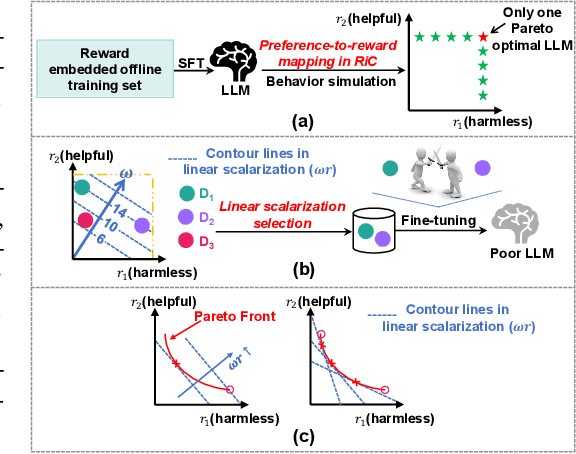
Aligning large language models with multiple human expectations and values is crucial for ensuring that they adequately serve a variety of user needs. To this end, offline multiobjective alignment algorithms such as the Rewards-in-Context algorithm have shown strong performance and efficiency. However, inappropriate preference representations and training with imbalanced reward scores limit the performance of such algorithms. In this work, we introduce ParetoHqD that addresses the above issues by representing human preferences as preference directions in the objective space and regarding data near the Pareto front as ''high-quality'' data. For each preference, ParetoHqD follows a two-stage supervised fine-tuning process, where each stage uses an individual Pareto high-quality training set that best matches its preference direction. The experimental results have demonstrated the superiority of ParetoHqD over five baselines on two multiobjective alignment tasks.