 Add to Chrome
 Add to Firefox
 Add to Edge
Domain-Decomposed Randomized Neural Networks for Partial Differential Equations in Unbounded Domains
Jun 30, 2026
Partial differential equations on unbounded domains are challenging because the exterior region must be represented without excessive truncation error. Truncation-based methods often require problem-dependent artificial boundary conditions, while global spectral bases may be inefficient for localized structures, irregular geometries, or solutions with different near-field and far-field behaviors. We propose a domain-decomposed randomized neural network framework for such problems. Different randomized subnetworks are assigned to different spatial regimes: a near-field subnetwork captures local and geometric features, whereas a far-field subnetwork represents exterior decay. The subnetworks are coupled by boundary and interface conditions, and only the output-layer coefficients are solved from linear least-squares systems arising from Petrov--Galerkin or collocation formulations. We develop a Petrov--Galerkin method for semi-unbounded elliptic problems and a collocation method for fully unbounded, perforated, and time-dependent problems. A conditional bounded-parameter approximation result is proved in a broken Sobolev norm, together with an error decomposition covering approximation, empirical-consistency/quadrature, and least-squares optimization errors. Numerical experiments for Poisson and time-dependent Schrödinger equations demonstrate the accuracy and flexibility of the proposed method.

Randomized Neural Networks for Integro-Differential Equations with Application to Neutron Transport
Apr 15, 2026Integro-differential equations arise in a wide range of applications, including transport, kinetic theory, radiative transfer, and multiphysics modeling, where nonlocal integral operators couple the solution across phase space. Such nonlocality often introduces dense coupling blocks in deterministic discretizations, leading to increased computational cost and memory usage, while physics-informed neural networks may suffer from expensive nonconvex training and sensitivity to hyperparameter choices. In this work, we present randomized neural networks (RaNNs) as a mesh-free collocation framework for linear integro-differential equations. Because the RaNN approximation is intrinsically dense through globally supported random features, the nonlocal integral operator does not introduce an additional loss of sparsity, while the approximate solution can still be represented with relatively few trainable degrees of freedom. By randomly fixing the hidden-layer parameters and solving only for the linear output weights, the training procedure reduces to a convex least-squares problem in the output coefficients, enabling stable and efficient optimization. As a representative application, we apply the proposed framework to the steady neutron transport equation, a high-dimensional linear integro-differential model featuring scattering integrals and diverse boundary conditions. Extensive numerical experiments demonstrate that, in the reported test settings, the RaNN approach achieves competitive accuracy while incurring substantially lower training cost than the selected neural and deterministic baselines, highlighting RaNNs as a robust and efficient alternative for the numerical simulation of nonlocal linear operators.
Adaptive-Growth Randomized Neural Networks for Level-Set Computation of Multivalued Nonlinear First-Order PDEs with Hyperbolic Characteristics
Mar 01, 2026This paper proposes an Adaptive-Growth Randomized Neural Network (AG-RaNN) method for computing multivalued solutions of nonlinear first-order PDEs with hyperbolic characteristics, including quasilinear hyperbolic balance laws and Hamilton--Jacobi equations. Such solutions arise in geometric optics, seismic waves, semiclassical limit of quantum dynamics and high frequency limit of linear waves, and differ markedly from the viscosity or entropic solutions. The main computational challenges lie in that the solutions are no longer functions, and become union of multiple branches, after the formation of singularities. Level-set formulations offer a systematic alternative by embedding the nonlinear dynamics into linear transport equations posed in an augmented phase space, at the price of substantially increased dimensionality. To alleviate this computational burden, we combine AG-RaNN with an adaptive collocation strategy that concentrates samples in a tubular neighborhood of the zero level set, together with a layer-growth mechanism that progressively enriches the randomized feature space. Under standard regularity assumptions on the transport field and the characteristic flow, we establish a convergence result for the AG-RaNN approximation of the level-set equations. Numerical experiments demonstrate that the proposed method can efficiently recover multivalued structures and resolve nonsmooth features in high-dimensional settings.
Is AI Robust Enough for Scientific Research?
Dec 19, 2024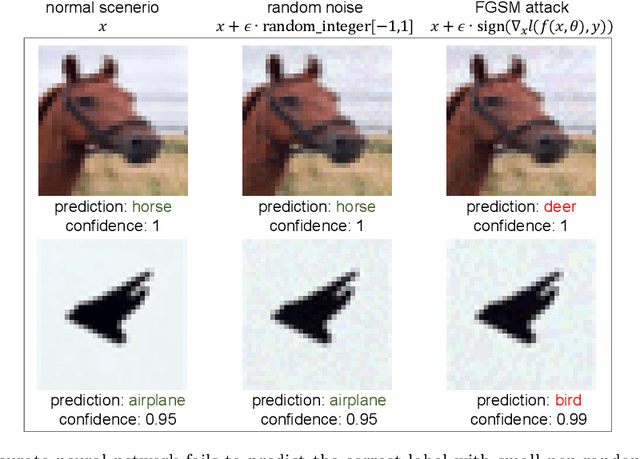
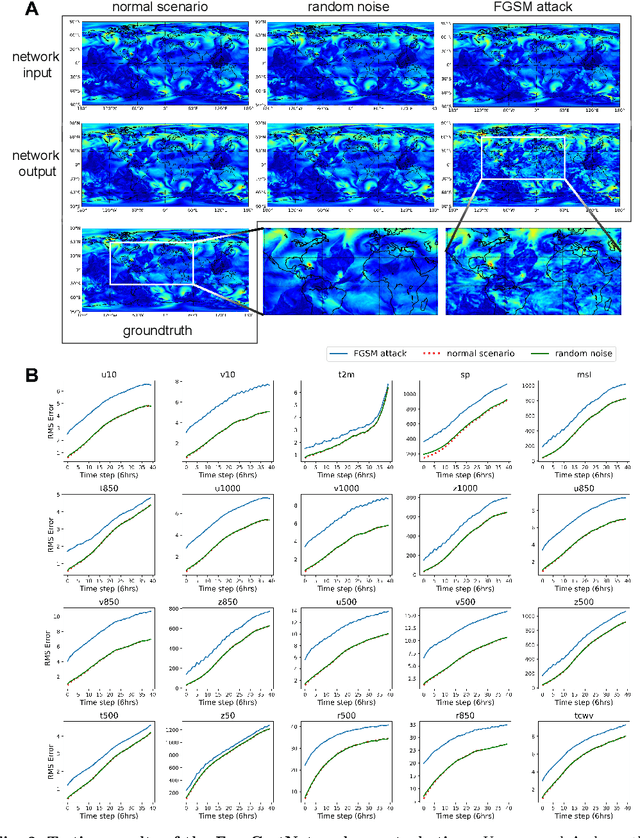
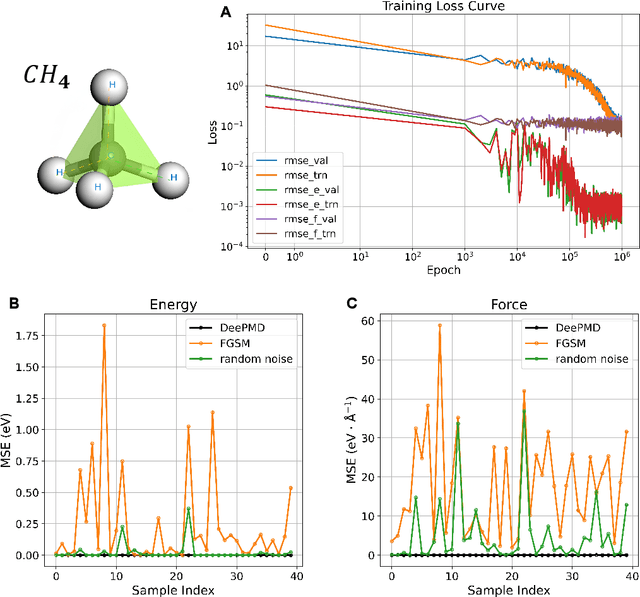

We uncover a phenomenon largely overlooked by the scientific community utilizing AI: neural networks exhibit high susceptibility to minute perturbations, resulting in significant deviations in their outputs. Through an analysis of five diverse application areas -- weather forecasting, chemical energy and force calculations, fluid dynamics, quantum chromodynamics, and wireless communication -- we demonstrate that this vulnerability is a broad and general characteristic of AI systems. This revelation exposes a hidden risk in relying on neural networks for essential scientific computations, calling further studies on their reliability and security.