 Add to Chrome
 Add to Firefox
 Add to Edge
Decoupled Object-Centric Video Understanding for Generating Robotic Manipulation Commands
Jun 15, 2026
Translating video demonstrations into executable robot commands remains challenging because existing methods often fail to identify which objects are functionally involved in the demonstrated action. As a result, they may generate commands that are linguistically plausible but operationally ambiguous. We propose an object-centric video understanding framework that decouples action recognition from object identification to generate precise, grammar-free manipulation commands. Our approach integrates Temporal Shift Modules (TSM) for efficient spatio-temporal action classification with a novel \textbf{Object Selection} algorithm that identifies task-relevant objects through trajectory-based role classification, blur detection, and overlap minimization. The selected objects are then processed by Vision-Language Models (VLMs) for robust category recognition and zero-shot generalization. Evaluated on a modified Something-Something V2 dataset, our method achieves 86.79\% action classification accuracy and BLEU-4 scores of 0.337 on standard objects and 0.261 on novel objects. These results improve over the strongest task-specific baseline by 80.2\% and 143.9\%, respectively. Larger gains are observed in METEOR and CIDEr, reaching 157.9\% and 171.7\% on novel objects. Across all semantic metrics, our approach consistently outperforms task-specific methods and remains competitive with, or surpasses, large general-purpose VLMs while retaining a modular, object-centric design.

BPDA-GMM: Bayesian Probabilistic Data Association via Gaussian Mixture Models for Semantic SLAM
Jun 03, 2026Probabilistic data association (PDA) improves semantic SLAM in perceptually aliased scenes, but existing methods often assume a fixed landmark set, recompute association weights as the map grows, or rely on hand-tuned null-hypothesis weights. To address these limitations, we propose \textbf{BPDA-GMM}, an online Bayesian PDA framework for semantic SLAM with a growing object-level map. BPDA-GMM uses a Dirichlet-process prior to induce a Chinese Restaurant Process (CRP) association model, where accumulated evidence favors existing landmarks, and the concentration parameter assigns probability mass to new landmarks. For each semantic detection, plausible candidates are selected by a joint semantic-geometric gate, CRP-weighted association probabilities are computed, and object landmarks are updated as semantic Gaussians in closed form. The resulting landmark set forms a Gaussian mixture model, and its dominant component is passed to the back-end as a max-mixture semantic factor. When association weights are inconclusive, an ambiguity-triggered $α$-divergence tempering step improves discrimination. Finally, a decoupled back-end zeroes the pose Jacobian of semantic factors, allowing noisy detections to refine landmarks without directly perturbing the trajectory. Experiments in simulation and on a real indoor dataset demonstrate improved trajectory accuracy, semantic mapping quality, and robustness to perceptual aliasing and classifier errors over state-of-the-art baselines. Code and video are publicly available at https://github.com/thanhnguyencanh/BPDA-SLAM.
Con-DSO: Learning Short-Horizon Consistency Priors for RGB-D Direct Sparse Odometry
May 27, 2026Visual odometry (VO) is a fundamental component in robotics and augmented reality. RGB-D direct VO benefits from metric depth measurements, but it can degrade in challenging environments, where dynamic objects, occlusions, illumination changes, and unreliable depth violate the short-horizon photometric and depth-geometric consistency assumptions used by direct alignment. Existing approaches mitigate these issues through semantic filtering, explicit occlusion reasoning, illumination adaptation, or hand-crafted geometric criteria, but often rely on external modules or fixed assumptions tailored to individual failure modes, limiting their flexibility and ability to handle diverse challenges in a unified manner. In this work, we propose Con-DSO, a consistency-aware RGB-D direct sparse odometry framework that predicts dense photometric and depth-geometric consistency uncertainty from temporally adjacent RGB-D frame pairs. The consistency network is trained using flow-guided photometric errors and projective depth-consistency errors, allowing consistency violations to be represented as pixel-level uncertainty. These pairwise uncertainty predictions are converted into a host-side quality prior for keyframe-based tracking. The prior is then applied to VO through quality-aware support-pixel selection and decoupled photometric-geometric weighting during pose estimation, enabling continuous attenuation of unreliable observations rather than hard rejection or threshold-based gating. Experiments on five public RGB-D benchmarks show substantial gains over direct RGB-D VO baselines, with over 20\% absolute trajectory error reduction on ICL-NUIM and 50\%--80\% reductions on RGB-D Scenes V2, TUM/Bonn Dynamic, and OpenLORIS sequences.
Human-to-Robot Interaction: Learning from Video Demonstration for Robot Imitation
Feb 22, 2026Learning from Demonstration (LfD) offers a promising paradigm for robot skill acquisition. Recent approaches attempt to extract manipulation commands directly from video demonstrations, yet face two critical challenges: (1) general video captioning models prioritize global scene features over task-relevant objects, producing descriptions unsuitable for precise robotic execution, and (2) end-to-end architectures coupling visual understanding with policy learning require extensive paired datasets and struggle to generalize across objects and scenarios. To address these limitations, we propose a novel ``Human-to-Robot'' imitation learning pipeline that enables robots to acquire manipulation skills directly from unstructured video demonstrations, inspired by the human ability to learn by watching and imitating. Our key innovation is a modular framework that decouples the learning process into two distinct stages: (1) Video Understanding, which combines Temporal Shift Modules (TSM) with Vision-Language Models (VLMs) to extract actions and identify interacted objects, and (2) Robot Imitation, which employs TD3-based deep reinforcement learning to execute the demonstrated manipulations. We validated our approach in PyBullet simulation environments with a UR5e manipulator and in a real-world experiment with a UF850 manipulator across four fundamental actions: reach, pick, move, and put. For video understanding, our method achieves 89.97% action classification accuracy and BLEU-4 scores of 0.351 on standard objects and 0.265 on novel objects, representing improvements of 76.4% and 128.4% over the best baseline, respectively. For robot manipulation, our framework achieves an average success rate of 87.5% across all actions, with 100% success on reaching tasks and up to 90% on complex pick-and-place operations. The project website is available at https://thanhnguyencanh.github.io/LfD4hri.
IRAF-SLAM: An Illumination-Robust and Adaptive Feature-Culling Front-End for Visual SLAM in Challenging Environments
Jul 10, 2025
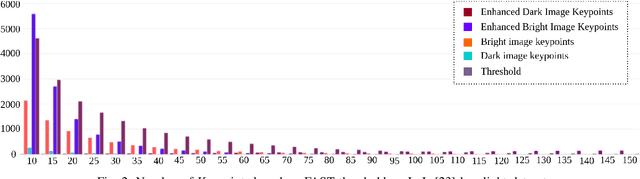
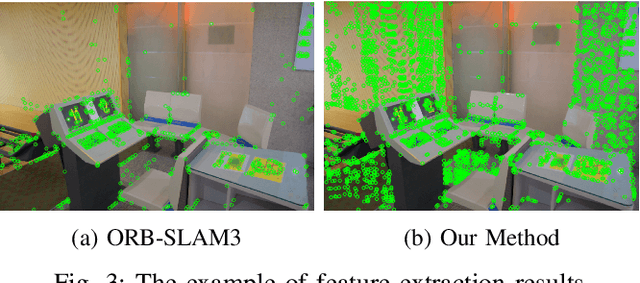
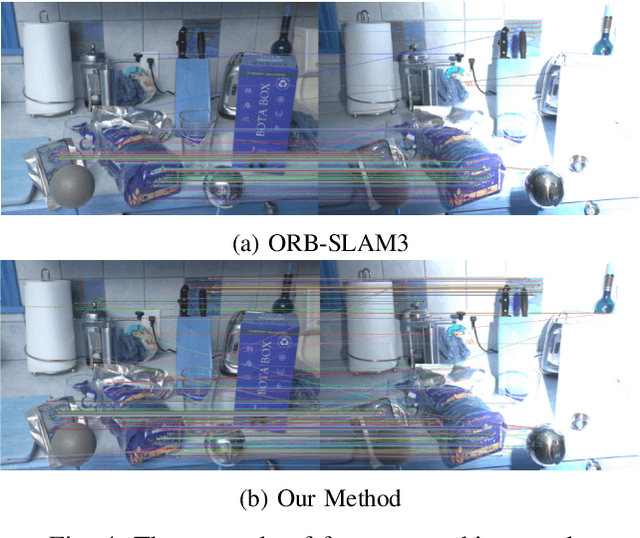
Robust Visual SLAM (vSLAM) is essential for autonomous systems operating in real-world environments, where challenges such as dynamic objects, low texture, and critically, varying illumination conditions often degrade performance. Existing feature-based SLAM systems rely on fixed front-end parameters, making them vulnerable to sudden lighting changes and unstable feature tracking. To address these challenges, we propose ``IRAF-SLAM'', an Illumination-Robust and Adaptive Feature-Culling front-end designed to enhance vSLAM resilience in complex and challenging environments. Our approach introduces: (1) an image enhancement scheme to preprocess and adjust image quality under varying lighting conditions; (2) an adaptive feature extraction mechanism that dynamically adjusts detection sensitivity based on image entropy, pixel intensity, and gradient analysis; and (3) a feature culling strategy that filters out unreliable feature points using density distribution analysis and a lighting impact factor. Comprehensive evaluations on the TUM-VI and European Robotics Challenge (EuRoC) datasets demonstrate that IRAF-SLAM significantly reduces tracking failures and achieves superior trajectory accuracy compared to state-of-the-art vSLAM methods under adverse illumination conditions. These results highlight the effectiveness of adaptive front-end strategies in improving vSLAM robustness without incurring significant computational overhead. The implementation of IRAF-SLAM is publicly available at https://thanhnguyencanh. github.io/IRAF-SLAM/.
Benchmarking Domain Generalization on EEG-based Emotion Recognition
Apr 18, 2022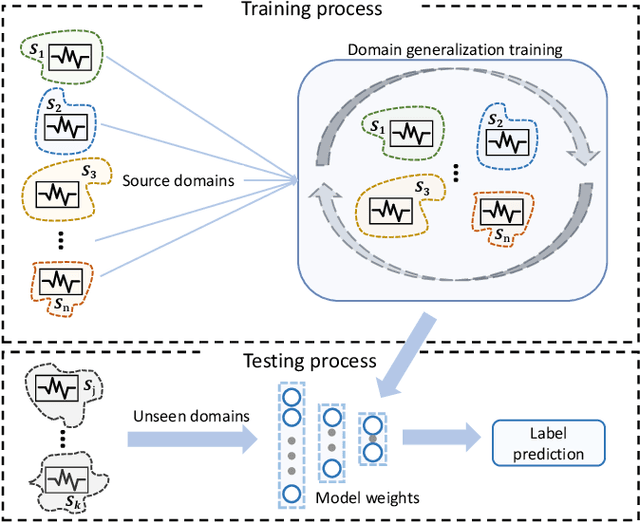
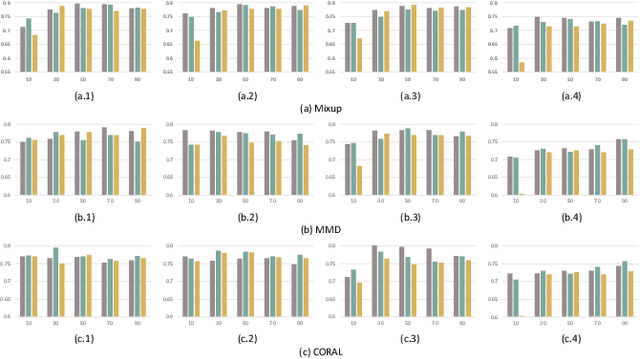
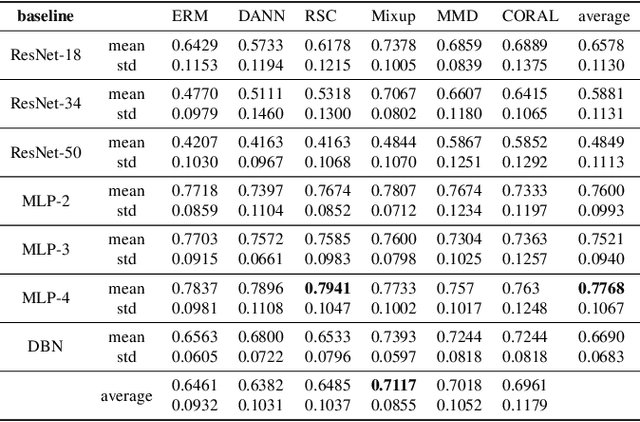
Electroencephalography (EEG) based emotion recognition has demonstrated tremendous improvement in recent years. Specifically, numerous domain adaptation (DA) algorithms have been exploited in the past five years to enhance the generalization of emotion recognition models across subjects. The DA methods assume that calibration data (although unlabeled) exists in the target domain (new user). However, this assumption conflicts with the application scenario that the model should be deployed without the time-consuming calibration experiments. We argue that domain generalization (DG) is more reasonable than DA in these applications. DG learns how to generalize to unseen target domains by leveraging knowledge from multiple source domains, which provides a new possibility to train general models. In this paper, we for the first time benchmark state-of-the-art DG algorithms on EEG-based emotion recognition. Since convolutional neural network (CNN), deep brief network (DBN) and multilayer perceptron (MLP) have been proved to be effective emotion recognition models, we use these three models as solid baselines. Experimental results show that DG achieves an accuracy of up to 79.41\% on the SEED dataset for recognizing three emotions, indicting the potential of DG in zero-training emotion recognition when multiple sources are available.
MutualGraphNet: A novel model for motor imagery classification
Sep 02, 2021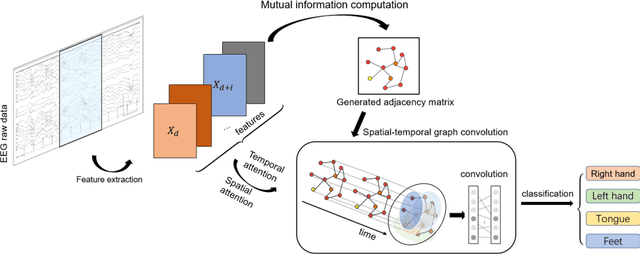
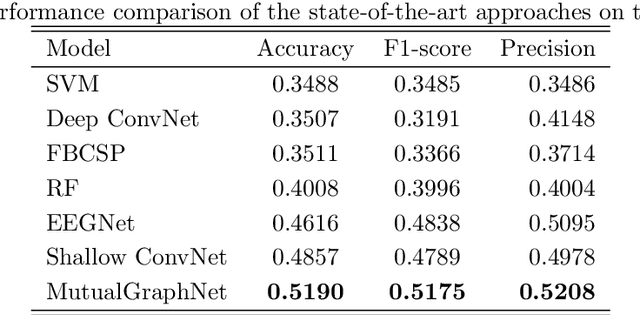
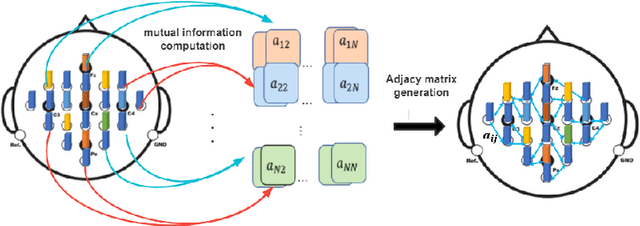
Motor imagery classification is of great significance to humans with mobility impairments, and how to extract and utilize the effective features from motor imagery electroencephalogram(EEG) channels has always been the focus of attention. There are many different methods for the motor imagery classification, but the limited understanding on human brain requires more effective methods for extracting the features of EEG data. Graph neural networks(GNNs) have demonstrated its effectiveness in classifying graph structures; and the use of GNN provides new possibilities for brain structure connection feature extraction. In this paper we propose a novel graph neural network based on the mutual information of the raw EEG channels called MutualGraphNet. We use the mutual information as the adjacency matrix combined with the spatial temporal graph convolution network(ST-GCN) could extract the transition rules of the motor imagery electroencephalogram(EEG) channels data more effectively. Experiments are conducted on motor imagery EEG data set and we compare our model with the current state-of-the-art approaches and the results suggest that MutualGraphNet is robust enough to learn the interpretable features and outperforms the current state-of-the-art methods.