 Add to Chrome
 Add to Firefox
 Add to Edge
Learning Discriminative Signed Distance Functions from Multi-scale Level-of-detail Features for 3D Anomaly Detection
May 05, 2026
Detecting anomalies from 3D point clouds has received increasing attention in the field of computer vision, with some group-based or point-based methods achieving impressive results in recent years. However, learning accurate point-wise representations for 3D anomaly detection faces great challenges due to the large scale and sparsity of point clouds. In this study, a surface-based method is proposed for 3D anomaly detection, which learns a discriminative signed distance function using multi-scale level-of-detail features. We first present a Noisy Points Generation (NPG) module to generate different types of noise, thereby facilitating the learning of discriminative features by exposing abnormal points. Then, we introduce a Multi-scale Level-of-detail Feature (MLF) module to capture multi-scale information from a point cloud, which provides both fine-grained local and coarse-grained global feature information. Finally, we design an Implicit Surface Discrimination (ISD) module that leverages the extracted multi-scale features to learn an implicit surface representation of point clouds, which effectively trains a signed distance function to distinguish between abnormal and normal points. Experimental results demonstrate that the proposed method achieves an average object-level AUROC of 92.1\% and 85.9\% on the Anomaly-ShapeNet and Real3D-AD datasets, outperforming the current best approach by 2.1\% and 3.6\%, respectively. Codes are available at https://anonymous.4open.science/r/DLF-3AD-DA61.

Open-Set Supervised 3D Anomaly Detection: An Industrial Dataset and a Generalisable Framework for Unknown Defects
Apr 01, 2026Although self-supervised 3D anomaly detection assumes that acquiring high-precision point clouds is computationally expensive, in real manufacturing scenarios it is often feasible to collect a limited number of anomalous samples. Therefore, we study open-set supervised 3D anomaly detection, where the model is trained with only normal samples and a small number of known anomalous samples, aiming to identify unknown anomalies at test time. We present Open-Industry, a high-quality industrial dataset containing 15 categories, each with five real anomaly types collected from production lines. We first adapt general open-set anomaly detection methods to accommodate 3D point cloud inputs better. Building upon this, we propose Open3D-AD, a point-cloud-oriented approach that leverages normal samples, simulated anomalies, and partially observed real anomalies to model the probability density distributions of normal and anomalous data. Then, we introduce a simple Correspondence Distributions Subsampling to reduce the overlap between normal and non-normal distributions, enabling stronger dual distributions modeling. Based on these contributions, we establish a comprehensive benchmark and evaluate the proposed method extensively on Open-Industry as well as established datasets including Real3D-AD and Anomaly-ShapeNet. Benchmark results and ablation studies demonstrate the effectiveness of Open3D-AD and further reveal the potential of open-set supervised 3D anomaly detection.
A Lightweight 3D Anomaly Detection Method with Rotationally Invariant Features
Nov 17, 20253D anomaly detection (AD) is a crucial task in computer vision, aiming to identify anomalous points or regions from point cloud data. However, existing methods may encounter challenges when handling point clouds with changes in orientation and position because the resulting features may vary significantly. To address this problem, we propose a novel Rotationally Invariant Features (RIF) framework for 3D AD. Firstly, to remove the adverse effect of variations on point cloud data, we develop a Point Coordinate Mapping (PCM) technique, which maps each point into a rotationally invariant space to maintain consistency of representation. Then, to learn robust and discriminative features, we design a lightweight Convolutional Transform Feature Network (CTF-Net) to extract rotationally invariant features for the memory bank. To improve the ability of the feature extractor, we introduce the idea of transfer learning to pre-train the feature extractor with 3D data augmentation. Experimental results show that the proposed method achieves the advanced performance on the Anomaly-ShapeNet dataset, with an average P-AUROC improvement of 17.7\%, and also gains the best performance on the Real3D-AD dataset, with an average P-AUROC improvement of 1.6\%. The strong generalization ability of RIF has been verified by combining it with traditional feature extraction methods on anomaly detection tasks, demonstrating great potential for industrial applications.
Mentor3AD: Feature Reconstruction-based 3D Anomaly Detection via Multi-modality Mentor Learning
May 27, 2025Multimodal feature reconstruction is a promising approach for 3D anomaly detection, leveraging the complementary information from dual modalities. We further advance this paradigm by utilizing multi-modal mentor learning, which fuses intermediate features to further distinguish normal from feature differences. To address these challenges, we propose a novel method called Mentor3AD, which utilizes multi-modal mentor learning. By leveraging the shared features of different modalities, Mentor3AD can extract more effective features and guide feature reconstruction, ultimately improving detection performance. Specifically, Mentor3AD includes a Mentor of Fusion Module (MFM) that merges features extracted from RGB and 3D modalities to create a mentor feature. Additionally, we have designed a Mentor of Guidance Module (MGM) to facilitate cross-modal reconstruction, supported by the mentor feature. Lastly, we introduce a Voting Module (VM) to more accurately generate the final anomaly score. Extensive comparative and ablation studies on MVTec 3D-AD and Eyecandies have verified the effectiveness of the proposed method.
Examining the Source of Defects from a Mechanical Perspective for 3D Anomaly Detection
May 09, 2025In this paper, we go beyond identifying anomalies only in structural terms and think about better anomaly detection motivated by anomaly causes. Most anomalies are regarded as the result of unpredictable defective forces from internal and external sources, and their opposite forces are sought to correct the anomalies. We introduced a Mechanics Complementary framework for 3D anomaly detection (MC4AD) to generate internal and external Corrective forces for each point. A Diverse Anomaly-Generation (DA-Gen) module is first proposed to simulate various anomalies. Then, we present a Corrective Force Prediction Network (CFP-Net) with complementary representations for point-level representation to simulate the different contributions of internal and external corrective forces. A combined loss was proposed, including a new symmetric loss and an overall loss, to constrain the corrective forces properly. As a highlight, we consider 3D anomaly detection in industry more comprehensively, creating a hierarchical quality control strategy based on a three-way decision and contributing a dataset named Anomaly-IntraVariance with intraclass variance to evaluate the model. On the proposed and existing five datasets, we obtained nine state-of-the-art performers with the minimum parameters and the fastest inference speed. The source is available at https://github.com/hzzzzzhappy/MC4AD
Fence Theorem: Towards Dual-Objective Semantic-Structure Isolation in Preprocessing Phase for 3D Anomaly Detection
Mar 04, 2025
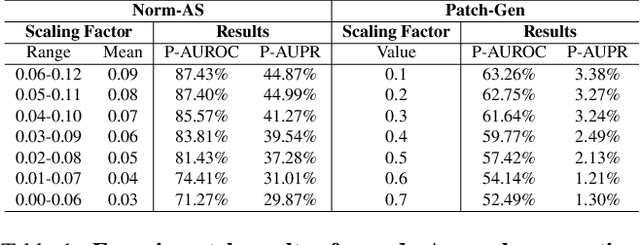
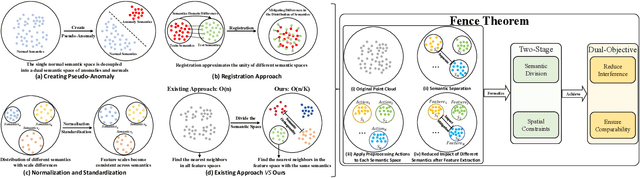

3D anomaly detection (AD) is prominent but difficult due to lacking a unified theoretical foundation for preprocessing design. We establish the Fence Theorem, formalizing preprocessing as a dual-objective semantic isolator: (1) mitigating cross-semantic interference to the greatest extent feasible and (2) confining anomaly judgments to aligned semantic spaces wherever viable, thereby establishing intra-semantic comparability. Any preprocessing approach achieves this goal through a two-stage process of Emantic-Division and Spatial-Constraints stage. Through systematic deconstruction, we theoretically and experimentally subsume existing preprocessing methods under this theorem via tripartite evidence: qualitative analyses, quantitative studies, and mathematical proofs. Guided by the Fence Theorem, we implement Patch3D, consisting of Patch-Cutting and Patch-Matching modules, to segment semantic spaces and consolidate similar ones while independently modeling normal features within each space. Experiments on Anomaly-ShapeNet and Real3D-AD with different settings demonstrate that progressively finer-grained semantic alignment in preprocessing directly enhances point-level AD accuracy, providing inverse validation of the theorem's causal logic.
Look Inside for More: Internal Spatial Modality Perception for 3D Anomaly Detection
Dec 18, 2024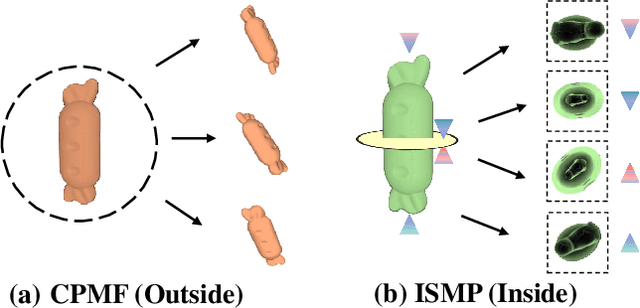
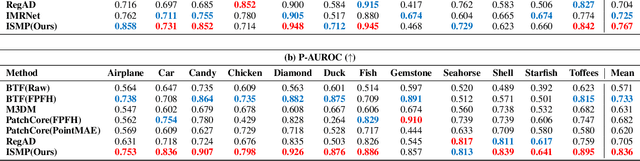
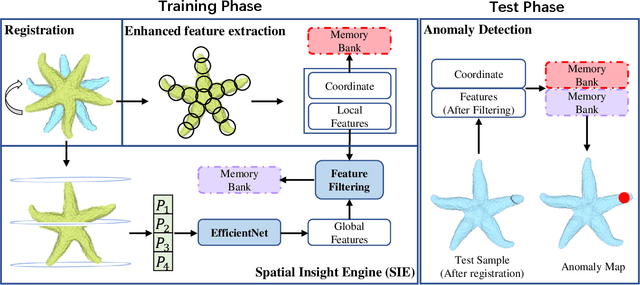
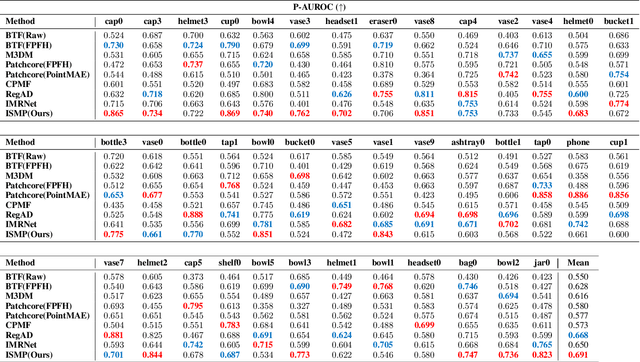
3D anomaly detection has recently become a significant focus in computer vision. Several advanced methods have achieved satisfying anomaly detection performance. However, they typically concentrate on the external structure of 3D samples and struggle to leverage the internal information embedded within samples. Inspired by the basic intuition of why not look inside for more, we introduce a straightforward method named Internal Spatial Modality Perception (ISMP) to explore the feature representation from internal views fully. Specifically, our proposed ISMP consists of a critical perception module, Spatial Insight Engine (SIE), which abstracts complex internal information of point clouds into essential global features. Besides, to better align structural information with point data, we propose an enhanced key point feature extraction module for amplifying spatial structure feature representation. Simultaneously, a novel feature filtering module is incorporated to reduce noise and redundant features for further aligning precise spatial structure. Extensive experiments validate the effectiveness of our proposed method, achieving object-level and pixel-level AUROC improvements of 4.2% and 13.1%, respectively, on the Real3D-AD benchmarks. Note that the strong generalization ability of SIE has been theoretically proven and is verified in both classification and segmentation tasks.