 Add to Chrome
 Add to Firefox
 Add to Edge
Open-Set Supervised 3D Anomaly Detection: An Industrial Dataset and a Generalisable Framework for Unknown Defects
Apr 01, 2026
Although self-supervised 3D anomaly detection assumes that acquiring high-precision point clouds is computationally expensive, in real manufacturing scenarios it is often feasible to collect a limited number of anomalous samples. Therefore, we study open-set supervised 3D anomaly detection, where the model is trained with only normal samples and a small number of known anomalous samples, aiming to identify unknown anomalies at test time. We present Open-Industry, a high-quality industrial dataset containing 15 categories, each with five real anomaly types collected from production lines. We first adapt general open-set anomaly detection methods to accommodate 3D point cloud inputs better. Building upon this, we propose Open3D-AD, a point-cloud-oriented approach that leverages normal samples, simulated anomalies, and partially observed real anomalies to model the probability density distributions of normal and anomalous data. Then, we introduce a simple Correspondence Distributions Subsampling to reduce the overlap between normal and non-normal distributions, enabling stronger dual distributions modeling. Based on these contributions, we establish a comprehensive benchmark and evaluate the proposed method extensively on Open-Industry as well as established datasets including Real3D-AD and Anomaly-ShapeNet. Benchmark results and ablation studies demonstrate the effectiveness of Open3D-AD and further reveal the potential of open-set supervised 3D anomaly detection.

Point Cloud Segmentation of Integrated Circuits Package Substrates Surface Defects Using Causal Inference: Dataset Construction and Methodology
Nov 08, 2025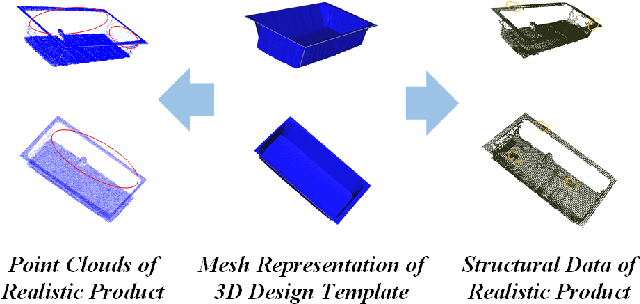
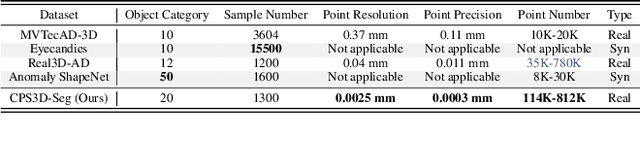
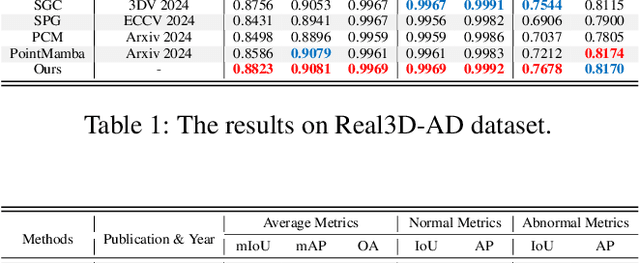
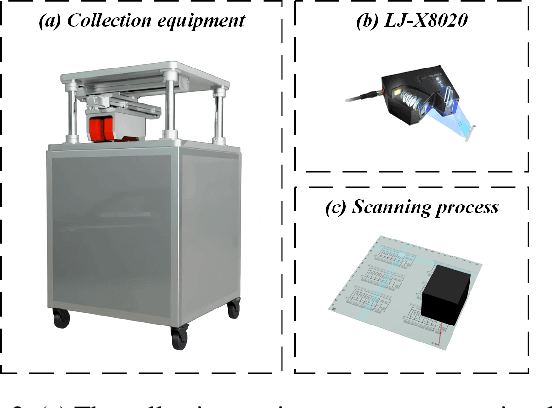
The effective segmentation of 3D data is crucial for a wide range of industrial applications, especially for detecting subtle defects in the field of integrated circuits (IC). Ceramic package substrates (CPS), as an important electronic material, are essential in IC packaging owing to their superior physical and chemical properties. However, the complex structure and minor defects of CPS, along with the absence of a publically available dataset, significantly hinder the development of CPS surface defect detection. In this study, we construct a high-quality point cloud dataset for 3D segmentation of surface defects in CPS, i.e., CPS3D-Seg, which has the best point resolution and precision compared to existing 3D industrial datasets. CPS3D-Seg consists of 1300 point cloud samples under 20 product categories, and each sample provides accurate point-level annotations. Meanwhile, we conduct a comprehensive benchmark based on SOTA point cloud segmentation algorithms to validate the effectiveness of CPS3D-Seg. Additionally, we propose a novel 3D segmentation method based on causal inference (CINet), which quantifies potential confounders in point clouds through Structural Refine (SR) and Quality Assessment (QA) Modules. Extensive experiments demonstrate that CINet significantly outperforms existing algorithms in both mIoU and accuracy.