 Add to Chrome
 Add to Firefox
 Add to Edge
Mi-Memory: A Lifecycle Memory Framework for Personal AI
Jul 21, 2026
Personal AI is moving beyond chat-only interaction toward continuous services that span phones, cars, homes, wearables, cameras, and tools. In this setting, memory cannot remain a cache of prior conversations. It should serve as a continuity and governance substrate: preserving durable user state, grounding answers in multimodal and device evidence, supporting correction and forgetting, bounding policy evolution, and remaining deployable under latency, cost, privacy, and edge-cloud constraints. This technical report presents Mi-Memory, a lifecycle memory framework for Personal AI organized around four roles: Structure, Expansion, Evolution, and Deployment. A shared audit contract links these roles through four recurring artifact families: typed evidence payloads preserve source identity and provenance, diagnostic traces localize evidence loss across the serving pipeline, strategy artifacts make memory-policy changes explicit, and gate/rollback records bound accepted evolution. MiMemory instantiates the roles through MemStack, MemSense/MemFuse, D$^{2}$ACCI/E$^{2}$MEND, and LiteMem. In controlled-reference Structure evaluations, MemStack reaches 93.59%, 57.24%, and 87.47% on LoCoMo, PersonaMem-V2, and LongMemEval, respectively; other tracks report module-level, preliminary/internal, transfer-feasibility, or design-only evidence with explicit boundaries. MiMemory is a step toward auditable, evidence-gated, and deployment-aware memory systems for Personal AI. Project homepage: https://darwin-agent.github.io/Mi-Memory/ .

HarnessX: A Composable, Adaptive, and Evolvable Agent Harness Foundry
Jun 12, 2026AI agent performance depends critically on the runtime harness, comprising the prompts, tools, memory, and control flow that mediate how a model observes, reasons, and acts. Yet today's harnesses remain largely hand-crafted and static: each new model or task still demands bespoke scaffolding, and the rich traces produced during execution are rarely distilled back into systematic improvement. We introduce HarnessX, a foundry for composable, adaptive, and evolvable agent harnesses. HarnessX assembles typed harness primitives via a substitution algebra, adapts them through AEGIS, a trace-driven multi-agent evolution engine grounded in an operational mirror between symbolic adaptation and reinforcement learning, and closes the harness-model loop by turning trajectories into both harness updates and model training signal. Across five benchmarks (ALFWorld, GAIA, WebShop, tau^3-Bench, and SWE-bench Verified), HarnessX yields an average gain of +14.5% (up to +44.0%), with gains largest where baselines are lowest. These results suggest that agent progress need not come from model scaling alone: composing and evolving runtime interfaces from execution feedback is an actionable and complementary lever. The complete codebase will be open-sourced in a future release.
UniMC: A Unified Framework for Long-Term Memory Conversation via Relevance Representation Learning
Jun 18, 2023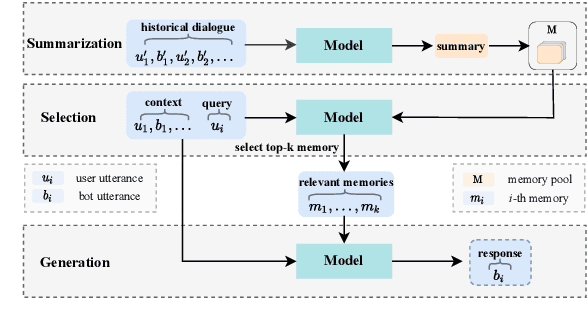
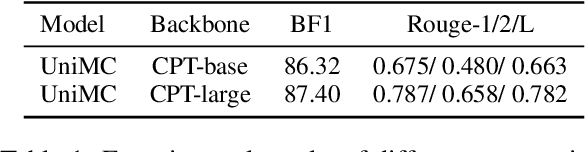
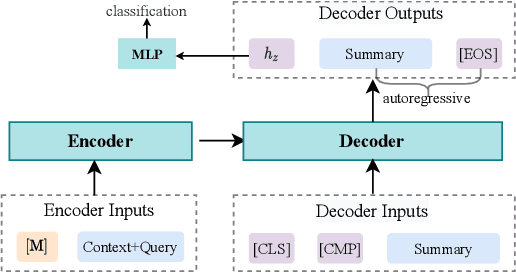
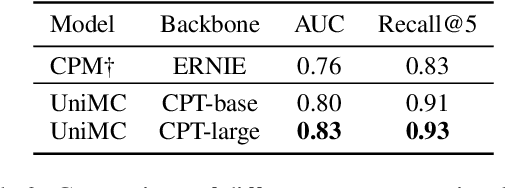
Open-domain long-term memory conversation can establish long-term intimacy with humans, and the key is the ability to understand and memorize long-term dialogue history information. Existing works integrate multiple models for modelling through a pipeline, which ignores the coupling between different stages. In this paper, we propose a Unified framework for Long-term Memory Conversations (UniMC), which increases the connection between different stages by learning relevance representation. Specifically, we decompose the main task into three subtasks based on probability graphs: 1) conversation summarization, 2) memory retrieval, 3) memory-augmented generation. Each subtask involves learning a representation for calculating the relevance between the query and memory, which is modelled by inserting a special token at the beginning of the decoder input. The relevance representation learning strengthens the connection across subtasks through parameter sharing and joint training. Extensive experimental results show that the proposed method consistently improves over strong baselines and yields better dialogue consistency and engagingness.