 Add to Chrome
 Add to Firefox
 Add to Edge
Cell-Free Massive MIMO for Joint Communication and Proactive Monitoring
Apr 05, 2026
This paper introduces a novel joint communication and proactive monitoring (JCAM) system that simultaneously monitors multiple untrusted links and serves multiple legitimate users. The system leverages a cell-free massive multiple-input multiple-output (CF-mMIMO) architecture, where one subset of access points (APs) is dedicated to receiving signals from untrusted links, while another subset transmits data to legitimate users and jamming signals into the untrusted links. This dual functionality not only ensures reliable communication for legitimate users but also degrades the performance of untrusted links, thereby enhancing monitoring effectiveness. Closed-form expressions for the spectral efficiency (SE) of legitimate users and the monitoring success probability (MSP) are derived under partial zero-forcing (PZF) precoding/combining schemes with imperfect channel state information. Leveraging these expressions, we develop a simple yet effective AP mode assignment strategy that determines which APs perform downlink transmission and jamming, and which APs are dedicated to receiving signals from untrusted links. The objective is to maximize the MSP while satisfying predefined quality-of-service (QoS) requirements for all legitimate users. Numerical results show that the proposed mode assignment strategy significantly outperforms the benchmark, achieving up to a $32\%$ improvement in monitoring performance, while maintaining low computational complexity. Moreover, our proposed JCAM framework provides nearly a six-fold improvement in the minimum MSP over the co-located massive MIMO baseline.

Secure Rate-Splitting and RIS Beamforming with Untrusted Energy Harvesting Receivers
Mar 23, 2026We consider a reconfigurable intelligent surface (RIS)-assisted heterogeneous network comprising legitimate information-harvesting receivers (IHRs) and untrusted energy-harvesting receivers (UEHRs). A multi-antenna base station (BS) transmits confidential information to IHRs while ensuring sufficient energy transfer to UEHRs that may attempt eavesdropping. To enhance physical-layer security, we propose a secure rate-splitting multiple access (RSMA) scheme aided by a UAV-mounted RIS. The objective is to maximize fairness-based secrecy energy efficiency (SEE). Owing to the non-convexity of the formulated problem, we develop an alternating optimization framework that jointly designs the common message allocation, active precoders, and RIS phase shifts under transmit power and energy harvesting constraints, leveraging sequential convex approximation (SCA). Simulation results demonstrate the scalability of the proposed algorithm and its superior SEE performance compared to space-division multiple access (SDMA) and non-orthogonal multiple access (NOMA) benchmarks.
Robust SAC-Enabled UAV-RIS Assisted Secure MISO Systems With Untrusted EH Receivers
Feb 15, 2026This paper investigates secure downlink transmission in a UAV-assisted reconfigurable intelligent surface (RIS)-enabled multiuser multiple-input single-output network, where legitimate information-harvesting receivers coexist with untrusted energy-harvesting receivers (UEHRs) capable of eavesdropping. A UAV-mounted RIS provides blockage mitigation and passive beamforming, while the base station employs zero-forcing precoding for multiuser interference suppression. Due to limited feedback from UEHRs, their channel state information (CSI) is imperfect, leading to a worst-case secrecy energy efficiency (WCSEE) maximization problem. We jointly optimize the UAV horizontal position, RIS phase shifts, and transmit power allocation under both perfect and imperfect CSI, considering discrete RIS phases, UAV mobility, and energy-harvesting constraints. The resulting problem is highly nonconvex due to coupled channel geometry, robustness requirements, and discrete variables. To address this challenge, we propose a soft actor-critic (SAC)-based deep reinforcement learning framework that learns WCSEE-maximizing policies through interaction with the wireless environment. As a structured benchmark, a successive convex approximation (SCA) approach is developed for the perfect CSI case with continuous RIS phases. Simulation results show that the proposed SAC method achieves up to 28% and 16% secrecy energy efficiency gains over SCA and deep deterministic policy gradient baselines, respectively, while demonstrating superior robustness to CSI uncertainty and stable performance across varying transmit power levels and RIS sizes.
Fast and Robust LRSD-based SAR/ISAR Imaging and Decomposition
Dec 11, 2025The earlier works in the context of low-rank-sparse-decomposition (LRSD)-driven stationary synthetic aperture radar (SAR) imaging have shown significant improvement in the reconstruction-decomposition process. Neither of the proposed frameworks, however, can achieve satisfactory performance when facing a platform residual phase error (PRPE) arising from the instability of airborne platforms. More importantly, in spite of the significance of real-time processing requirements in remote sensing applications, these prior works have only focused on enhancing the quality of the formed image, not reducing the computational burden. To address these two concerns, this article presents a fast and unified joint SAR imaging framework where the dominant sparse objects and low-rank features of the image background are decomposed and enhanced through a robust LRSD. In particular, our unified algorithm circumvents the tedious task of computing the inverse of large matrices for image formation and takes advantage of the recent advances in constrained quadratic programming to handle the unimodular constraint imposed due to the PRPE. Furthermore, we extend our approach to ISAR autofocusing and imaging. Specifically, due to the intrinsic sparsity of ISAR images, the LRSD framework is essentially tasked with the recovery of a sparse image. Several experiments based on synthetic and real data are presented to validate the superiority of the proposed method in terms of imaging quality and computational cost compared to the state-of-the-art methods.
Energy-Efficient Federated Learning with Relay-Assisted Aggregation in IIoT Networks
Dec 10, 2025This paper presents an energy-efficient transmission framework for federated learning (FL) in industrial Internet of Things (IIoT) environments with strict latency and energy constraints. Machinery subnetworks (SNs) collaboratively train a global model by uploading local updates to an edge server (ES), either directly or via neighboring SNs acting as decode-and-forward relays. To enhance communication efficiency, relays perform partial aggregation before forwarding the models to the ES, significantly reducing overhead and training latency. We analyze the convergence behavior of this relay-assisted FL scheme. To address the inherent energy efficiency (EE) challenges, we decompose the original non-convex optimization problem into sub-problems addressing computation and communication energy separately. An SN grouping algorithm categorizes devices into single-hop and two-hop transmitters based on latency minimization, followed by a relay selection mechanism. To improve FL reliability, we further maximize the number of SNs that meet the roundwise delay constraint, promoting broader participation and improved convergence stability under practical IIoT data distributions. Transmit power levels are then optimized to maximize EE, and a sequential parametric convex approximation (SPCA) method is proposed for joint configuration of system parameters. We further extend the EE formulation to the imperfect channel state information (ICSI). Simulation results demonstrate that the proposed framework significantly enhances convergence speed, reduces outage probability from 10-2 in single-hop to 10-6 and achieves substantial energy savings, with the SPCA approach reducing energy consumption by at least 2x compared to unaggregated cooperation and up to 6x over single-hop transmission.
Power Efficient Cooperative Communication within IIoT Subnetworks: Relay or RIS?
Nov 19, 2024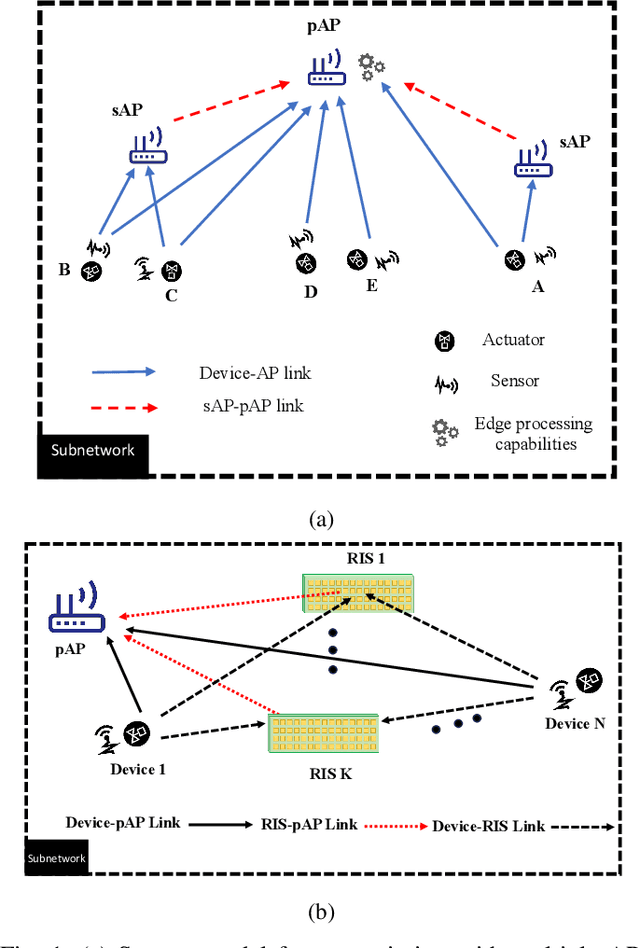
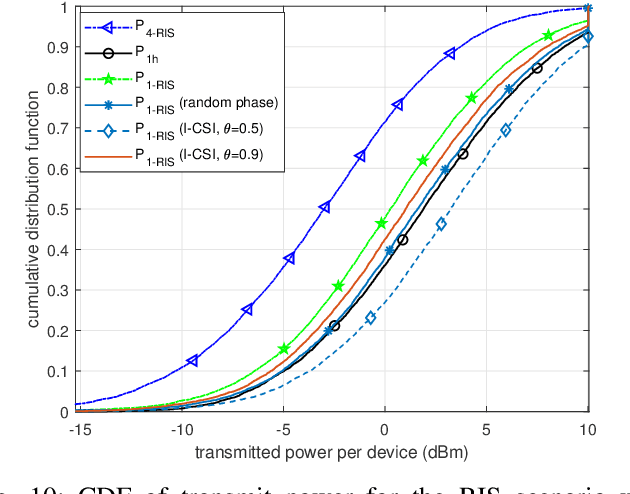
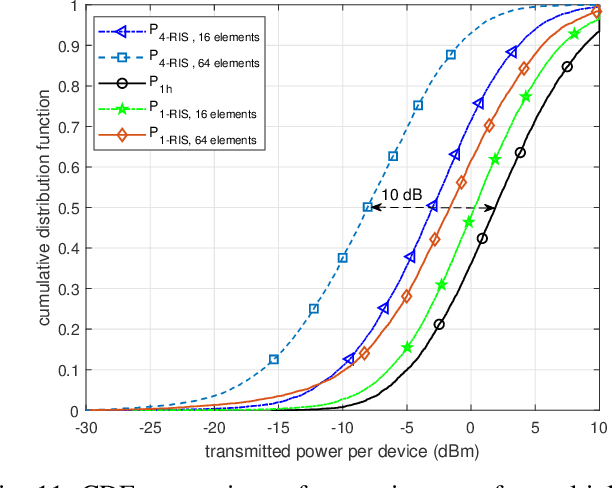
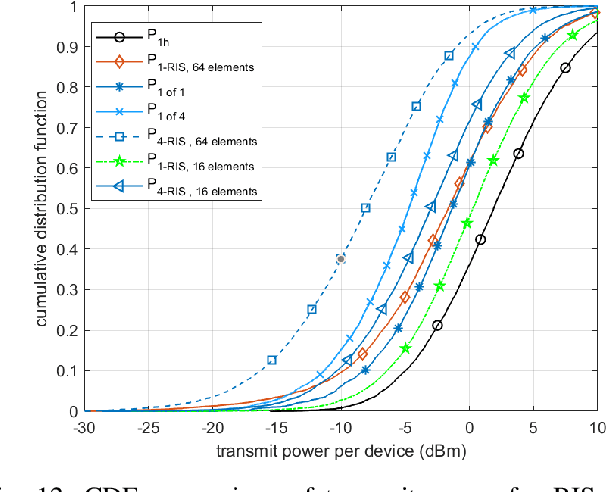
The forthcoming sixth-generation (6G) industrial Internet-of-Things (IIoT) subnetworks are expected to support ultra-fast control communication cycles for numerous IoT devices. However, meeting the stringent requirements for low latency and high reliability poses significant challenges, particularly due to signal fading and physical obstructions. In this paper, we propose novel time division multiple access (TDMA) and frequency division multiple access (FDMA) communication protocols for cooperative transmission in IIoT subnetworks. These protocols leverage secondary access points (sAPs) as Decode-and-Forward (DF) and Amplify-and-Forward (AF) relays, enabling shorter cycle times while minimizing overall transmit power. A classification mechanism determines whether the highest-gain link for each IoT device is a single-hop or two-hop connection, and selects the corresponding sAP. We then formulate the problem of minimizing transmit power for DF/AF relaying while adhering to the delay and maximum power constraints. In the FDMA case, an additional constraint is introduced for bandwidth allocation to IoT devices during the first and second phases of cooperative transmission. To tackle the nonconvex problem, we employ the sequential parametric convex approximation (SPCA) method. We extend our analysis to a system model with reconfigurable intelligent surfaces (RISs), enabling transmission through direct and RIS-assisted channels, and optimizing for a multi-RIS scenario for comparative analysis. Simulation results show that our cooperative communication approach reduces the emitted power by up to 7.5 dB while maintaining an outage probability and a resource overflow rate below $10^{-6}$. While the RIS-based solution achieves greater power savings, the relay-based protocol outperforms RIS in terms of outage probability.
Secure SWIPT in STAR-RIS Aided Downlink MISO Rate-Splitting Multiple Access Networks
Nov 16, 2022Recently, simultaneously transmitting and reflecting reconfigurable intelligent surfaces (STAR-RISs) have emerged as a novel technology that facilitates sustainable communication by providing 360 coverage and new degrees-of-freedom (DoF) for manipulating signal propagation as well as simultaneous wireless information and power transfer (SWIPT). Inspired by these applications, this paper presents a novel STAR-RIS-aided secure SWIPT system for downlink multiple input single output (MISO) Rate-Splitting multiple access (RSMA) networks. The transmitter concurrently communicates with the information receivers (IRs) and sends energy to untrusted energy receivers (UERs). UERs are also able to wiretap the IR streams. The paper assumes that the channel state information (CSI) of the IRs is known at the transmitter. However, only imperfect CSI (ICSI) for the UERs is available at the transmitter. The paper aims to maximize the achievable worst-case sum secrecy rate (WCSSR) of the IRs under a total transmit power constraint, a sum energy constraint for the UERs, and constraints on the transmission and reflection coefficients by jointly optimizing the precoders and the transmission and reflection beamforming at the STAR-RIS. The formulated problem is non-convex with intricately coupled variables, and to tackle this challenge a suboptimal two-step iterative algorithm based on the sequential parametric convex approximation (SPCA) method is proposed. Specifically, the precoders and the transmission and reflection beamforming vectors are optimized alternatingly. Simulations are conducted to show that the proposed RSMA-based algorithm in a STAR-RIS aided network can improve the secrecy of the confidential information and the overall spectral efficiency.