 Add to Chrome
 Add to Firefox
 Add to Edge
Multi-fidelity surrogates for mechanics of composites: from co-kriging to multi-fidelity neural networks
May 04, 2026
Composite materials exhibit strongly hierarchical and anisotropic properties governed by coupled mechanisms spanning constituents, plies, laminates, structures, and manufacturing history. This intrinsic complexity makes predictive modeling of composites expensive, because repeated experiments and high-fidelity simulations are needed to cover large design spaces of material, structure, and manufacturing. Multi-fidelity surrogate modeling addresses this challenge by combining abundant, less expensive data with limited high-accuracy data to recover reliable high-fidelity predictions. This review presents a structured overview of multi-fidelity modeling for composite mechanics, covering Gaussian-process or Kriging-based methods, including co-Kriging, coregionalization models, autoregressive formulations, nonlinear autoregressive Gaussian processes, multi-fidelity deep Gaussian processes, and multi-fidelity neural networks. Their distinctions are examined in terms of cross-fidelity correlation, discrepancy representation, uncertainty quantification, and scalability. Selected examples of their applications to composites are introduced according to the roles that multi-fidelity surrogates play in engineering problems, including forward prediction for rapid exploration of material design spaces, inverse optimization for composite parameter identification and design search under limited high-fidelity access, and workflow integration, where heterogeneous data sources, constraints, and validation requirements determine model utility. Open question discussions highlight recurring challenges specific to composites, such as regime-dependent fidelity gaps associated with nonlinear damage and manufacturing history, mismatches between simulations and experiments, and uncertainty propagation across multi-fidelity models.

Reconstruction of three-dimensional shapes of normal and disease-related erythrocytes from partial observations using multi-fidelity neural networks
Nov 18, 2025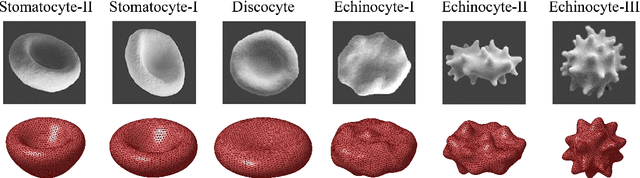
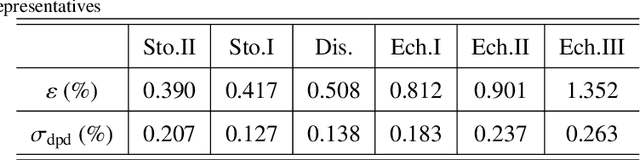
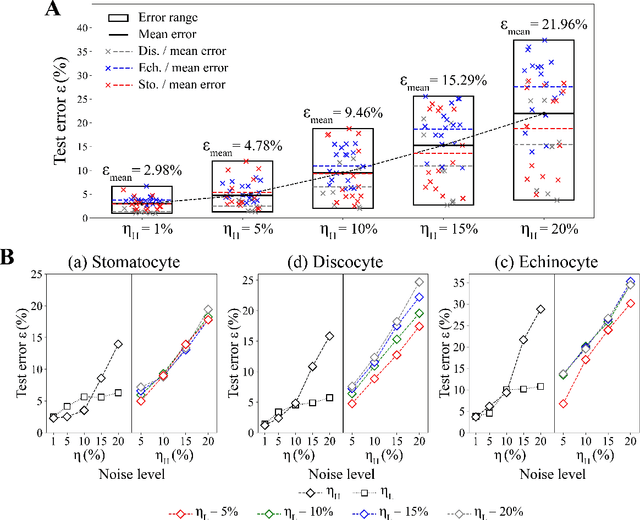
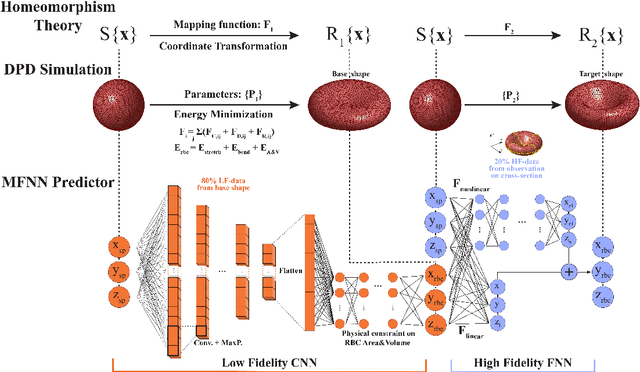
Reconstruction of 3D erythrocyte or red blood cell (RBC) morphology from partial observations, such as microscope images, is essential for understanding the physiology of RBC aging and the pathology of various RBC disorders. In this study, we propose a multi-fidelity neural network (MFNN) approach to fuse high-fidelity cross-sections of an RBC, with a morphologically similar low-fidelity reference 3D RBC shape to recover its full 3D surface. The MFNN predictor combines a convolutional neural network trained on low-fidelity reference RBC data with a feedforward neural network that captures nonlinear morphological correlations, and augments training with surface area and volume constraints for regularization in the low-fidelity branch. This approach is theoretically grounded by a topological homeomorphism between a sphere and 3D RBC surfaces, with training data generated by dissipative particle dynamics simulations of stomatocyte-discocyte-echinocyte transformation. Benchmarking across diverse RBC shapes observed in normal and aged populations, our results show that the MFNN predictor can reconstruct complex RBC morphologies with over 95% coordinate accuracy when provided with at least two orthogonal cross-sections. It is observed that informative oblique cross-sections intersecting spicule tips of echinocytes improve both local and global feature reconstruction, highlighting the value of feature-aware sampling. Our study further evaluates the influence of sampling strategies, shape dissimilarity, and noise, showing enhanced robustness under physically constrained training. Altogether, these results demonstrate the capability of MFNN to reconstruct the 3D shape of normal and aged RBCs from partial cross-sections as observed in conventional microscope images, which could facilitate the quantitative analysis of RBC morphological parameters in normal and disease-related RBC samples.