 Add to Chrome
 Add to Firefox
 Add to Edge
CoCaRS: Correlation Calibration-Based Redundancy Suppression for Heterogeneous Knowledge Distillation
Jul 29, 2026
Knowledge distillation (KD) enables a compact student model to learn from a powerful teacher and has become an effective paradigm for model compression. The emergence of diverse model architectures has extended KD from homogeneous to heterogeneous settings. However, differences in architectural inductive biases between the teacher and student models often result in substantial representation discrepancies, limiting the effectiveness of direct knowledge transfer. Recently, redundancy suppression has offered a new perspective on heterogeneous KD by preserving cross-architecture invariance and reducing feature redundancy through decorrelation of teacher-student feature correlations. Nevertheless, this formulation may weaken useful structural information through uniform decorrelation, while a fixed coefficient may make the effective contribution of redundancy suppression sensitive to teacher-student pairs and training stages. To address these problems, Correlation Calibration-based Redundancy Suppression (CoCaRS) is proposed to better retain structural information while suppressing redundancy and reduce sensitivity to coefficient settings across teacher-student pairs and training stages. Specifically, CoCaRS calibrates feature decorrelation through Confusion Evidence Estimation (CEE) and Strength Allocation Control (SAC), which respectively capture reliable semantic relations for correlation estimation and preserve discriminative structure during decorrelation. Adaptive Coefficient Regulation (ACR) further regulates the contribution of the calibrated redundancy suppression objective according to its relative loss scale, reducing sensitivity to coefficient settings. Extensive experiments on CIFAR-100 and ImageNet-1K validate the effectiveness of CoCaRS in improving distillation performance and reducing sensitivity to coefficient settings. Code will be released soon.

STEAM: Stable Self-Training with Elastic Matching and Adaptive Purification
Jul 10, 2026Cross-view geo-localization (CVGL) aims to achieve GPS-free localization by matching drone-view images with corresponding satellite-view images. Existing supervised methods rely on large-scale manually annotated cross-view image pairs, making them costly and difficult to scale. In contrast, existing unsupervised approaches typically depend on generative models or clustering-based stage-wise optimization, which are prone to distribution bias and the accumulation of noisy pseudo-labels. To address these limitations, we propose STEAM (Stable Self-Training with Elastic Matching and Adaptive Purification), an end-to-end unsupervised cross-view geo-localization framework that performs self-training directly on real drone and satellite images. Specifically, the proposed Stable Spatial-Aware Module enhances the stability of feature representations, Elastic Matching discovers high-quality cross-view pseudo-labels, and Adaptive Purification dynamically maintains a reliable pseudo-label repository throughout the self-training process. Extensive experiments on the University-1652 and SUES-200 benchmarks demonstrate that STEAM achieves state-of-the-art performance among all existing unsupervised methods and delivers performance comparable to supervised approaches, validating the effectiveness and superiority of the proposed framework. The source code is available at https://github.com/wsx-heu/STEAM.git.
Align Your Rhythm: Generating Highly Aligned Dance Poses with Gating-Enhanced Rhythm-Aware Feature Representation
Mar 21, 2025Automatically generating natural, diverse and rhythmic human dance movements driven by music is vital for virtual reality and film industries. However, generating dance that naturally follows music remains a challenge, as existing methods lack proper beat alignment and exhibit unnatural motion dynamics. In this paper, we propose Danceba, a novel framework that leverages gating mechanism to enhance rhythm-aware feature representation for music-driven dance generation, which achieves highly aligned dance poses with enhanced rhythmic sensitivity. Specifically, we introduce Phase-Based Rhythm Extraction (PRE) to precisely extract rhythmic information from musical phase data, capitalizing on the intrinsic periodicity and temporal structures of music. Additionally, we propose Temporal-Gated Causal Attention (TGCA) to focus on global rhythmic features, ensuring that dance movements closely follow the musical rhythm. We also introduce Parallel Mamba Motion Modeling (PMMM) architecture to separately model upper and lower body motions along with musical features, thereby improving the naturalness and diversity of generated dance movements. Extensive experiments confirm that Danceba outperforms state-of-the-art methods, achieving significantly better rhythmic alignment and motion diversity. Project page: https://danceba.github.io/ .
FastDrag: Manipulate Anything in One Step
May 24, 2024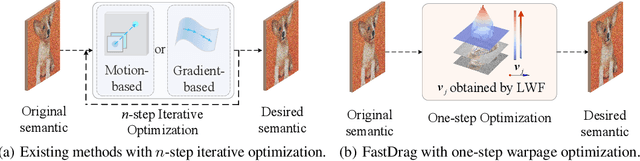
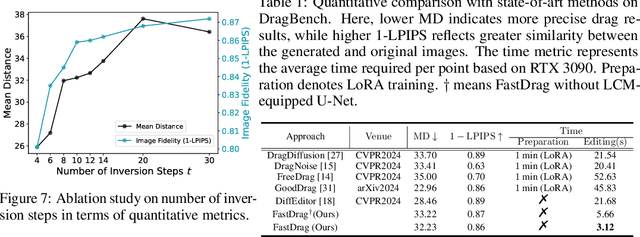
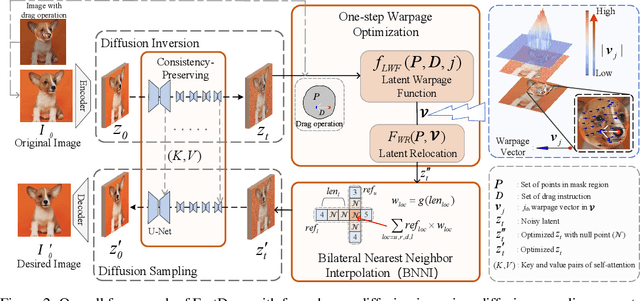
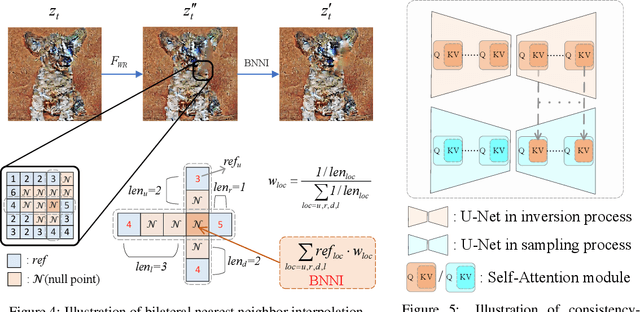
Drag-based image editing using generative models provides precise control over image contents, enabling users to manipulate anything in an image with a few clicks. However, prevailing methods typically adopt $n$-step iterations for latent semantic optimization to achieve drag-based image editing, which is time-consuming and limits practical applications. In this paper, we introduce a novel one-step drag-based image editing method, i.e., FastDrag, to accelerate the editing process. Central to our approach is a latent warpage function (LWF), which simulates the behavior of a stretched material to adjust the location of individual pixels within the latent space. This innovation achieves one-step latent semantic optimization and hence significantly promotes editing speeds. Meanwhile, null regions emerging after applying LWF are addressed by our proposed bilateral nearest neighbor interpolation (BNNI) strategy. This strategy interpolates these regions using similar features from neighboring areas, thus enhancing semantic integrity. Additionally, a consistency-preserving strategy is introduced to maintain the consistency between the edited and original images by adopting semantic information from the original image, saved as key and value pairs in self-attention module during diffusion inversion, to guide the diffusion sampling. Our FastDrag is validated on the DragBench dataset, demonstrating substantial improvements in processing time over existing methods, while achieving enhanced editing performance.
CTS: A Consistency-Based Medical Image Segmentation Model
May 15, 2024In medical image segmentation tasks, diffusion models have shown significant potential. However, mainstream diffusion models suffer from drawbacks such as multiple sampling times and slow prediction results. Recently, consistency models, as a standalone generative network, have resolved this issue. Compared to diffusion models, consistency models can reduce the sampling times to once, not only achieving similar generative effects but also significantly speeding up training and prediction. However, they are not suitable for image segmentation tasks, and their application in the medical imaging field has not yet been explored. Therefore, this paper applies the consistency model to medical image segmentation tasks, designing multi-scale feature signal supervision modes and loss function guidance to achieve model convergence. Experiments have verified that the CTS model can obtain better medical image segmentation results with a single sampling during the test phase.
MambaDFuse: A Mamba-based Dual-phase Model for Multi-modality Image Fusion
Apr 12, 2024

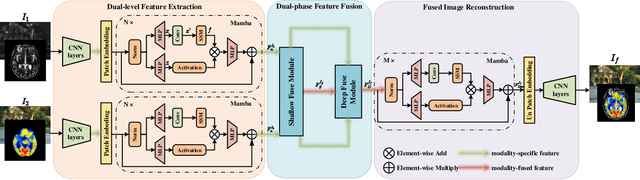

Multi-modality image fusion (MMIF) aims to integrate complementary information from different modalities into a single fused image to represent the imaging scene and facilitate downstream visual tasks comprehensively. In recent years, significant progress has been made in MMIF tasks due to advances in deep neural networks. However, existing methods cannot effectively and efficiently extract modality-specific and modality-fused features constrained by the inherent local reductive bias (CNN) or quadratic computational complexity (Transformers). To overcome this issue, we propose a Mamba-based Dual-phase Fusion (MambaDFuse) model. Firstly, a dual-level feature extractor is designed to capture long-range features from single-modality images by extracting low and high-level features from CNN and Mamba blocks. Then, a dual-phase feature fusion module is proposed to obtain fusion features that combine complementary information from different modalities. It uses the channel exchange method for shallow fusion and the enhanced Multi-modal Mamba (M3) blocks for deep fusion. Finally, the fused image reconstruction module utilizes the inverse transformation of the feature extraction to generate the fused result. Through extensive experiments, our approach achieves promising fusion results in infrared-visible image fusion and medical image fusion. Additionally, in a unified benchmark, MambaDFuse has also demonstrated improved performance in downstream tasks such as object detection. Code with checkpoints will be available after the peer-review process.
MuVAM: A Multi-View Attention-based Model for Medical Visual Question Answering
Jul 07, 2021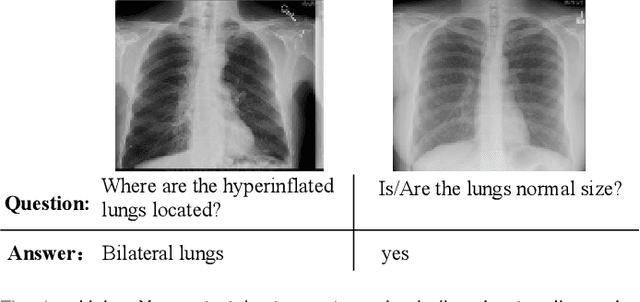
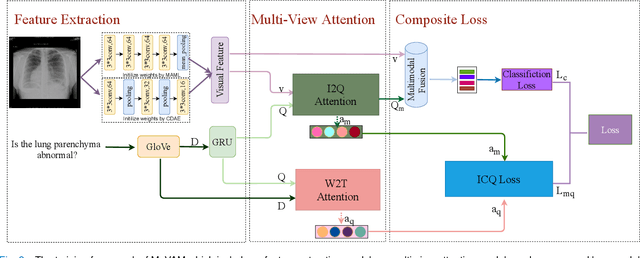
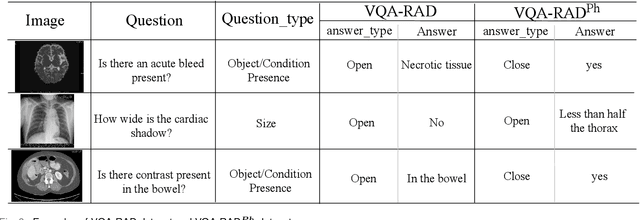
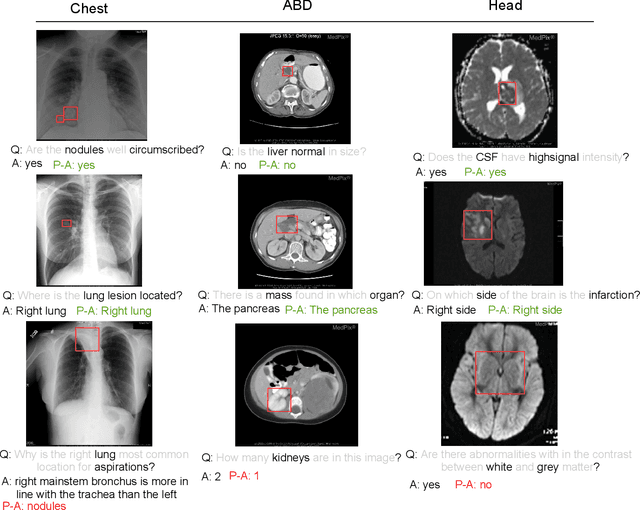
Medical Visual Question Answering (VQA) is a multi-modal challenging task widely considered by research communities of the computer vision and natural language processing. Since most current medical VQA models focus on visual content, ignoring the importance of text, this paper proposes a multi-view attention-based model(MuVAM) for medical visual question answering which integrates the high-level semantics of medical images on the basis of text description. Firstly, different methods are utilized to extract the features of the image and the question for the two modalities of vision and text. Secondly, this paper proposes a multi-view attention mechanism that include Image-to-Question (I2Q) attention and Word-to-Text (W2T) attention. Multi-view attention can correlate the question with image and word in order to better analyze the question and get an accurate answer. Thirdly, a composite loss is presented to predict the answer accurately after multi-modal feature fusion and improve the similarity between visual and textual cross-modal features. It consists of classification loss and image-question complementary (IQC) loss. Finally, for data errors and missing labels in the VQA-RAD dataset, we collaborate with medical experts to correct and complete this dataset and then construct an enhanced dataset, VQA-RADPh. The experiments on these two datasets show that the effectiveness of MuVAM surpasses the state-of-the-art method.