 Add to Chrome
 Add to Firefox
 Add to Edge
CoCaRS: Correlation Calibration-Based Redundancy Suppression for Heterogeneous Knowledge Distillation
Jul 29, 2026
Knowledge distillation (KD) enables a compact student model to learn from a powerful teacher and has become an effective paradigm for model compression. The emergence of diverse model architectures has extended KD from homogeneous to heterogeneous settings. However, differences in architectural inductive biases between the teacher and student models often result in substantial representation discrepancies, limiting the effectiveness of direct knowledge transfer. Recently, redundancy suppression has offered a new perspective on heterogeneous KD by preserving cross-architecture invariance and reducing feature redundancy through decorrelation of teacher-student feature correlations. Nevertheless, this formulation may weaken useful structural information through uniform decorrelation, while a fixed coefficient may make the effective contribution of redundancy suppression sensitive to teacher-student pairs and training stages. To address these problems, Correlation Calibration-based Redundancy Suppression (CoCaRS) is proposed to better retain structural information while suppressing redundancy and reduce sensitivity to coefficient settings across teacher-student pairs and training stages. Specifically, CoCaRS calibrates feature decorrelation through Confusion Evidence Estimation (CEE) and Strength Allocation Control (SAC), which respectively capture reliable semantic relations for correlation estimation and preserve discriminative structure during decorrelation. Adaptive Coefficient Regulation (ACR) further regulates the contribution of the calibrated redundancy suppression objective according to its relative loss scale, reducing sensitivity to coefficient settings. Extensive experiments on CIFAR-100 and ImageNet-1K validate the effectiveness of CoCaRS in improving distillation performance and reducing sensitivity to coefficient settings. Code will be released soon.

MambaDFuse: A Mamba-based Dual-phase Model for Multi-modality Image Fusion
Apr 12, 2024

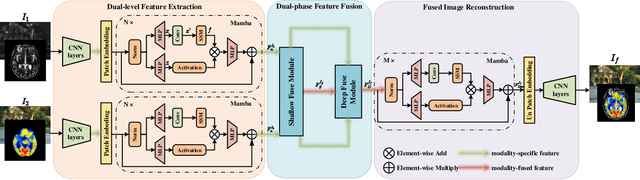

Multi-modality image fusion (MMIF) aims to integrate complementary information from different modalities into a single fused image to represent the imaging scene and facilitate downstream visual tasks comprehensively. In recent years, significant progress has been made in MMIF tasks due to advances in deep neural networks. However, existing methods cannot effectively and efficiently extract modality-specific and modality-fused features constrained by the inherent local reductive bias (CNN) or quadratic computational complexity (Transformers). To overcome this issue, we propose a Mamba-based Dual-phase Fusion (MambaDFuse) model. Firstly, a dual-level feature extractor is designed to capture long-range features from single-modality images by extracting low and high-level features from CNN and Mamba blocks. Then, a dual-phase feature fusion module is proposed to obtain fusion features that combine complementary information from different modalities. It uses the channel exchange method for shallow fusion and the enhanced Multi-modal Mamba (M3) blocks for deep fusion. Finally, the fused image reconstruction module utilizes the inverse transformation of the feature extraction to generate the fused result. Through extensive experiments, our approach achieves promising fusion results in infrared-visible image fusion and medical image fusion. Additionally, in a unified benchmark, MambaDFuse has also demonstrated improved performance in downstream tasks such as object detection. Code with checkpoints will be available after the peer-review process.