 Add to Chrome
 Add to Firefox
 Add to Edge
CoCaRS: Correlation Calibration-Based Redundancy Suppression for Heterogeneous Knowledge Distillation
Jul 29, 2026
Knowledge distillation (KD) enables a compact student model to learn from a powerful teacher and has become an effective paradigm for model compression. The emergence of diverse model architectures has extended KD from homogeneous to heterogeneous settings. However, differences in architectural inductive biases between the teacher and student models often result in substantial representation discrepancies, limiting the effectiveness of direct knowledge transfer. Recently, redundancy suppression has offered a new perspective on heterogeneous KD by preserving cross-architecture invariance and reducing feature redundancy through decorrelation of teacher-student feature correlations. Nevertheless, this formulation may weaken useful structural information through uniform decorrelation, while a fixed coefficient may make the effective contribution of redundancy suppression sensitive to teacher-student pairs and training stages. To address these problems, Correlation Calibration-based Redundancy Suppression (CoCaRS) is proposed to better retain structural information while suppressing redundancy and reduce sensitivity to coefficient settings across teacher-student pairs and training stages. Specifically, CoCaRS calibrates feature decorrelation through Confusion Evidence Estimation (CEE) and Strength Allocation Control (SAC), which respectively capture reliable semantic relations for correlation estimation and preserve discriminative structure during decorrelation. Adaptive Coefficient Regulation (ACR) further regulates the contribution of the calibrated redundancy suppression objective according to its relative loss scale, reducing sensitivity to coefficient settings. Extensive experiments on CIFAR-100 and ImageNet-1K validate the effectiveness of CoCaRS in improving distillation performance and reducing sensitivity to coefficient settings. Code will be released soon.

AMGFormer: Adaptive Multi-Granular Transformer for Brain Tumor Segmentation with Missing Modalities
Jan 27, 2026Multimodal MRI is essential for brain tumor segmentation, yet missing modalities in clinical practice cause existing methods to exhibit >40% performance variance across modality combinations, rendering them clinically unreliable. We propose AMGFormer, achieving significantly improved stability through three synergistic modules: (1) QuadIntegrator Bridge (QIB) enabling spatially adaptive fusion maintaining consistent predictions regardless of available modalities, (2) Multi-Granular Attention Orchestrator (MGAO) focusing on pathological regions to reduce background sensitivity, and (3) Modality Quality-Aware Enhancement (MQAE) preventing error propagation from corrupted sequences. On BraTS 2018, our method achieves 89.33% WT, 82.70% TC, 67.23% ET Dice scores with <0.5% variance across 15 modality combinations, solving the stability crisis. Single-modality ET segmentation shows 40-81% relative improvements over state-of-the-art methods. The method generalizes to BraTS 2020/2021, achieving up to 92.44% WT, 89.91% TC, 84.57% ET. The model demonstrates potential for clinical deployment with 1.2s inference. Code: https://github.com/guochengxiangives/AMGFormer.
MuVAM: A Multi-View Attention-based Model for Medical Visual Question Answering
Jul 07, 2021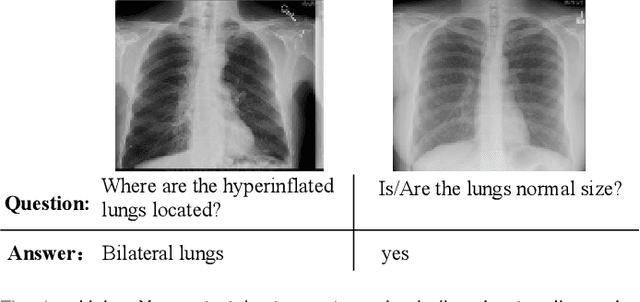
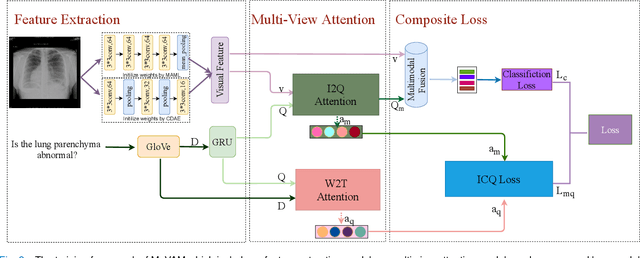
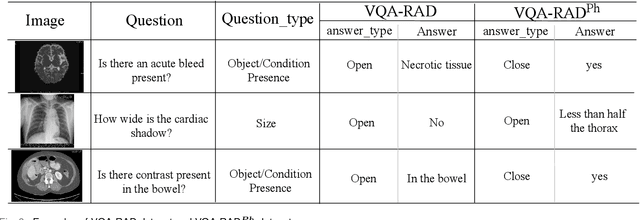
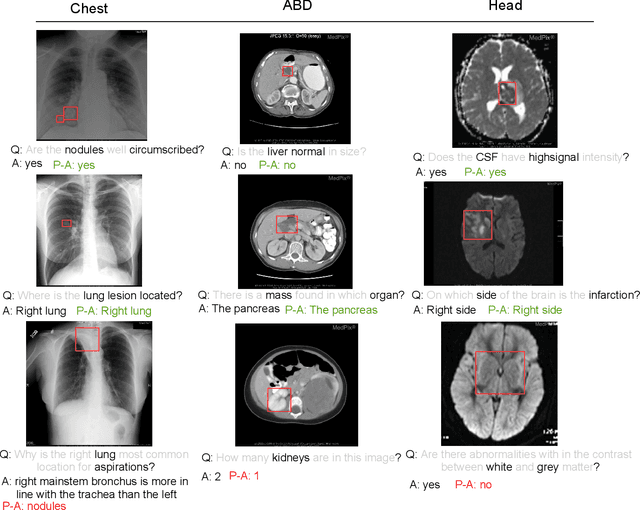
Medical Visual Question Answering (VQA) is a multi-modal challenging task widely considered by research communities of the computer vision and natural language processing. Since most current medical VQA models focus on visual content, ignoring the importance of text, this paper proposes a multi-view attention-based model(MuVAM) for medical visual question answering which integrates the high-level semantics of medical images on the basis of text description. Firstly, different methods are utilized to extract the features of the image and the question for the two modalities of vision and text. Secondly, this paper proposes a multi-view attention mechanism that include Image-to-Question (I2Q) attention and Word-to-Text (W2T) attention. Multi-view attention can correlate the question with image and word in order to better analyze the question and get an accurate answer. Thirdly, a composite loss is presented to predict the answer accurately after multi-modal feature fusion and improve the similarity between visual and textual cross-modal features. It consists of classification loss and image-question complementary (IQC) loss. Finally, for data errors and missing labels in the VQA-RAD dataset, we collaborate with medical experts to correct and complete this dataset and then construct an enhanced dataset, VQA-RADPh. The experiments on these two datasets show that the effectiveness of MuVAM surpasses the state-of-the-art method.