 Add to Chrome
 Add to Firefox
 Add to Edge
PE-CSNet: An equivariant network architecture with learnable patch-based sparse representation
Aug 11, 2026
Compressive sensing (CS) enables accurate signal reconstruction from sparse measurements and is widely applied in medical imaging, remote sensing, and image compression. However, designing an effective, task-specific sparse transform and the corresponding optimization procedure for high-quality CS remains challenging. This process typically requires expert domain knowledge and laborious parameter tuning. To address this issue, we present a Patch-based Equivariant deep unrolling architecture, termed PE-CSNet, for accurate CS recovery. While traditional CS methods generally use predefined patch-based transform sparsity, we generalize this idea by incorporating learnable transform sparsity that adapts to the specific CS task through an optimization-driven process. Specifically, we first establish a generalized patch-based CS model, which we solve via a block coordinate descent (BCD) algorithm. The BCD solver is then unrolled into a deep neural network, where all parameters of both the CS model and solver are learned through end-to-end training. To improve data efficiency, we introduce a stochastic equivariant training strategy that exploits the patch-wise structure of the network, enabling PE-CSNet to learn effectively even from limited data. We further provide a simpler, parameter-shared version of PE-CSNet and briefly discuss its convergence as an iterative solver. For practical applications, the network uses stage-specific (non-shared) parameters to enhance its expressive power and thereby improve its performance. On the tasks of CS magnetic resonance imaging (CS-MRI) and CS coded diffraction patterns (CS-CDP), PE-CSNet achieves state-of-the-art accuracy with fast computational speed, outperforming traditional methods and existing deep unrolling methods.

SCC: an efficient deep reinforcement learning agent mastering the game of StarCraft II
Dec 24, 2020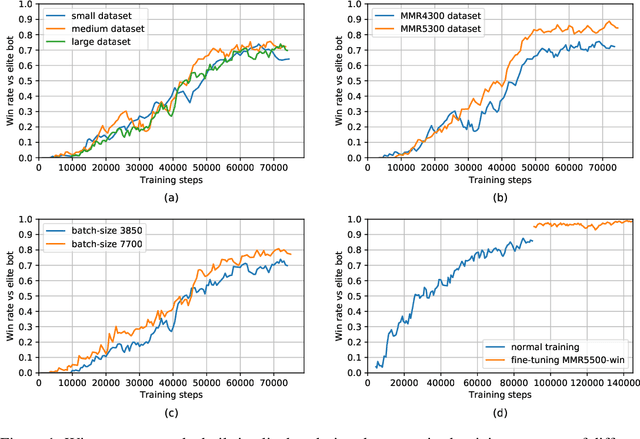
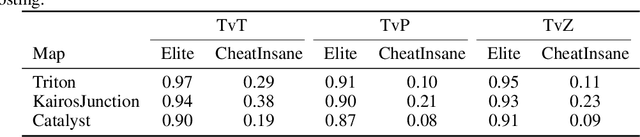
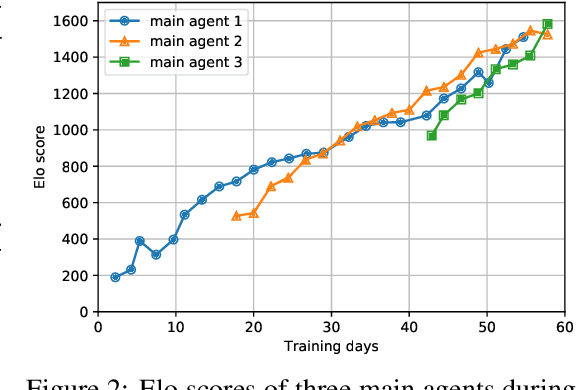
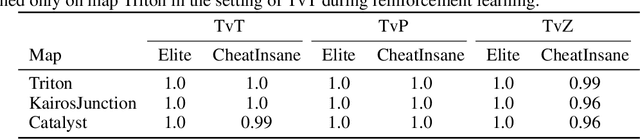
AlphaStar, the AI that reaches GrandMaster level in StarCraft II, is a remarkable milestone demonstrating what deep reinforcement learning can achieve in complex Real-Time Strategy (RTS) games. However, the complexities of the game, algorithms and systems, and especially the tremendous amount of computation needed are big obstacles for the community to conduct further research in this direction. We propose a deep reinforcement learning agent, StarCraft Commander (SCC). With order of magnitude less computation, it demonstrates top human performance defeating GrandMaster players in test matches and top professional players in a live event. Moreover, it shows strong robustness to various human strategies and discovers novel strategies unseen from human plays. In this paper, we will share the key insights and optimizations on efficient imitation learning and reinforcement learning for StarCraft II full game.
Multiagent Bidirectionally-Coordinated Nets: Emergence of Human-level Coordination in Learning to Play StarCraft Combat Games
Sep 14, 2017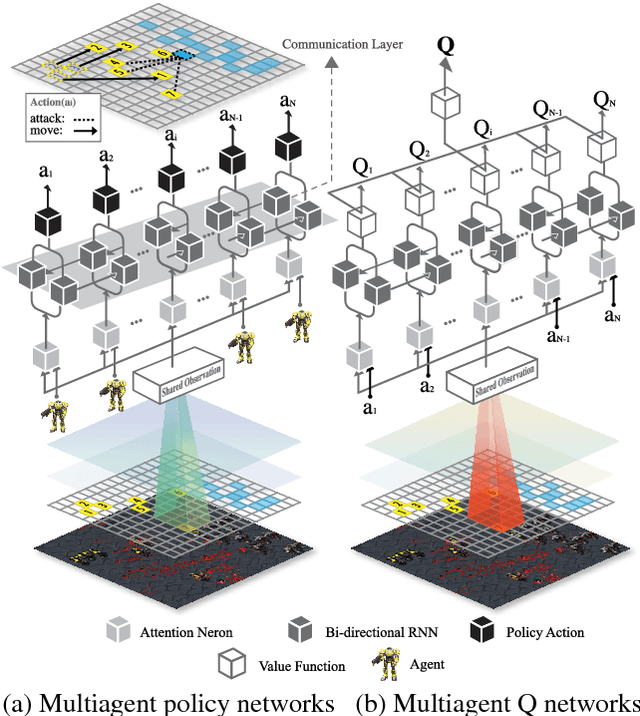
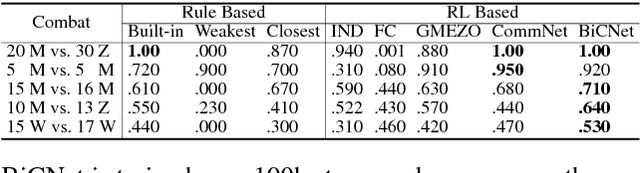
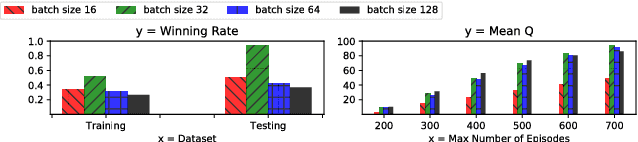
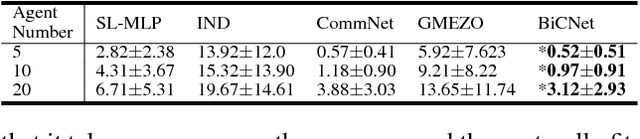
Many artificial intelligence (AI) applications often require multiple intelligent agents to work in a collaborative effort. Efficient learning for intra-agent communication and coordination is an indispensable step towards general AI. In this paper, we take StarCraft combat game as a case study, where the task is to coordinate multiple agents as a team to defeat their enemies. To maintain a scalable yet effective communication protocol, we introduce a Multiagent Bidirectionally-Coordinated Network (BiCNet ['bIknet]) with a vectorised extension of actor-critic formulation. We show that BiCNet can handle different types of combats with arbitrary numbers of AI agents for both sides. Our analysis demonstrates that without any supervisions such as human demonstrations or labelled data, BiCNet could learn various types of advanced coordination strategies that have been commonly used by experienced game players. In our experiments, we evaluate our approach against multiple baselines under different scenarios; it shows state-of-the-art performance, and possesses potential values for large-scale real-world applications.