 Add to Chrome
 Add to Firefox
 Add to Edge
Lemon Agent Technical Report
Feb 06, 2026
Recent advanced LLM-powered agent systems have exhibited their remarkable capabilities in tackling complex, long-horizon tasks. Nevertheless, they still suffer from inherent limitations in resource efficiency, context management, and multimodal perception. Based on these observations, Lemon Agent is introduced, a multi-agent orchestrator-worker system built on a newly proposed AgentCortex framework, which formalizes the classic Planner-Executor-Memory paradigm through an adaptive task execution mechanism. Our system integrates a hierarchical self-adaptive scheduling mechanism that operates at both the overall orchestrator layer and workers layer. This mechanism can dynamically adjust computational intensity based on task complexity. It enables orchestrator to allocate one or more workers for parallel subtask execution, while workers can further improve operational efficiency by invoking tools concurrently. By virtue of this two-tier architecture, the system achieves synergistic balance between global task coordination and local task execution, thereby optimizing resource utilization and task processing efficiency in complex scenarios. To reduce context redundancy and increase information density during parallel steps, we adopt a three-tier progressive context management strategy. To make fuller use of historical information, we propose a self-evolving memory system, which can extract multi-dimensional valid information from all historical experiences to assist in completing similar tasks. Furthermore, we provide an enhanced MCP toolset. Empirical evaluations on authoritative benchmarks demonstrate that our Lemon Agent can achieve a state-of-the-art 91.36% overall accuracy on GAIA and secures the top position on the xbench-DeepSearch leaderboard with a score of 77+.

3D Object Visibility Prediction in Autonomous Driving
Mar 06, 2024
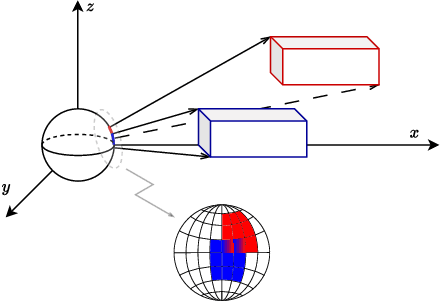


With the rapid advancement of hardware and software technologies, research in autonomous driving has seen significant growth. The prevailing framework for multi-sensor autonomous driving encompasses sensor installation, perception, path planning, decision-making, and motion control. At the perception phase, a common approach involves utilizing neural networks to infer 3D bounding box (Bbox) attributes from raw sensor data, including classification, size, and orientation. In this paper, we present a novel attribute and its corresponding algorithm: 3D object visibility. By incorporating multi-task learning, the introduction of this attribute, visibility, negligibly affects the model's effectiveness and efficiency. Our proposal of this attribute and its computational strategy aims to expand the capabilities for downstream tasks, thereby enhancing the safety and reliability of real-time autonomous driving in real-world scenarios.