 Add to Chrome
 Add to Firefox
 Add to Edge
LemonHarness Technical Report
Jun 23, 2026
As large language model (LLM) agents are applied to longer tasks, they increasingly modify workspace state across multiple rounds of iteration. However, agents typically observe only tool outputs and log fragments, while the actual state changes occur in the file system. Without explicit workspace boundaries, state-changing operations such as file writes and temporary artifact generation may scatter changes across paths. Over time, these weakly constrained changes accumulate, making states such as modified files difficult to track. This paper presents LemonHarness, an integrated execution framework for long-horizon agents. LemonHarness establishes an explicit execution boundary by constraining state-changing operations within a clearly defined workspace and bringing model invocation, tool execution, and rule knowledge within a single controlled boundary. State-changing operations, including file writes, dependency installation, and temporary artifact creation, are executed through structured tool interfaces, with execution feedback recorded as observations available to subsequent model decisions. The system also introduces a reusable rule knowledge base, which turns recurring execution rules and acceptance criteria into runtime knowledge. LemonHarness further adds a time-aware execution mechanism that exposes elapsed and remaining budget to the model, so it can rebalance exploration, implementation, and validation effort as time pressure shifts and avoid timeouts from long waits or excessive verification. On Terminal-Bench 2.0, LemonHarness_GPT-5.3-CodeX reached 84.49% accuracy over 445 trials; pairing the same framework with the stronger GPT-5.5 backbone raised the average accuracy to 86.52% across five jobs. The results suggest that a unified runtime boundary, callable rule knowledge, and time-aware execution can improve the stability of long-horizon agent execution.

Lemon Agent Technical Report
Feb 06, 2026Recent advanced LLM-powered agent systems have exhibited their remarkable capabilities in tackling complex, long-horizon tasks. Nevertheless, they still suffer from inherent limitations in resource efficiency, context management, and multimodal perception. Based on these observations, Lemon Agent is introduced, a multi-agent orchestrator-worker system built on a newly proposed AgentCortex framework, which formalizes the classic Planner-Executor-Memory paradigm through an adaptive task execution mechanism. Our system integrates a hierarchical self-adaptive scheduling mechanism that operates at both the overall orchestrator layer and workers layer. This mechanism can dynamically adjust computational intensity based on task complexity. It enables orchestrator to allocate one or more workers for parallel subtask execution, while workers can further improve operational efficiency by invoking tools concurrently. By virtue of this two-tier architecture, the system achieves synergistic balance between global task coordination and local task execution, thereby optimizing resource utilization and task processing efficiency in complex scenarios. To reduce context redundancy and increase information density during parallel steps, we adopt a three-tier progressive context management strategy. To make fuller use of historical information, we propose a self-evolving memory system, which can extract multi-dimensional valid information from all historical experiences to assist in completing similar tasks. Furthermore, we provide an enhanced MCP toolset. Empirical evaluations on authoritative benchmarks demonstrate that our Lemon Agent can achieve a state-of-the-art 91.36% overall accuracy on GAIA and secures the top position on the xbench-DeepSearch leaderboard with a score of 77+.
ReInAgent: A Context-Aware GUI Agent Enabling Human-in-the-Loop Mobile Task Navigation
Oct 09, 2025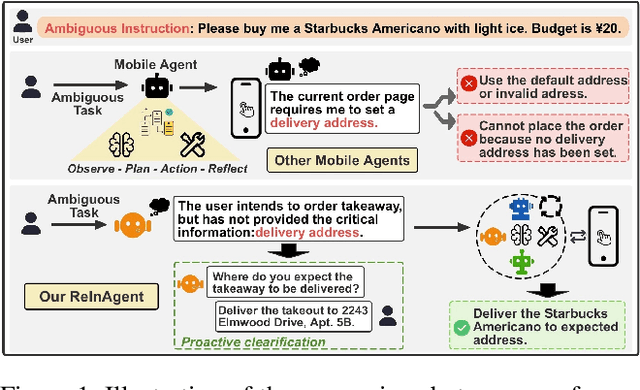
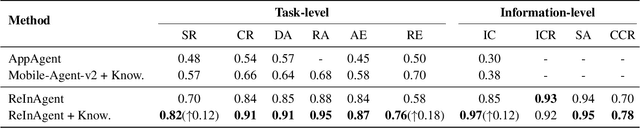
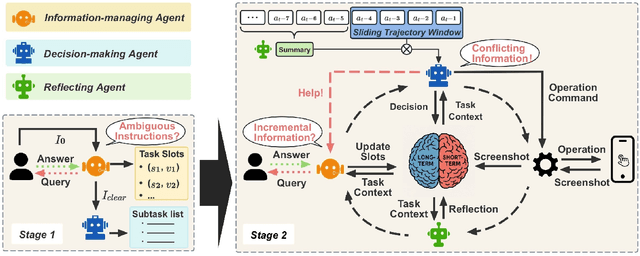
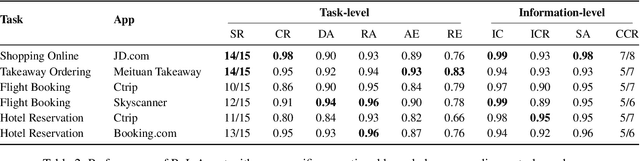
Mobile GUI agents exhibit substantial potential to facilitate and automate the execution of user tasks on mobile phones. However, exist mobile GUI agents predominantly privilege autonomous operation and neglect the necessity of active user engagement during task execution. This omission undermines their adaptability to information dilemmas including ambiguous, dynamically evolving, and conflicting task scenarios, leading to execution outcomes that deviate from genuine user requirements and preferences. To address these shortcomings, we propose ReInAgent, a context-aware multi-agent framework that leverages dynamic information management to enable human-in-the-loop mobile task navigation. ReInAgent integrates three specialized agents around a shared memory module: an information-managing agent for slot-based information management and proactive interaction with the user, a decision-making agent for conflict-aware planning, and a reflecting agent for task reflection and information consistency validation. Through continuous contextual information analysis and sustained user-agent collaboration, ReInAgent overcomes the limitation of existing approaches that rely on clear and static task assumptions. Consequently, it enables more adaptive and reliable mobile task navigation in complex, real-world scenarios. Experimental results demonstrate that ReInAgent effectively resolves information dilemmas and produces outcomes that are more closely aligned with genuine user preferences. Notably, on complex tasks involving information dilemmas, ReInAgent achieves a 25% higher success rate than Mobile-Agent-v2.