 Add to Chrome
 Add to Firefox
 Add to Edge
DarkDriving: A Real-World Day and Night Aligned Dataset for Autonomous Driving in the Dark Environment
Mar 18, 2026
The low-light conditions are challenging to the vision-centric perception systems for autonomous driving in the dark environment. In this paper, we propose a new benchmark dataset (named DarkDriving) to investigate the low-light enhancement for autonomous driving. The existing real-world low-light enhancement benchmark datasets can be collected by controlling various exposures only in small-ranges and static scenes. The dark images of the current nighttime driving datasets do not have the precisely aligned daytime counterparts. The extreme difficulty to collect a real-world day and night aligned dataset in the dynamic driving scenes significantly limited the research in this area. With a proposed automatic day-night Trajectory Tracking based Pose Matching (TTPM) method in a large real-world closed driving test field (area: 69 acres), we collected the first real-world day and night aligned dataset for autonomous driving in the dark environment. The DarkDriving dataset has 9,538 day and night image pairs precisely aligned in location and spatial contents, whose alignment error is in just several centimeters. For each pair, we also manually label the object 2D bounding boxes. DarkDriving introduces four perception related tasks, including low-light enhancement, generalized low-light enhancement, and low-light enhancement for 2D detection and 3D detection of autonomous driving in the dark environment. The experimental results show that our DarkDriving dataset provides a comprehensive benchmark for evaluating low-light enhancement for autonomous driving and it can also be generalized to enhance dark images and promote detection in some other low-light driving environment, such as nuScenes.

OBJVanish: Physically Realizable Text-to-3D Adv. Generation of LiDAR-Invisible Objects
Oct 08, 2025LiDAR-based 3D object detectors are fundamental to autonomous driving, where failing to detect objects poses severe safety risks. Developing effective 3D adversarial attacks is essential for thoroughly testing these detection systems and exposing their vulnerabilities before real-world deployment. However, existing adversarial attacks that add optimized perturbations to 3D points have two critical limitations: they rarely cause complete object disappearance and prove difficult to implement in physical environments. We introduce the text-to-3D adversarial generation method, a novel approach enabling physically realizable attacks that can generate 3D models of objects truly invisible to LiDAR detectors and be easily realized in the real world. Specifically, we present the first empirical study that systematically investigates the factors influencing detection vulnerability by manipulating the topology, connectivity, and intensity of individual pedestrian 3D models and combining pedestrians with multiple objects within the CARLA simulation environment. Building on the insights, we propose the physically-informed text-to-3D adversarial generation (Phy3DAdvGen) that systematically optimizes text prompts by iteratively refining verbs, objects, and poses to produce LiDAR-invisible pedestrians. To ensure physical realizability, we construct a comprehensive object pool containing 13 3D models of real objects and constrain Phy3DAdvGen to generate 3D objects based on combinations of objects in this set. Extensive experiments demonstrate that our approach can generate 3D pedestrians that evade six state-of-the-art (SOTA) LiDAR 3D detectors in both CARLA simulation and physical environments, thereby highlighting vulnerabilities in safety-critical applications.
DriveAgent: Multi-Agent Structured Reasoning with LLM and Multimodal Sensor Fusion for Autonomous Driving
May 04, 2025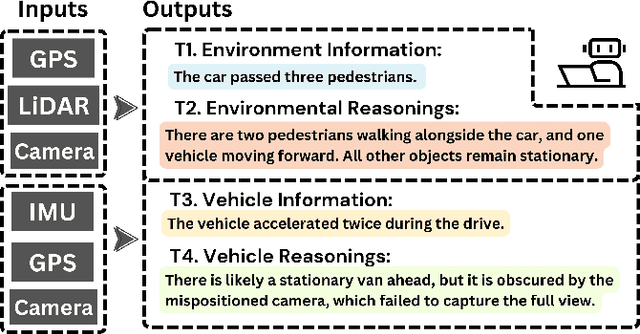
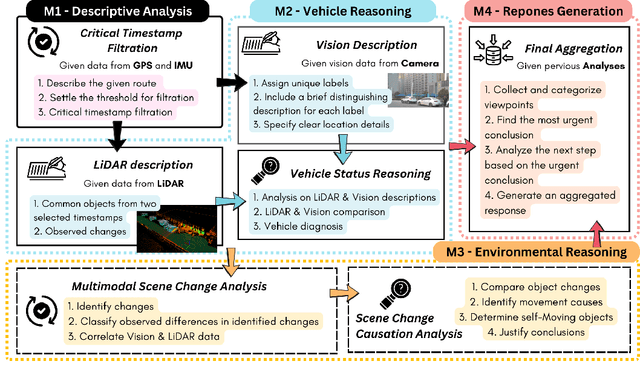
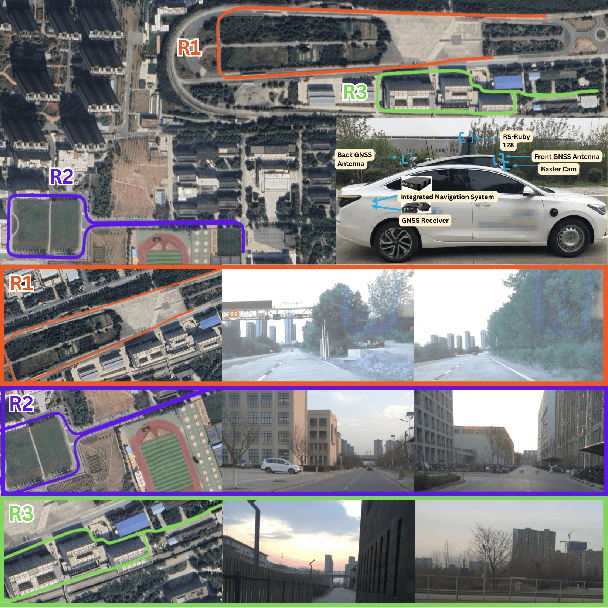
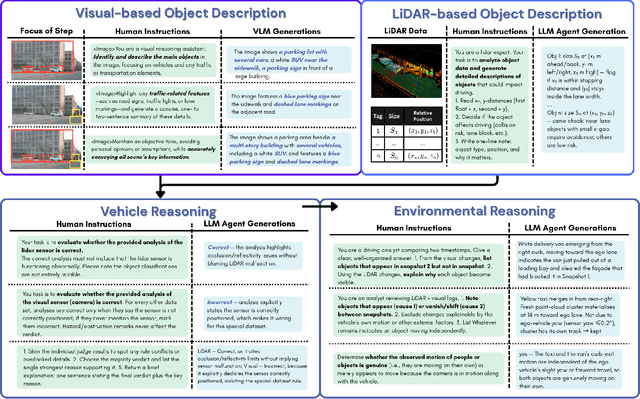
We introduce DriveAgent, a novel multi-agent autonomous driving framework that leverages large language model (LLM) reasoning combined with multimodal sensor fusion to enhance situational understanding and decision-making. DriveAgent uniquely integrates diverse sensor modalities-including camera, LiDAR, GPS, and IMU-with LLM-driven analytical processes structured across specialized agents. The framework operates through a modular agent-based pipeline comprising four principal modules: (i) a descriptive analysis agent identifying critical sensor data events based on filtered timestamps, (ii) dedicated vehicle-level analysis conducted by LiDAR and vision agents that collaboratively assess vehicle conditions and movements, (iii) environmental reasoning and causal analysis agents explaining contextual changes and their underlying mechanisms, and (iv) an urgency-aware decision-generation agent prioritizing insights and proposing timely maneuvers. This modular design empowers the LLM to effectively coordinate specialized perception and reasoning agents, delivering cohesive, interpretable insights into complex autonomous driving scenarios. Extensive experiments on challenging autonomous driving datasets demonstrate that DriveAgent is achieving superior performance on multiple metrics against baseline methods. These results validate the efficacy of the proposed LLM-driven multi-agent sensor fusion framework, underscoring its potential to substantially enhance the robustness and reliability of autonomous driving systems.