 Add to Chrome
 Add to Firefox
 Add to Edge
A Multi-Dataset Benchmark for Evaluating LLM Agents in Microservice Failure Diagnosis
Jun 28, 2026
LLM-based agents are reshaping microservice operations into AgentOps, where benchmarks are key to evaluating failure diagnosis over multimodal observability data. However, existing benchmarks remain largely outcome-oriented: they score only the final answer and fail to assess the systematic reasoning process in failure diagnosis. We address this gap by introducing two large-scale datasets (AIOps2025 and RCA100) under a reasoning-process evaluation paradigm that assesses agentic diagnostic capability along three dimensions: Localization (where the fault occurs), Identification (what type of fault it is), and Reason (whether the reasoning trace is grounded in relevant evidence). Together, the two datasets comprise over 500 expert-labeled failure cases across two representative microservice systems (HipsterShop and the OpenTelemetry Demo Store). They cover diverse fault scenarios across resource, network, runtime, middleware/database, and application-logic categories and provide fine-grained causal evidence to support agent learning and reasoning-process evaluation. Beyond scale and coverage, the datasets have been carefully labelled by domain experts and validated through large-scale competitions, supporting more than 6,000 participating teams. This makes them not only expert-labeled diagnostic datasets, but also competition-validated benchmarks for evaluating agentic failure diagnosis in real-world microservice environments. Datasets are available at https://www.aiops.cn/gitlab/aiops-live-benchmark/agenticopseval.

On Trustworthy Decision-Making Process of Human Drivers from the View of Perceptual Uncertainty Reduction
Oct 15, 2022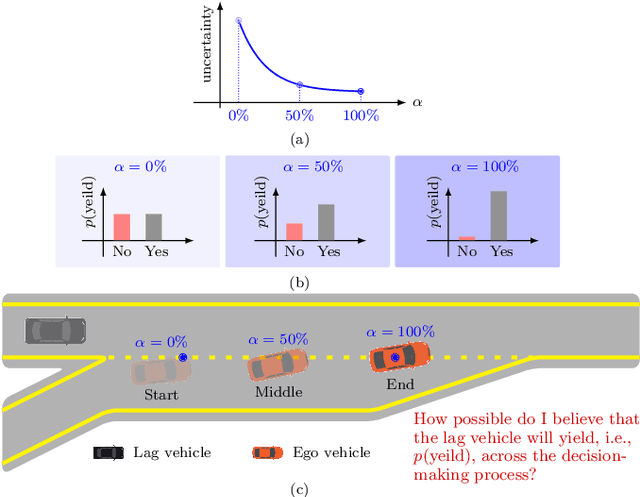
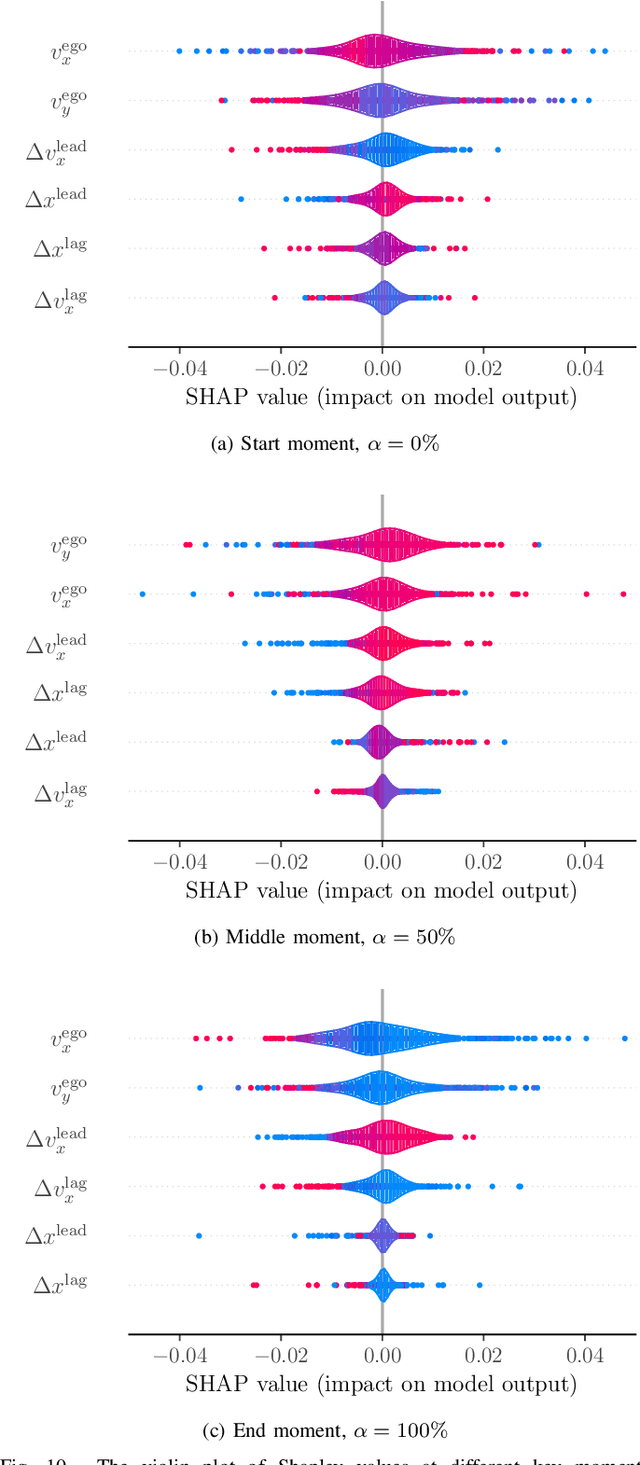
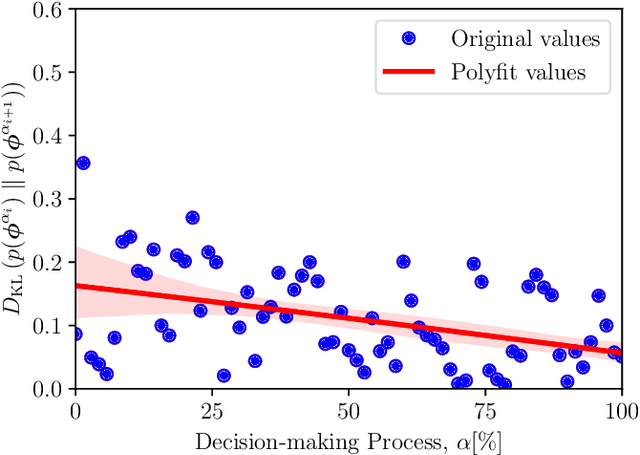
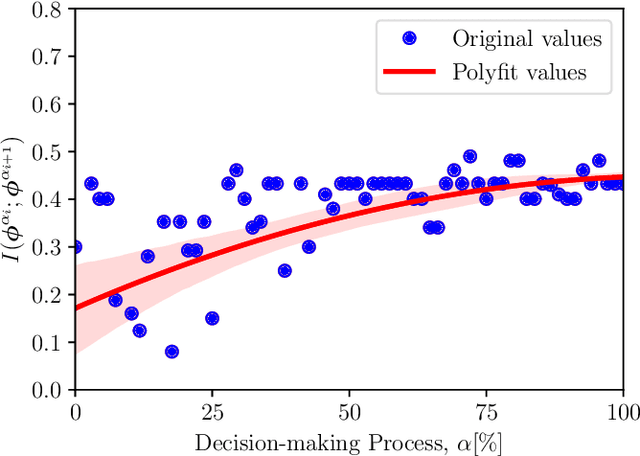
Humans are experts in making decisions for challenging driving tasks with uncertainties. Many efforts have been made to model the decision-making process of human drivers at the behavior level. However, limited studies explain how human drivers actively make reliable sequential decisions to complete interactive driving tasks in an uncertain environment. This paper argues that human drivers intently search for actions to reduce the uncertainty of their perception of the environment, i.e., perceptual uncertainty, to a low level that allows them to make a trustworthy decision easily. This paper provides a proof of concept framework to empirically reveal that human drivers' perceptual uncertainty decreases when executing interactive tasks with uncertainties. We first introduce an explainable-artificial intelligence approach (i.e., SHapley Additive exPlanation, SHAP) to determine the salient features on which human drivers make decisions. Then, we use entropy-based measures to quantify the drivers' perceptual changes in these ranked salient features across the decision-making process, reflecting the changes in uncertainties. The validation and verification of our proposed method are conducted in the highway on-ramp merging scenario with congested traffic using the INTERACTION dataset. Experimental results support that human drivers intentionally seek information to reduce their perceptual uncertainties in the number and rank of salient features of their perception of environments to make a trustworthy decision.
Enhanced Memory Network: The novel network structure for Symbolic Music Generation
Oct 07, 2021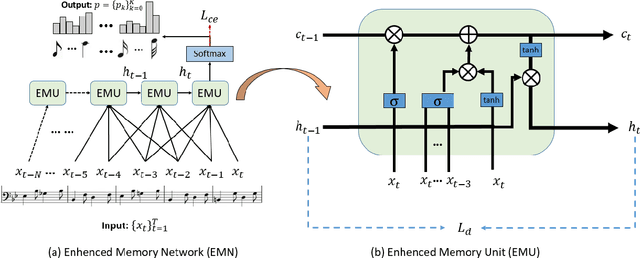
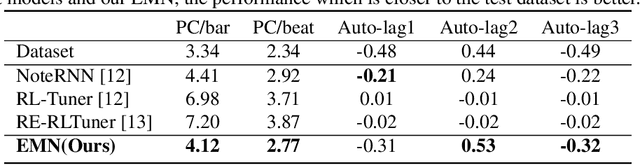
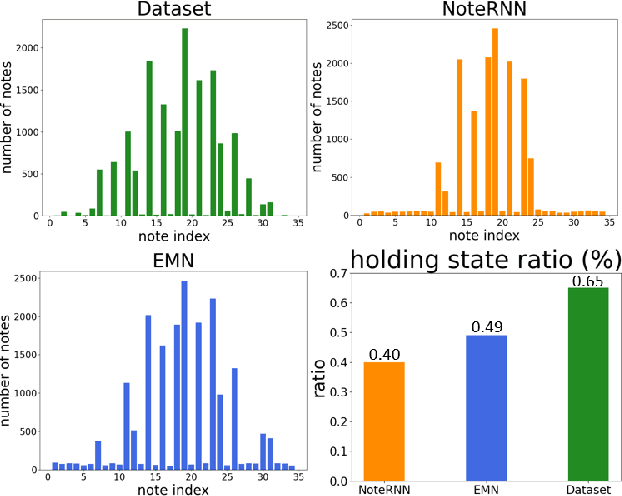
Symbolic melodies generation is one of the essential tasks for automatic music generation. Recently, models based on neural networks have had a significant influence on generating symbolic melodies. However, the musical context structure is complicated to capture through deep neural networks. Although long short-term memory (LSTM) is attempted to solve this problem through learning order dependence in the musical sequence, it is not capable of capturing musical context with only one note as input for each time step of LSTM. In this paper, we propose a novel Enhanced Memory Network (EMN) with several recurrent units, named Enhanced Memory Unit (EMU), to explicitly modify the internal architecture of LSTM for containing music beat information and reinforces the memory of the latest musical beat through aggregating beat inside the memory gate. In addition, to increase the diversity of generated musical notes, cosine distance among adjacent time steps of hidden states is considered as part of loss functions to avoid a high similarity score that harms the diversity of generated notes. Objective and subjective evaluation results show that the proposed method achieves state-of-the-art performance. Code and music demo are available at https://github.com/qrqrqrqr/EMU