 Add to Chrome
 Add to Firefox
 Add to Edge
A Multi-Dataset Benchmark for Evaluating LLM Agents in Microservice Failure Diagnosis
Jun 28, 2026
LLM-based agents are reshaping microservice operations into AgentOps, where benchmarks are key to evaluating failure diagnosis over multimodal observability data. However, existing benchmarks remain largely outcome-oriented: they score only the final answer and fail to assess the systematic reasoning process in failure diagnosis. We address this gap by introducing two large-scale datasets (AIOps2025 and RCA100) under a reasoning-process evaluation paradigm that assesses agentic diagnostic capability along three dimensions: Localization (where the fault occurs), Identification (what type of fault it is), and Reason (whether the reasoning trace is grounded in relevant evidence). Together, the two datasets comprise over 500 expert-labeled failure cases across two representative microservice systems (HipsterShop and the OpenTelemetry Demo Store). They cover diverse fault scenarios across resource, network, runtime, middleware/database, and application-logic categories and provide fine-grained causal evidence to support agent learning and reasoning-process evaluation. Beyond scale and coverage, the datasets have been carefully labelled by domain experts and validated through large-scale competitions, supporting more than 6,000 participating teams. This makes them not only expert-labeled diagnostic datasets, but also competition-validated benchmarks for evaluating agentic failure diagnosis in real-world microservice environments. Datasets are available at https://www.aiops.cn/gitlab/aiops-live-benchmark/agenticopseval.

LogParser-LLM: Advancing Efficient Log Parsing with Large Language Models
Aug 25, 2024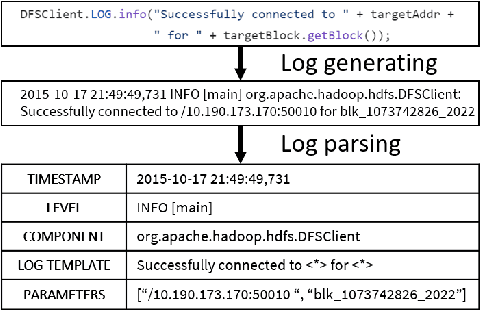
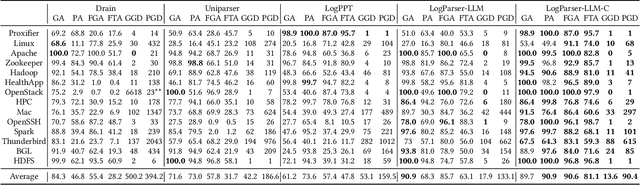
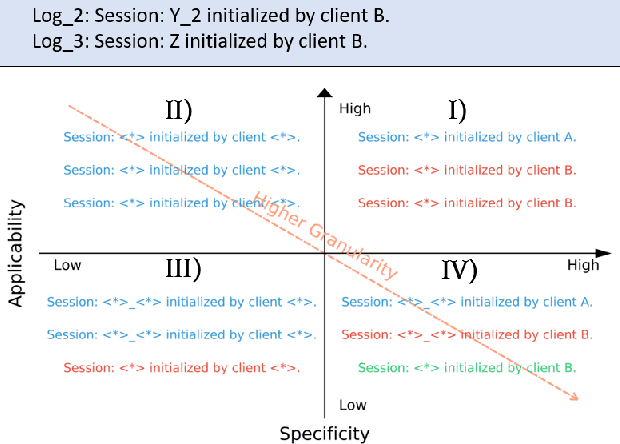

Logs are ubiquitous digital footprints, playing an indispensable role in system diagnostics, security analysis, and performance optimization. The extraction of actionable insights from logs is critically dependent on the log parsing process, which converts raw logs into structured formats for downstream analysis. Yet, the complexities of contemporary systems and the dynamic nature of logs pose significant challenges to existing automatic parsing techniques. The emergence of Large Language Models (LLM) offers new horizons. With their expansive knowledge and contextual prowess, LLMs have been transformative across diverse applications. Building on this, we introduce LogParser-LLM, a novel log parser integrated with LLM capabilities. This union seamlessly blends semantic insights with statistical nuances, obviating the need for hyper-parameter tuning and labeled training data, while ensuring rapid adaptability through online parsing. Further deepening our exploration, we address the intricate challenge of parsing granularity, proposing a new metric and integrating human interactions to allow users to calibrate granularity to their specific needs. Our method's efficacy is empirically demonstrated through evaluations on the Loghub-2k and the large-scale LogPub benchmark. In evaluations on the LogPub benchmark, involving an average of 3.6 million logs per dataset across 14 datasets, our LogParser-LLM requires only 272.5 LLM invocations on average, achieving a 90.6% F1 score for grouping accuracy and an 81.1% for parsing accuracy. These results demonstrate the method's high efficiency and accuracy, outperforming current state-of-the-art log parsers, including pattern-based, neural network-based, and existing LLM-enhanced approaches.