 Add to Chrome
 Add to Firefox
 Add to Edge
Noisy-label Learning with Sample Selection based on Noise Rate Estimate
May 31, 2023
Noisy-labels are challenging for deep learning due to the high capacity of the deep models that can overfit noisy-label training samples. Arguably the most realistic and coincidentally challenging type of label noise is the instance-dependent noise (IDN), where the labelling errors are caused by the ambivalent information present in the images. The most successful label noise learning techniques to address IDN problems usually contain a noisy-label sample selection stage to separate clean and noisy-label samples during training. Such sample selection depends on a criterion, such as loss or gradient, and on a curriculum to define the proportion of training samples to be classified as clean at each training epoch. Even though the estimated noise rate from the training set appears to be a natural signal to be used in the definition of this curriculum, previous approaches generally rely on arbitrary thresholds or pre-defined selection functions to the best of our knowledge. This paper addresses this research gap by proposing a new noisy-label learning graphical model that can easily accommodate state-of-the-art (SOTA) noisy-label learning methods and provide them with a reliable noise rate estimate to be used in a new sample selection curriculum. We show empirically that our model integrated with many SOTA methods can improve their results in many IDN benchmarks, including synthetic and real-world datasets.

A Closer Look at Audio-Visual Semantic Segmentation
Apr 11, 2023Audio-visual segmentation (AVS) is a complex task that involves accurately segmenting the corresponding sounding object based on audio-visual queries. Successful audio-visual learning requires two essential components: 1) an unbiased dataset with high-quality pixel-level multi-class labels, and 2) a model capable of effectively linking audio information with its corresponding visual object. However, these two requirements are only partially addressed by current methods, with training sets containing biased audio-visual data, and models that generalise poorly beyond this biased training set. In this work, we propose a new strategy to build cost-effective and relatively unbiased audio-visual semantic segmentation benchmarks. Our strategy, called Visual Post-production (VPO), explores the observation that it is not necessary to have explicit audio-visual pairs extracted from single video sources to build such benchmarks. We also refine the previously proposed AVSBench to transform it into the audio-visual semantic segmentation benchmark AVSBench-Single+. Furthermore, this paper introduces a new pixel-wise audio-visual contrastive learning method to enable a better generalisation of the model beyond the training set. We verify the validity of the VPO strategy by showing that state-of-the-art (SOTA) models trained with datasets built by matching audio and visual data from different sources or with datasets containing audio and visual data from the same video source produce almost the same accuracy. Then, using the proposed VPO benchmarks and AVSBench-Single+, we show that our method produces more accurate audio-visual semantic segmentation than SOTA models. Code and dataset will be available.
PASS: Peer-Agreement based Sample Selection for training with Noisy Labels
Mar 20, 2023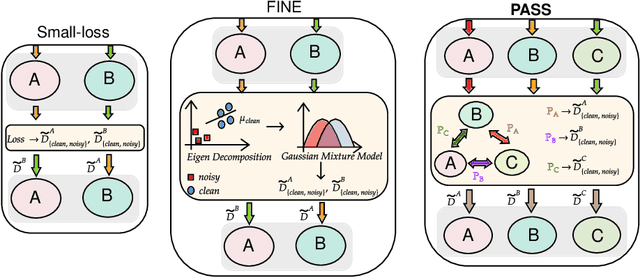
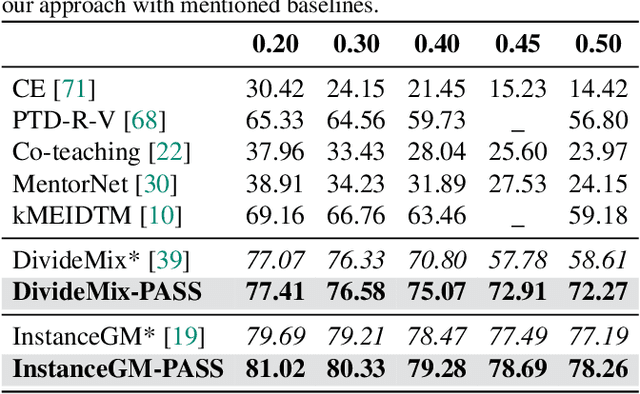
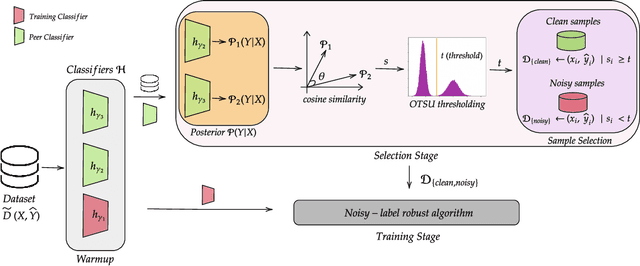
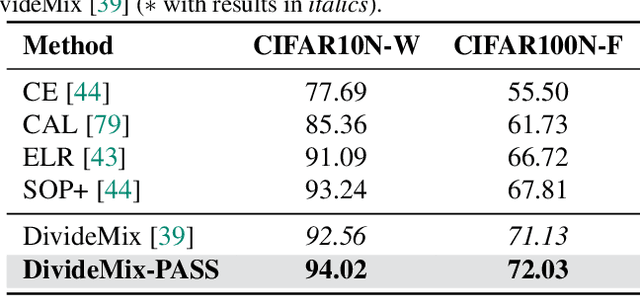
Noisy labels present a significant challenge in deep learning because models are prone to overfitting. This problem has driven the development of sophisticated techniques to address the issue, with one critical component being the selection of clean and noisy label samples. Selecting noisy label samples is commonly based on the small-loss hypothesis or on feature-based sampling, but we present empirical evidence that shows that both strategies struggle to differentiate between noisy label and hard samples, resulting in relatively large proportions of samples falsely selected as clean. To address this limitation, we propose a novel peer-agreement based sample selection (PASS). An automated thresholding technique is then applied to the agreement score to select clean and noisy label samples. PASS is designed to be easily integrated into existing noisy label robust frameworks, and it involves training a set of classifiers in a round-robin fashion, with peer models used for sample selection. In the experiments, we integrate our PASS with several state-of-the-art (SOTA) models, including InstanceGM, DivideMix, SSR, FaMUS, AugDesc, and C2D, and evaluate their effectiveness on several noisy label benchmark datasets, such as CIFAR-100, CIFAR-N, Animal-10N, Red Mini-Imagenet, Clothing1M, Mini-Webvision, and Imagenet. Our results demonstrate that our new sample selection approach improves the existing SOTA results of algorithms.
Multi-Head Multi-Loss Model Calibration
Mar 02, 2023Delivering meaningful uncertainty estimates is essential for a successful deployment of machine learning models in the clinical practice. A central aspect of uncertainty quantification is the ability of a model to return predictions that are well-aligned with the actual probability of the model being correct, also known as model calibration. Although many methods have been proposed to improve calibration, no technique can match the simple, but expensive approach of training an ensemble of deep neural networks. In this paper we introduce a form of simplified ensembling that bypasses the costly training and inference of deep ensembles, yet it keeps its calibration capabilities. The idea is to replace the common linear classifier at the end of a network by a set of heads that are supervised with different loss functions to enforce diversity on their predictions. Specifically, each head is trained to minimize a weighted Cross-Entropy loss, but the weights are different among the different branches. We show that the resulting averaged predictions can achieve excellent calibration without sacrificing accuracy in two challenging datasets for histopathological and endoscopic image classification. Our experiments indicate that Multi-Head Multi-Loss classifiers are inherently well-calibrated, outperforming other recent calibration techniques and even challenging Deep Ensembles' performance. Code to reproduce our experiments can be found at \url{https://github.com/agaldran/mhml_calibration} .
AIROGS: Artificial Intelligence for RObust Glaucoma Screening Challenge
Feb 10, 2023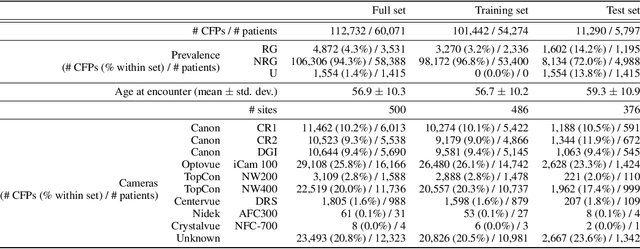

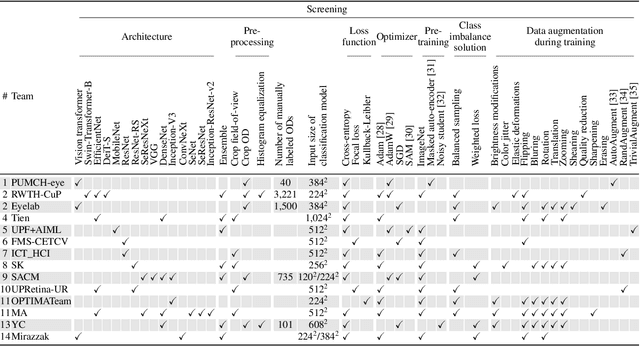
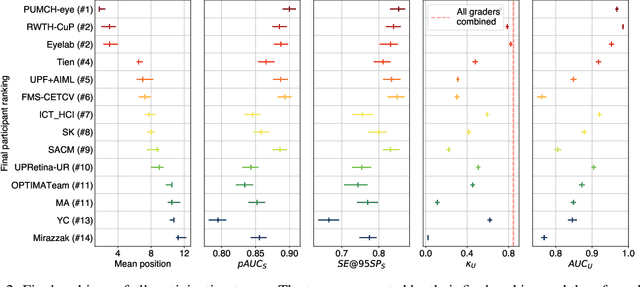
The early detection of glaucoma is essential in preventing visual impairment. Artificial intelligence (AI) can be used to analyze color fundus photographs (CFPs) in a cost-effective manner, making glaucoma screening more accessible. While AI models for glaucoma screening from CFPs have shown promising results in laboratory settings, their performance decreases significantly in real-world scenarios due to the presence of out-of-distribution and low-quality images. To address this issue, we propose the Artificial Intelligence for Robust Glaucoma Screening (AIROGS) challenge. This challenge includes a large dataset of around 113,000 images from about 60,000 patients and 500 different screening centers, and encourages the development of algorithms that are robust to ungradable and unexpected input data. We evaluated solutions from 14 teams in this paper, and found that the best teams performed similarly to a set of 20 expert ophthalmologists and optometrists. The highest-scoring team achieved an area under the receiver operating characteristic curve of 0.99 (95% CI: 0.98-0.99) for detecting ungradable images on-the-fly. Additionally, many of the algorithms showed robust performance when tested on three other publicly available datasets. These results demonstrate the feasibility of robust AI-enabled glaucoma screening.
BRAIxDet: Learning to Detect Malignant Breast Lesion with Incomplete Annotations
Feb 02, 2023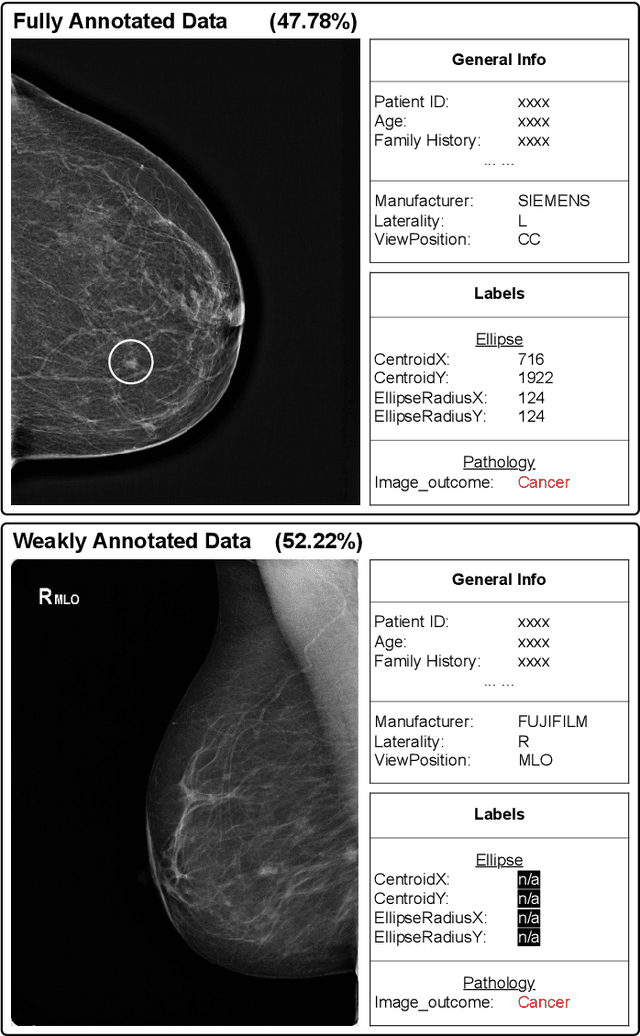


Methods to detect malignant lesions from screening mammograms are usually trained with fully annotated datasets, where images are labelled with the localisation and classification of cancerous lesions. However, real-world screening mammogram datasets commonly have a subset that is fully annotated and another subset that is weakly annotated with just the global classification (i.e., without lesion localisation). Given the large size of such datasets, researchers usually face a dilemma with the weakly annotated subset: to not use it or to fully annotate it. The first option will reduce detection accuracy because it does not use the whole dataset, and the second option is too expensive given that the annotation needs to be done by expert radiologists. In this paper, we propose a middle-ground solution for the dilemma, which is to formulate the training as a weakly- and semi-supervised learning problem that we refer to as malignant breast lesion detection with incomplete annotations. To address this problem, our new method comprises two stages, namely: 1) pre-training a multi-view mammogram classifier with weak supervision from the whole dataset, and 2) extending the trained classifier to become a multi-view detector that is trained with semi-supervised student-teacher learning, where the training set contains fully and weakly-annotated mammograms. We provide extensive detection results on two real-world screening mammogram datasets containing incomplete annotations, and show that our proposed approach achieves state-of-the-art results in the detection of malignant breast lesions with incomplete annotations.
Learning Support and Trivial Prototypes for Interpretable Image Classification
Jan 08, 2023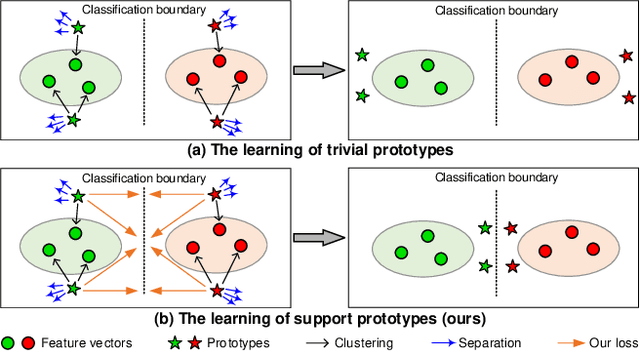
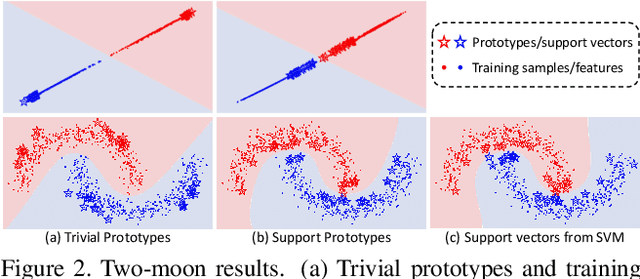
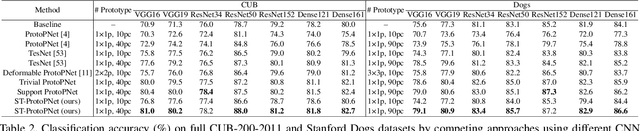
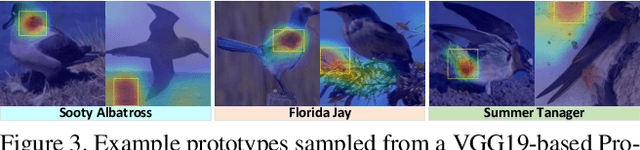
Prototypical part network (ProtoPNet) methods have been designed to achieve interpretable classification by associating predictions with a set of training prototypes, which we refer to as trivial (i.e., easy-to-learn) prototypes because they are trained to lie far from the classification boundary in the feature space. Note that it is possible to make an analogy between ProtoPNet and support vector machine (SVM) given that the classification from both methods relies on computing similarity with a set of training points (i.e., trivial prototypes in ProtoPNet, and support vectors in SVM). However, while trivial prototypes are located far from the classification boundary, support vectors are located close to this boundary, and we argue that this discrepancy with the well-established SVM theory can result in ProtoPNet models with suboptimal classification accuracy. In this paper, we aim to improve the classification accuracy of ProtoPNet with a new method to learn support prototypes that lie near the classification boundary in the feature space, as suggested by the SVM theory. In addition, we target the improvement of classification interpretability with a new model, named ST-ProtoPNet, which exploits our support prototypes and the trivial prototypes to provide complementary interpretability information. Experimental results on CUB-200-2011, Stanford Cars, and Stanford Dogs datasets demonstrate that the proposed method achieves state-of-the-art classification accuracy and produces more visually meaningful and diverse prototypes.
Towards the Identifiability in Noisy Label Learning: A Multinomial Mixture Approach
Jan 04, 2023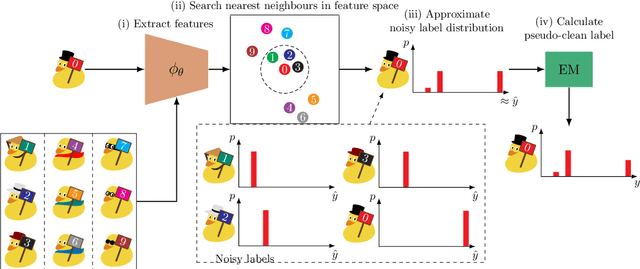
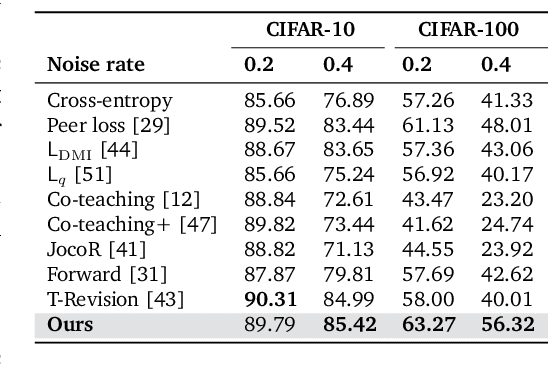
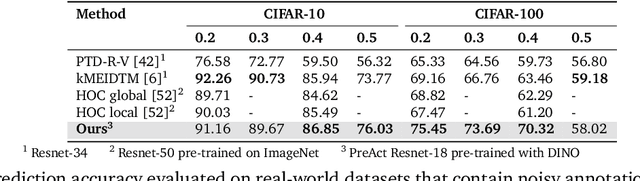
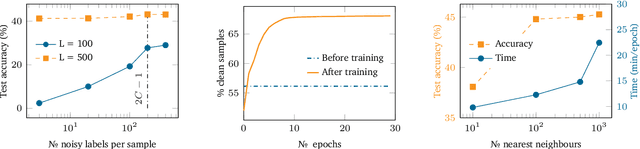
Learning from noisy labels plays an important role in the deep learning era. Despite numerous studies with promising results, identifying clean labels from a noisily-annotated dataset is still challenging since the conventional noisy label learning problem with single noisy label per instance is not identifiable, i.e., it does not theoretically have a unique solution unless one has access to clean labels or introduces additional assumptions. This paper aims to formally investigate such identifiability issue by formulating the noisy label learning problem as a multinomial mixture model, enabling the formulation of the identifiability constraint. In particular, we prove that the noisy label learning problem is identifiable if there are at least $2C - 1$ noisy labels per instance provided, with $C$ being the number of classes. In light of such requirement, we propose a method that automatically generates additional noisy labels per training sample by estimating the noisy label distribution based on nearest neighbours. Such additional noisy labels allow us to apply the Expectation - Maximisation algorithm to estimate the posterior of clean labels. We empirically demonstrate that the proposed method is not only capable of estimating clean labels without any heuristics in several challenging label noise benchmarks, including synthetic, web-controlled and real-world label noises, but also of performing competitively with many state-of-the-art methods.
Task Weighting in Meta-learning with Trajectory Optimisation
Jan 04, 2023Developing meta-learning algorithms that are un-biased toward a subset of training tasks often requires hand-designed criteria to weight tasks, potentially resulting in sub-optimal solutions. In this paper, we introduce a new principled and fully-automated task-weighting algorithm for meta-learning methods. By considering the weights of tasks within the same mini-batch as an action, and the meta-parameter of interest as the system state, we cast the task-weighting meta-learning problem to a trajectory optimisation and employ the iterative linear quadratic regulator to determine the optimal action or weights of tasks. We theoretically show that the proposed algorithm converges to an $\epsilon_{0}$-stationary point, and empirically demonstrate that the proposed approach out-performs common hand-engineering weighting methods in two few-shot learning benchmarks.
Asymmetric Co-teaching with Multi-view Consensus for Noisy Label Learning
Jan 01, 2023
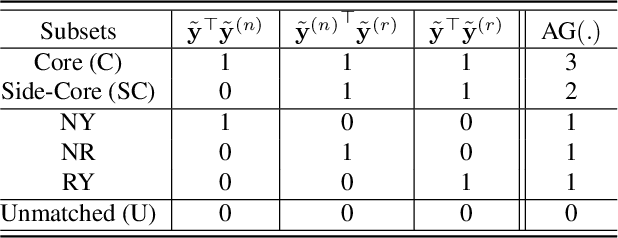

Learning with noisy-labels has become an important research topic in computer vision where state-of-the-art (SOTA) methods explore: 1) prediction disagreement with co-teaching strategy that updates two models when they disagree on the prediction of training samples; and 2) sample selection to divide the training set into clean and noisy sets based on small training loss. However, the quick convergence of co-teaching models to select the same clean subsets combined with relatively fast overfitting of noisy labels may induce the wrong selection of noisy label samples as clean, leading to an inevitable confirmation bias that damages accuracy. In this paper, we introduce our noisy-label learning approach, called Asymmetric Co-teaching (AsyCo), which introduces novel prediction disagreement that produces more consistent divergent results of the co-teaching models, and a new sample selection approach that does not require small-loss assumption to enable a better robustness to confirmation bias than previous methods. More specifically, the new prediction disagreement is achieved with the use of different training strategies, where one model is trained with multi-class learning and the other with multi-label learning. Also, the new sample selection is based on multi-view consensus, which uses the label views from training labels and model predictions to divide the training set into clean and noisy for training the multi-class model and to re-label the training samples with multiple top-ranked labels for training the multi-label model. Extensive experiments on synthetic and real-world noisy-label datasets show that AsyCo improves over current SOTA methods.