 Add to Chrome
 Add to Firefox
 Add to Edge
Consistency Regularisation for Unsupervised Domain Adaptation in Monocular Depth Estimation
May 27, 2024
In monocular depth estimation, unsupervised domain adaptation has recently been explored to relax the dependence on large annotated image-based depth datasets. However, this comes at the cost of training multiple models or requiring complex training protocols. We formulate unsupervised domain adaptation for monocular depth estimation as a consistency-based semi-supervised learning problem by assuming access only to the source domain ground truth labels. To this end, we introduce a pairwise loss function that regularises predictions on the source domain while enforcing perturbation consistency across multiple augmented views of the unlabelled target samples. Importantly, our approach is simple and effective, requiring only training of a single model in contrast to the prior work. In our experiments, we rely on the standard depth estimation benchmarks KITTI and NYUv2 to demonstrate state-of-the-art results compared to related approaches. Furthermore, we analyse the simplicity and effectiveness of our approach in a series of ablation studies. The code is available at \url{https://github.com/AmirMaEl/SemiSupMDE}.

Enhancing Multi-modal Learning: Meta-learned Cross-modal Knowledge Distillation for Handling Missing Modalities
May 12, 2024
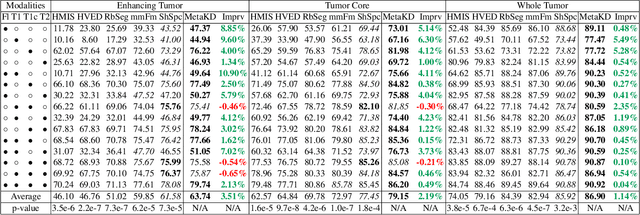
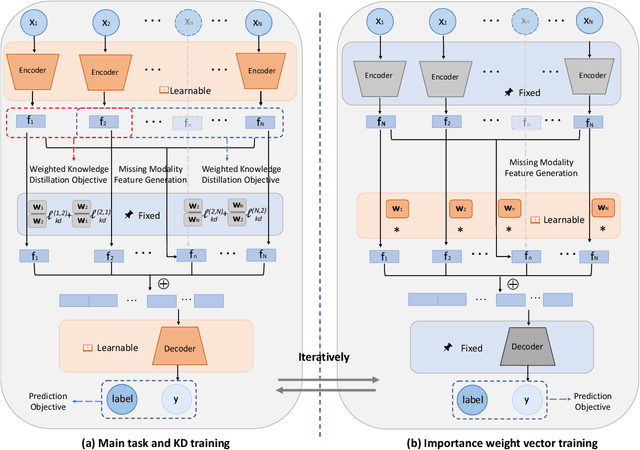
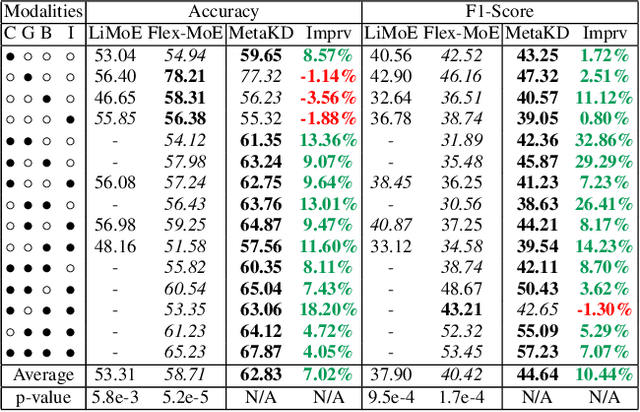
In multi-modal learning, some modalities are more influential than others, and their absence can have a significant impact on classification/segmentation accuracy. Hence, an important research question is if it is possible for trained multi-modal models to have high accuracy even when influential modalities are absent from the input data. In this paper, we propose a novel approach called Meta-learned Cross-modal Knowledge Distillation (MCKD) to address this research question. MCKD adaptively estimates the importance weight of each modality through a meta-learning process. These dynamically learned modality importance weights are used in a pairwise cross-modal knowledge distillation process to transfer the knowledge from the modalities with higher importance weight to the modalities with lower importance weight. This cross-modal knowledge distillation produces a highly accurate model even with the absence of influential modalities. Differently from previous methods in the field, our approach is designed to work in multiple tasks (e.g., segmentation and classification) with minimal adaptation. Experimental results on the Brain tumor Segmentation Dataset 2018 (BraTS2018) and the Audiovision-MNIST classification dataset demonstrate the superiority of MCKD over current state-of-the-art models. Particularly in BraTS2018, we achieve substantial improvements of 3.51\% for enhancing tumor, 2.19\% for tumor core, and 1.14\% for the whole tumor in terms of average segmentation Dice score.
Frequency Attention for Knowledge Distillation
Mar 09, 2024Knowledge distillation is an attractive approach for learning compact deep neural networks, which learns a lightweight student model by distilling knowledge from a complex teacher model. Attention-based knowledge distillation is a specific form of intermediate feature-based knowledge distillation that uses attention mechanisms to encourage the student to better mimic the teacher. However, most of the previous attention-based distillation approaches perform attention in the spatial domain, which primarily affects local regions in the input image. This may not be sufficient when we need to capture the broader context or global information necessary for effective knowledge transfer. In frequency domain, since each frequency is determined from all pixels of the image in spatial domain, it can contain global information about the image. Inspired by the benefits of the frequency domain, we propose a novel module that functions as an attention mechanism in the frequency domain. The module consists of a learnable global filter that can adjust the frequencies of student's features under the guidance of the teacher's features, which encourages the student's features to have patterns similar to the teacher's features. We then propose an enhanced knowledge review-based distillation model by leveraging the proposed frequency attention module. The extensive experiments with various teacher and student architectures on image classification and object detection benchmark datasets show that the proposed approach outperforms other knowledge distillation methods.
Mixture of Gaussian-distributed Prototypes with Generative Modelling for Interpretable Image Classification
Nov 30, 2023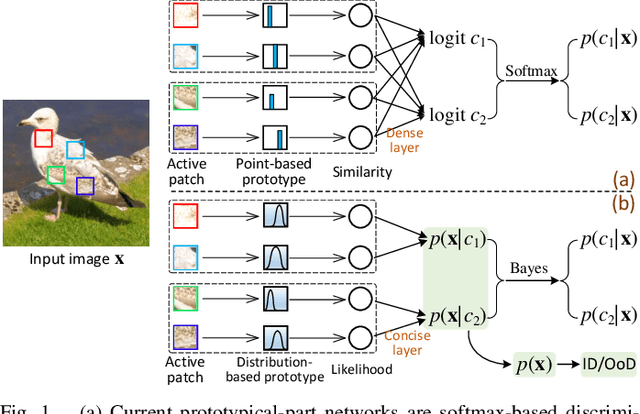
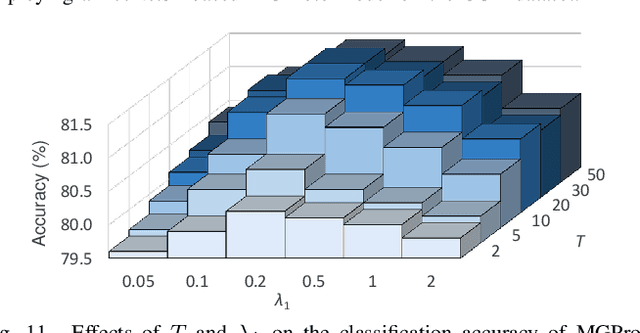
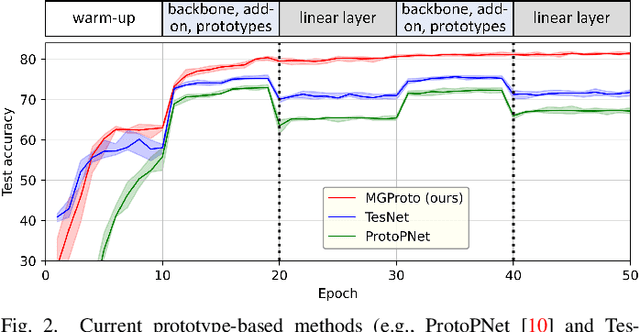
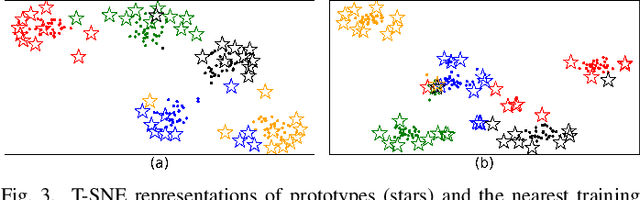
Prototypical-part interpretable methods, e.g., ProtoPNet, enhance interpretability by connecting classification predictions to class-specific training prototypes, thereby offering an intuitive insight into their decision-making. Current methods rely on a discriminative classifier trained with point-based learning techniques that provide specific values for prototypes. Such prototypes have relatively low representation power due to their sparsity and potential redundancy, with each prototype containing no variability measure. In this paper, we present a new generative learning of prototype distributions, named Mixture of Gaussian-distributed Prototypes (MGProto), which are represented by Gaussian mixture models (GMM). Such an approach enables the learning of more powerful prototype representations since each learned prototype will own a measure of variability, which naturally reduces the sparsity given the spread of the distribution around each prototype, and we also integrate a prototype diversity objective function into the GMM optimisation to reduce redundancy. Incidentally, the generative nature of MGProto offers a new and effective way for detecting out-of-distribution samples. To improve the compactness of MGProto, we further propose to prune Gaussian-distributed prototypes with a low prior. Experiments on CUB-200-2011, Stanford Cars, Stanford Dogs, and Oxford-IIIT Pets datasets show that MGProto achieves state-of-the-art classification and OoD detection performances with encouraging interpretability results.
Learning to Complement with Multiple Humans (LECOMH): Integrating Multi-rater and Noisy-Label Learning into Human-AI Collaboration
Nov 22, 2023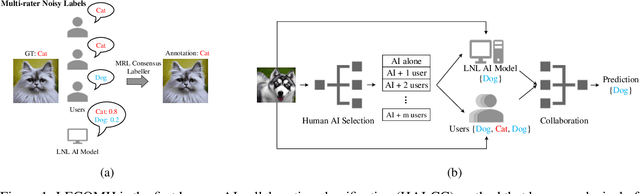
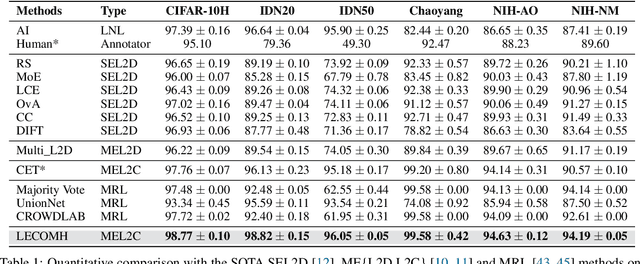
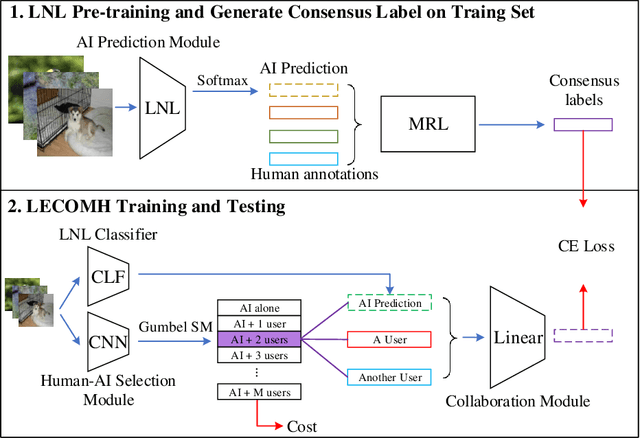
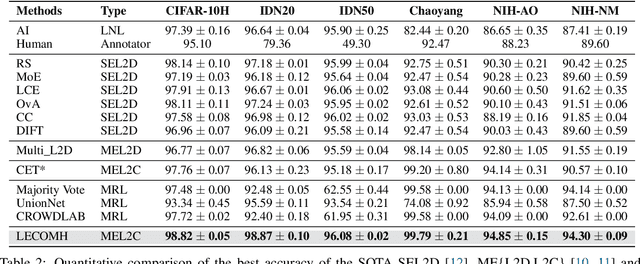
The advent of learning with noisy labels (LNL), multi-rater learning, and human-AI collaboration has revolutionised the development of robust classifiers, enabling them to address the challenges posed by different types of data imperfections and complex decision processes commonly encountered in real-world applications. While each of these methodologies has individually made significant strides in addressing their unique challenges, the development of techniques that can simultaneously tackle these three problems remains underexplored. This paper addresses this research gap by integrating noisy-label learning, multi-rater learning, and human-AI collaboration with new benchmarks and the innovative Learning to Complement with Multiple Humans (LECOMH) approach. LECOMH optimises the level of human collaboration during testing, aiming to optimise classification accuracy while minimising collaboration costs that vary from 0 to M, where M is the maximum number of human collaborators. We quantitatively compare LECOMH with leading human-AI collaboration methods using our proposed benchmarks. LECOMH consistently outperforms the competition, with accuracy improving as collaboration costs increase. Notably, LECOMH is the only method enhancing human labeller performance across all benchmarks.
Learnable Cross-modal Knowledge Distillation for Multi-modal Learning with Missing Modality
Oct 02, 2023The problem of missing modalities is both critical and non-trivial to be handled in multi-modal models. It is common for multi-modal tasks that certain modalities contribute more compared to other modalities, and if those important modalities are missing, the model performance drops significantly. Such fact remains unexplored by current multi-modal approaches that recover the representation from missing modalities by feature reconstruction or blind feature aggregation from other modalities, instead of extracting useful information from the best performing modalities. In this paper, we propose a Learnable Cross-modal Knowledge Distillation (LCKD) model to adaptively identify important modalities and distil knowledge from them to help other modalities from the cross-modal perspective for solving the missing modality issue. Our approach introduces a teacher election procedure to select the most ``qualified'' teachers based on their single modality performance on certain tasks. Then, cross-modal knowledge distillation is performed between teacher and student modalities for each task to push the model parameters to a point that is beneficial for all tasks. Hence, even if the teacher modalities for certain tasks are missing during testing, the available student modalities can accomplish the task well enough based on the learned knowledge from their automatically elected teacher modalities. Experiments on the Brain Tumour Segmentation Dataset 2018 (BraTS2018) shows that LCKD outperforms other methods by a considerable margin, improving the state-of-the-art performance by 3.61% for enhancing tumour, 5.99% for tumour core, and 3.76% for whole tumour in terms of segmentation Dice score.
SelectNAdapt: Support Set Selection for Few-Shot Domain Adaptation
Aug 09, 2023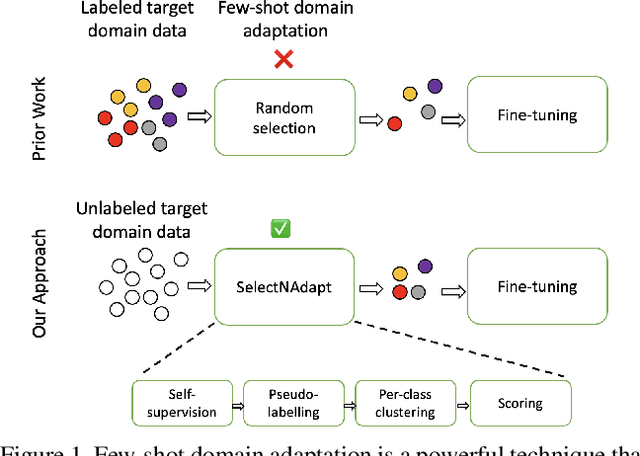

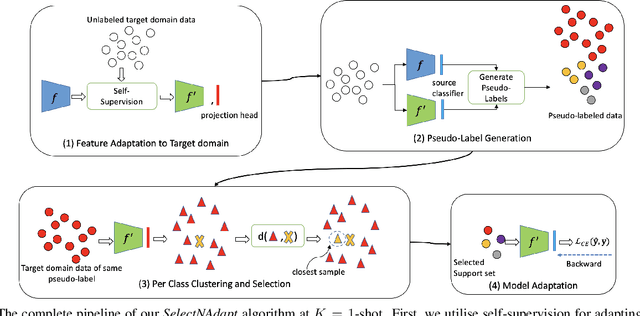
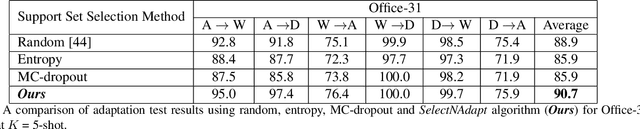
Generalisation of deep neural networks becomes vulnerable when distribution shifts are encountered between train (source) and test (target) domain data. Few-shot domain adaptation mitigates this issue by adapting deep neural networks pre-trained on the source domain to the target domain using a randomly selected and annotated support set from the target domain. This paper argues that randomly selecting the support set can be further improved for effectively adapting the pre-trained source models to the target domain. Alternatively, we propose SelectNAdapt, an algorithm to curate the selection of the target domain samples, which are then annotated and included in the support set. In particular, for the K-shot adaptation problem, we first leverage self-supervision to learn features of the target domain data. Then, we propose a per-class clustering scheme of the learned target domain features and select K representative target samples using a distance-based scoring function. Finally, we bring our selection setup towards a practical ground by relying on pseudo-labels for clustering semantically similar target domain samples. Our experiments show promising results on three few-shot domain adaptation benchmarks for image recognition compared to related approaches and the standard random selection.
Generative Noisy-Label Learning by Implicit Dicriminative Approximation with Partial Label Prior
Aug 02, 2023The learning with noisy labels has been addressed with both discriminative and generative models. Although discriminative models have dominated the field due to their simpler modeling and more efficient computational training processes, generative models offer a more effective means of disentangling clean and noisy labels and improving the estimation of the label transition matrix. However, generative approaches maximize the joint likelihood of noisy labels and data using a complex formulation that only indirectly optimizes the model of interest associating data and clean labels. Additionally, these approaches rely on generative models that are challenging to train and tend to use uninformative clean label priors. In this paper, we propose a new generative noisy-label learning approach that addresses these three issues. First, we propose a new model optimisation that directly associates data and clean labels. Second, the generative model is implicitly estimated using a discriminative model, eliminating the inefficient training of a generative model. Third, we propose a new informative label prior inspired by partial label learning as supervision signal for noisy label learning. Extensive experiments on several noisy-label benchmarks demonstrate that our generative model provides state-of-the-art results while maintaining a similar computational complexity as discriminative models.
Multi-modal Learning with Missing Modality via Shared-Specific Feature Modelling
Jul 26, 2023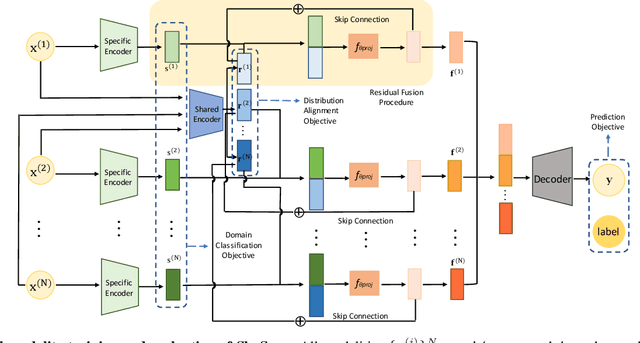
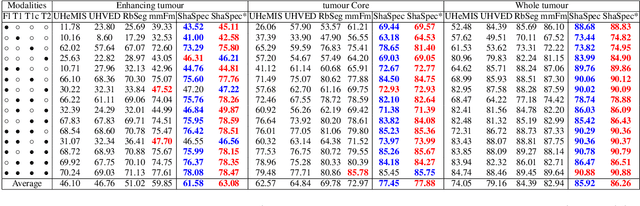
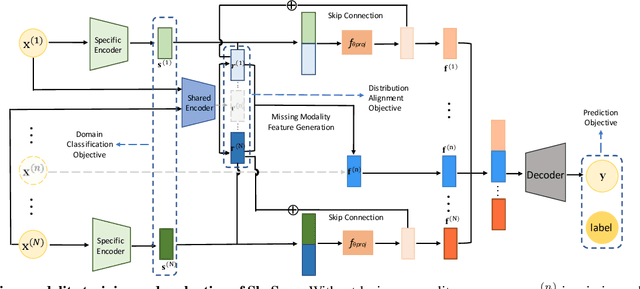

The missing modality issue is critical but non-trivial to be solved by multi-modal models. Current methods aiming to handle the missing modality problem in multi-modal tasks, either deal with missing modalities only during evaluation or train separate models to handle specific missing modality settings. In addition, these models are designed for specific tasks, so for example, classification models are not easily adapted to segmentation tasks and vice versa. In this paper, we propose the Shared-Specific Feature Modelling (ShaSpec) method that is considerably simpler and more effective than competing approaches that address the issues above. ShaSpec is designed to take advantage of all available input modalities during training and evaluation by learning shared and specific features to better represent the input data. This is achieved from a strategy that relies on auxiliary tasks based on distribution alignment and domain classification, in addition to a residual feature fusion procedure. Also, the design simplicity of ShaSpec enables its easy adaptation to multiple tasks, such as classification and segmentation. Experiments are conducted on both medical image segmentation and computer vision classification, with results indicating that ShaSpec outperforms competing methods by a large margin. For instance, on BraTS2018, ShaSpec improves the SOTA by more than 3% for enhancing tumour, 5% for tumour core and 3% for whole tumour.
Distilling Missing Modality Knowledge from Ultrasound for Endometriosis Diagnosis with Magnetic Resonance Images
Jul 05, 2023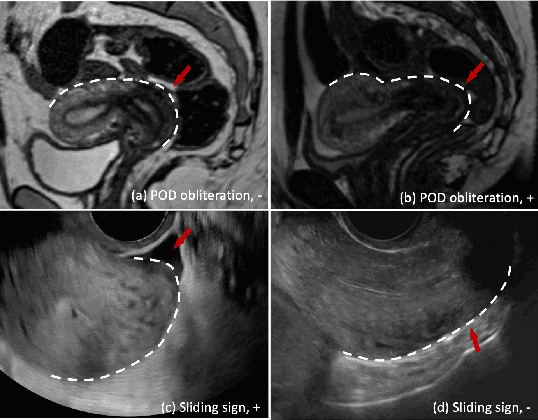
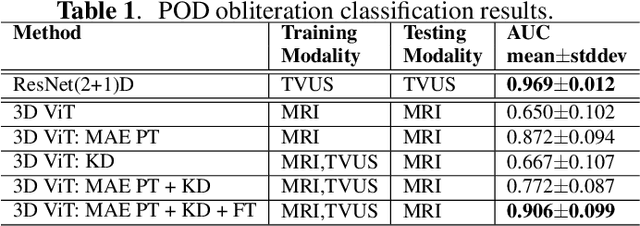
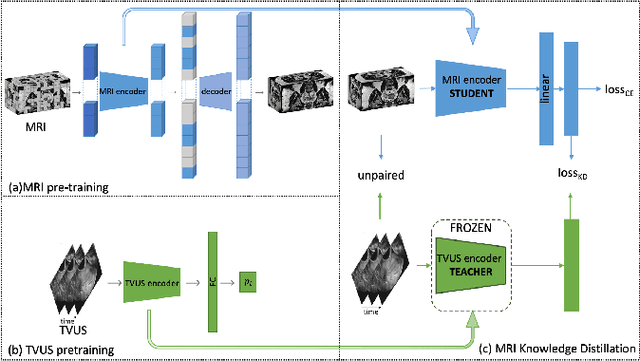
Endometriosis is a common chronic gynecological disorder that has many characteristics, including the pouch of Douglas (POD) obliteration, which can be diagnosed using Transvaginal gynecological ultrasound (TVUS) scans and magnetic resonance imaging (MRI). TVUS and MRI are complementary non-invasive endometriosis diagnosis imaging techniques, but patients are usually not scanned using both modalities and, it is generally more challenging to detect POD obliteration from MRI than TVUS. To mitigate this classification imbalance, we propose in this paper a knowledge distillation training algorithm to improve the POD obliteration detection from MRI by leveraging the detection results from unpaired TVUS data. More specifically, our algorithm pre-trains a teacher model to detect POD obliteration from TVUS data, and it also pre-trains a student model with 3D masked auto-encoder using a large amount of unlabelled pelvic 3D MRI volumes. Next, we distill the knowledge from the teacher TVUS POD obliteration detector to train the student MRI model by minimizing a regression loss that approximates the output of the student to the teacher using unpaired TVUS and MRI data. Experimental results on our endometriosis dataset containing TVUS and MRI data demonstrate the effectiveness of our method to improve the POD detection accuracy from MRI.